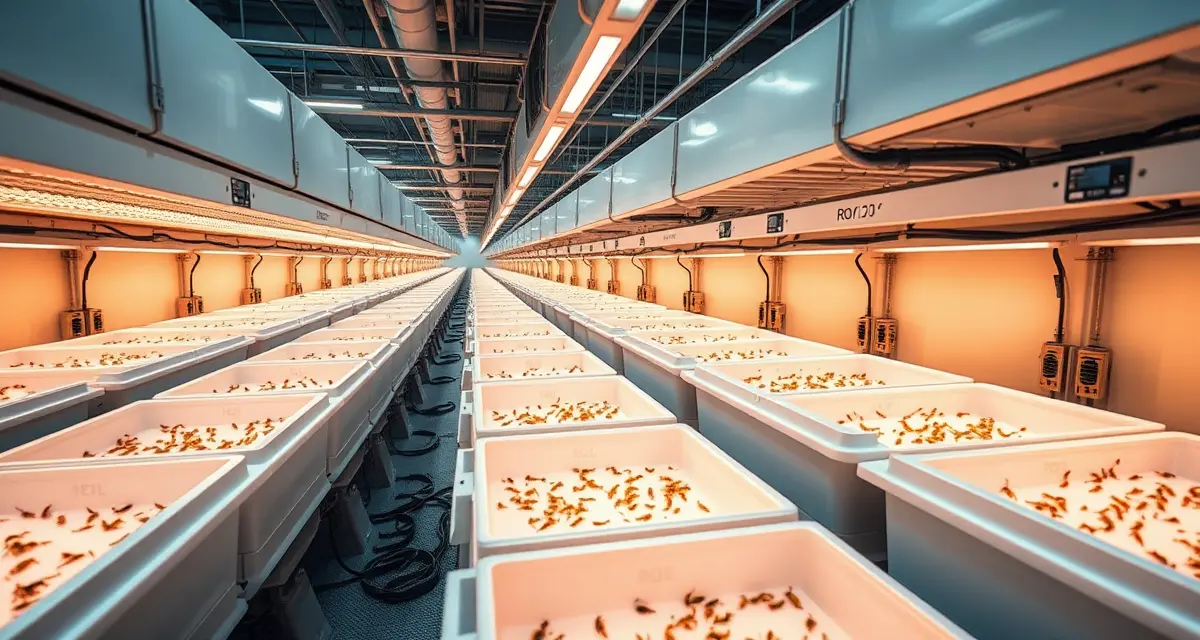
Cricket Farm Automation ROI: Calculating the Return on Each Upgrade
Temperature sensors at $150 per bin have an average ROI of 340% in the first year based on die-off prevention savings. That number comes from a straightforward calculation: a single die-off event on a 30-bin farm can cost $800-$1,500 in lost production. A temperature sensor that prevents even one such event per year pays for itself multiple times over.
Automation investments on cricket farms often get evaluated by gut feel rather than math. Either the operator buys every piece of technology they can find, or they resist all of it because the upfront cost feels high. Neither approach serves the farm well. Calculating the actual ROI for each specific upgrade, based on your farm's real costs and real production numbers, tells you which automation investments pay and which ones wait.
TL;DR
- Temperature sensors at $150 per bin have an average ROI of 340% in the first year based on die-off prevention savings.
- That number comes from a straightforward calculation: a single die-off event on a 30-bin farm can cost $800-$1,500 in lost production.
- Cost: CricketOps subscription varies by plan.
- A sensor at $100-$250 per unit that prevents even one temperature-related die-off event prevents $400-$800 in lost production.
- Cricket farms lose 5-20% of a bin population when temperatures go outside the target range for extended periods.
- Operators typically save 3-5 hours per week moving from manual tracking to CricketOps.
- At your effective labor cost (owner's time or staff time), 3 hours/week x 52 weeks = 156 hours/year.
- At $25/hour, that's $3,900 in labor savings.
- FCR improvement: Farms that track FCR consistently improve it by 5-15% in the first year.
- Conservatively, preventing one additional event per year: $400.
Cost: CricketOps subscription varies by plan.
Cost: CricketOps subscription varies by plan.
- A sensor at $100-$250 per unit that prevents even one temperature-related die-off event prevents $400-$800 in lost production.
The ROI Framework
ROI for any automation investment on a cricket farm follows the same structure:
ROI = (Annual Benefit - Annual Cost) ÷ Initial Investment x 100%
Annual Benefit = what you save or earn more because of the automation, on an annualized basis
Annual Cost = ongoing costs of the automation (subscription fees, maintenance, consumables)
Initial Investment = upfront cost (hardware, installation, setup)
If a temperature sensor costs $150 upfront, has a $0 ongoing cost, and saves you $510 in die-off losses in year one, your ROI = ($510 - $0) ÷ $150 = 340%.
The harder part is estimating the benefit realistically. Here's how to do it for the most common cricket farm automation investments.
Temperature Sensors
What they prevent: Temperature deviations that cause die-offs. Cricket farms lose 5-20% of a bin population when temperatures go outside the target range for extended periods. These losses are often avoidable with early warning.
Benefit calculation:
- Estimate how many die-off events per year are temperature-related (use your mortality records to identify events where temperature deviated)
- For each event, estimate the lost cricket value (crickets lost x your price per 1,000)
- A conservative estimate for a well-run 30-bin farm: 2-3 temperature-related die-off events per year with an average loss of $400 per event = $800-$1,200 in annual savings
Cost: $100-$250 per sensor, depending on the sensor and whether it includes alerts. No ongoing cost for basic sensors; some premium sensors charge a small monthly data subscription.
ROI range at 2 events prevented per year, $400 per event: ($800 - $0) ÷ $150 = 533%
This is why temperature sensors are almost always the highest-ROI automation investment for cricket farms. The cricket farm automation guide covers sensor selection in detail.
CricketOps Farm Management Software
What it provides: Reduction in management time, improved data quality, better production planning, and early detection of performance trends.
Benefit calculation:
- Time savings: How many hours per week do you currently spend on manual data entry, spreadsheet calculation, and report preparation? Operators typically save 3-5 hours per week moving from manual tracking to CricketOps.
- At your effective labor cost (owner's time or staff time), 3 hours/week x 52 weeks = 156 hours/year. At $25/hour, that's $3,900 in labor savings.
- FCR improvement: Farms that track FCR consistently improve it by 5-15% in the first year. On a 30-bin farm producing $180,000 annually, a 10% FCR improvement that reduces feed costs by $3,000-$5,000 is a direct savings.
- Die-off prevention through trend detection: Early identification of mortality trends before they become major events. Conservatively, preventing one additional event per year: $400.
Cost: CricketOps subscription varies by plan. Professional plans for commercial farms run $50-$200/month ($600-$2,400/year).
ROI at conservative benefit estimate ($3,900 labor + $3,000 FCR savings + $400 die-off prevention = $7,300):
($7,300 - $1,200 annual subscription) ÷ $0 initial investment = infinite (subscription model, no upfront capital) → more practically, $6,100 net annual benefit
Automated Feeding Systems
What they provide: Consistent feed delivery on a timed schedule without manual feeding rounds. Reduces labor, improves feeding consistency (consistent feeding improves FCR).
Benefit calculation:
- Labor savings: Manual feeding on a 30-bin farm typically takes 60-90 minutes per feeding round, 2x/day = 2-3 hours/day of labor. Automating feeding saves 400-600 hours/year at $15-$25/hour = $6,000-$15,000 in labor savings annually.
- FCR improvement from consistent feeding schedule: 3-8% FCR improvement from eliminating missed feedings and inconsistent quantities.
Cost: Automated cricket feeding systems range from $5,000 (basic gravity-feed systems for small farms) to $30,000+ (commercial-scale automated systems).
ROI for a $8,000 system saving $7,500/year in labor and FCR:
($7,500 - $500 annual maintenance) ÷ $8,000 = 87.5% in year one, with full payback in 14 months.
Prioritizing Your Automation Investment
The sequence that maximizes ROI for most farms:
- Temperature sensors (highest ROI, lowest cost, immediate payback)
- Farm management software (high ROI, subscription model, no capital required)
- Automated feeding (strong ROI, requires capital, higher installation complexity)
The cricket farm management system is the data foundation that makes your ROI calculations for all subsequent automation investments more accurate.
Frequently Asked Questions
What is the ROI of temperature sensors for a cricket farm?
Temperature sensors typically deliver 340-500%+ ROI in the first year based on die-off prevention savings. A sensor at $100-$250 per unit that prevents even one temperature-related die-off event prevents $400-$800 in lost production. For a 30-bin farm where temperature-related events cause 2-4 losses per year, the sensor payback period is measured in weeks, not months. The ROI calculation: annual die-off savings ÷ sensor cost. At $400 saved per event x 2 events per year on a $150 sensor: ROI = ($800 ÷ $150) x 100% = 533%. Sensors that include alert functionality (alerting your phone when temperature deviates) provide higher ROI because they also enable overnight response rather than discovering the issue the next morning.
How do I calculate the ROI of CricketOps for my cricket farm?
Start with your current time investment in farm data management: how many hours per week do you spend on spreadsheets, manual calculations, and report preparation? Multiply those hours by your effective hourly rate (your own time has value). Add any FCR improvement savings that come from consistent tracking (historically 5-15% improvement in first year, worth 3-8% feed cost reduction). Add any die-off prevention value from early trend detection. Then subtract your CricketOps subscription cost. For most commercial farms with 20+ bins, the net annual benefit exceeds $5,000, making it strongly ROI-positive. Start a free trial to establish your pre-CricketOps baseline, then measure the improvement over the first 90 days.
Which cricket farm automation upgrade has the fastest payback?
Temperature sensors have the fastest payback period of any cricket farm automation investment, typically under 2 months. A single prevented die-off event pays for the sensor, and most farms with active temperature sensors prevent 2-4 events per year that they previously experienced. Farm management software (CricketOps) has no upfront capital cost, so the ROI clock starts immediately with the first month of time savings and any FCR improvement. Automated feeding systems have longer payback periods (12-24 months) due to higher initial capital requirements, but still represent strong long-term ROI through labor reduction and FCR improvement from consistent feeding schedules.
What data should a cricket farm management system track at minimum?
At minimum: bin identification, population counts by life stage, feed inputs and quantities, mortality events, temperature and humidity readings, and harvest dates and weights. These categories give you enough data to calculate FCR, identify underperforming bins, and audit any production batch. More advanced tracking adds environmental sensor integration, financial cost allocation, and buyer order fulfillment records.
How long does it take to see a return on investment from farm management software?
Operations that move from spreadsheets to purpose-built software typically see measurable FCR improvement within two to three production cycles, as patterns invisible in manual records become visible in aggregated data. The timeline depends on operation size -- larger farms benefit faster because there are more data points and more decisions that can be improved. The ROI accelerates when the software also reduces the time spent on manual data entry and reporting.
Can cricket farm management software integrate with environmental sensors?
Yes, platforms designed specifically for commercial insect production such as CricketOps support direct integration with temperature and humidity sensors via IoT protocols. This eliminates the need for manual environmental logging and enables automated alerts when readings fall outside set thresholds. When evaluating software, confirm which sensor brands and communication protocols (WiFi, Zigbee, 4G) are supported before purchasing equipment.
Sources
- Food and Agriculture Organization of the United Nations (FAO) -- Edible Insects: Future Prospects for Food and Feed Security
- North American Coalition for Insect Agriculture (NACIA)
- Entomological Society of America
- USDA Agricultural Research Service
- AgriNovus Indiana -- AgTech Industry Resources
Get Started with CricketOps
Managing a cricket operation with disconnected tools -- a spreadsheet for bins, a separate doc for feed logs, manual temperature notes -- creates gaps in your data that become costly blind spots. CricketOps brings bin tracking, environmental monitoring, FCR calculations, and harvest records into one place built specifically for insect agriculture. Try it and see how much clearer your production picture becomes.