Home Cricket Farm vs Commercial Cricket Farm: Key Differences
A lot of cricket farmers start in a spare room or garage. That's not a problem, it's how the industry grows. But at some point, the operation that started as a side project starts generating real revenue, and you're suddenly not sure whether you're running a home hobby or a business with compliance requirements.
The line between home cricket farm and commercial farm is blurrier than most people expect. Most home operations are limited to 50-100 bins before requiring commercial zoning. But the transition isn't just about bin count, it's about regulation, equipment investment, and how you structure the business.
Here's what actually changes as you scale.
TL;DR
- Most home operations are limited to 50-100 bins before requiring commercial zoning.
- Cricket farm management software becomes practical necessity rather than nice-to-have once you're managing 50+ bins and dealing with commercial buyers.
- A home cricket farm typically runs 10-50 bins in a spare room, basement, garage, or dedicated outbuilding.
- A 50-bin home operation, well-managed, can realistically generate $10,000-$25,000 per year in gross revenue selling feeder crickets to local pet stores, reptile shows, or online.
- The 50-100 bin threshold is where most home operations face a decision.
- Checking your local zoning code before scaling past 50 bins is not optional advice, it's how you avoid a cease-and-desist order.
- The investment gap is real: a home setup might cost $2,000-$8,000.
Record-Keeping and Traceability
Home farmers track things in notebooks or simple spreadsheets.
- When was it harvested?
Cricket farm management software becomes practical necessity rather than nice-to-have once you're managing 50+ bins and dealing with commercial buyers.
- This is table stakes for any operation generating meaningful revenue.
Step 2: Zoning Check
Before adding more bins, verify what your local zoning actually allows.
- Make this decision early because it shapes every subsequent infrastructure investment.
Step 4: Upgrade Your Tracking
This is where proper farm management software earns its cost.
TL;DR Verdict
| Factor | Home Cricket Farm | Commercial Cricket Farm |
|---|---|---|
| Typical bin count | 1-50 bins | 50-500+ bins |
| Revenue ceiling | $5,000-$25,000/year | $50,000-$500,000+/year |
| Zoning requirements | Residential (often) | Commercial/agricultural |
| Food safety regulation | Light (feeder only) | FDA compliance (food-grade) |
| Business registration | Optional early on | Required |
| Equipment investment | $2,000-$8,000 | $15,000-$100,000+ |
| Management system | Spreadsheet workable | Software recommended |
The gap between these two models isn't just size. It's operational complexity, compliance exposure, and how much the business is worth if you ever want to sell it.
What a Home Cricket Farm Actually Looks Like
The Setup
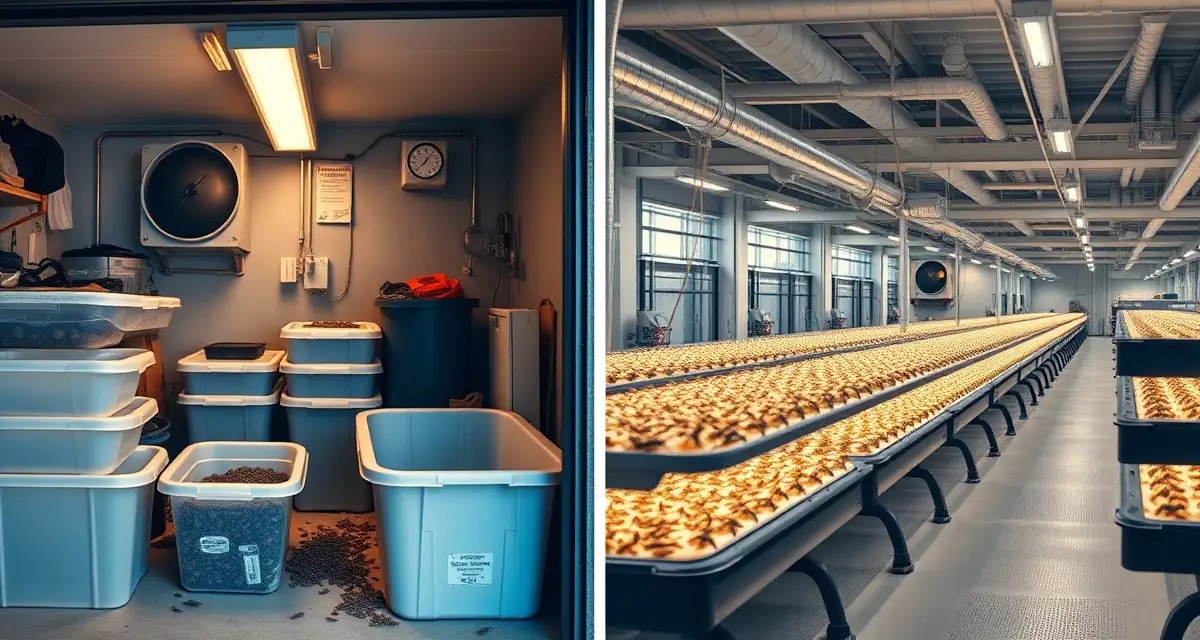
A home cricket farm typically runs 10-50 bins in a spare room, basement, garage, or dedicated outbuilding. The equipment is relatively simple: plastic bins with screen lids, heat lamps or space heaters, water dispensers (usually water crystals or hydration gel), and egg cartons or cardboard for hide material.
Climate control is often manual or semi-automated. You check temperatures daily, adjust heaters, and manage humidity with ventilation and substrate management. It works. Plenty of profitable operations have run this way for years.
Revenue Reality
A 50-bin home operation, well-managed, can realistically generate $10,000-$25,000 per year in gross revenue selling feeder crickets to local pet stores, reptile shows, or online. That's not nothing. For a side business, it's meaningful income.
The ceiling exists for real reasons: bin count is limited by space, your time is finite, and local zoning typically doesn't allow commercial-scale production in residential areas.
Where Home Farms Hit the Wall
The 50-100 bin threshold is where most home operations face a decision. At that scale, you're producing enough volume to attract commercial buyers, but you may also be triggering zoning questions, neighbor complaints about noise, and buyer requests for food safety documentation you haven't developed yet.
What Switches When You Go Commercial
Zoning and Permits
This is the change most home farmers don't anticipate until they're already operating at commercial scale. Residential zoning typically prohibits "commercial agricultural production." That's vague, and enforcement varies, but it creates real risk for a home operation generating notable revenue.
Commercial cricket farming typically requires agricultural or light industrial zoning. Some municipalities have specific permits for insect farming operations. States like California, Texas, and Florida have their own requirements. Checking your local zoning code before scaling past 50 bins is not optional advice, it's how you avoid a cease-and-desist order.
The cricket farm zoning and permits guide covers the state-by-state landscape in detail.
Food Safety Compliance
Selling feeder insects doesn't typically require FDA food safety compliance. But if you want to sell cricket flour, dried crickets for human consumption, or supply any food brand, the FDA's requirements kick in, FSMA registration, allergen labeling, facility documentation, and potentially a food safety plan.
Commercial operations targeting the human food market need this infrastructure. Home operations can often avoid it entirely by staying in the feeder market.
Equipment and Infrastructure
Home farms manage with basic equipment. Commercial operations need more reliable climate control, backup power for temperature emergencies, higher-capacity water and feed delivery systems, and typically dedicated biosecurity protocols.
The investment gap is real: a home setup might cost $2,000-$8,000. A commercial operation requires $15,000-$100,000+ depending on scale and target market.
Record-Keeping and Traceability
Home farmers track things in notebooks or simple spreadsheets. It works at small scale. At commercial scale, especially if you're supplying food brands or retailers, buyers expect traceability. Which bin did this batch come from? What was the feed? When was it harvested?
Cricket farm management software becomes practical necessity rather than nice-to-have once you're managing 50+ bins and dealing with commercial buyers. The administrative overhead of manual tracking at commercial scale is where operations fail quietly, not dramatically.
The 50-100 Bin Decision Point
Most home cricket farms reach a natural inflection point between 50 and 100 bins. This is where several things happen at once:
- Revenue is substantial enough to justify proper business formation
- Operational complexity exceeds what spreadsheets handle well
- Buyer expectations for documentation begin to increase
- Zoning and permit questions become real
- The time commitment starts feeling like a job rather than a side project
The decision you face at this point isn't really "should I keep going?" It's "am I going to do this properly or keep operating informally?" Operating informally past this threshold creates legal and financial exposure. A commercial buyer who requests your food safety documentation and gets nothing is a buyer you'll lose.
Making the Transition
Step 1: Business Formation
Register as an LLC or appropriate entity. Get an EIN. Open a dedicated business bank account. This is table stakes for any operation generating meaningful revenue.
Step 2: Zoning Check
Before adding more bins, verify what your local zoning actually allows. If you need to change locations or apply for an agricultural or commercial permit, do it proactively, not after a neighbor complaint.
Step 3: Food Safety Assessment
Decide which markets you're targeting. Feeder cricket only? Lighter compliance burden. Human food? You need FDA FSMA registration and a documented food safety system. Make this decision early because it shapes every subsequent infrastructure investment.
Step 4: Upgrade Your Tracking
This is where proper farm management software earns its cost. Managing 100+ bins across multiple production cycles without reliable tracking is how margins disappear and quality problems get missed.
FAQ
When does a home cricket farm need to become a commercial operation?
There's no single legal threshold, but practically, the 50-100 bin range is where most operators need to formalize. By that point, revenue is notable, zoning questions become real, and commercial buyers start asking for documentation. Proactively making the transition, registering the business, checking zoning, and formalizing record-keeping, before hitting that wall is far easier than doing it reactively.
What regulations apply to a home-based cricket farm that don't apply to commercial?
The regulatory difference runs the other direction: commercial operations face more regulation, not less. A home operation selling feeder insects informally operates under minimal regulatory scrutiny. A commercial food-grade cricket operation must comply with FDA FSMA, state agricultural licensing, and potentially commercial zoning requirements. The home farm has an easier compliance path; it just has a lower revenue ceiling.
What is the revenue ceiling for a home cricket farm?
Most home cricket farms cap out at $5,000-$25,000 per year in gross revenue, limited by space, bin count, and the informal nature of the operation. Operators who want to exceed that need to make the commercial transition, dedicated facility, proper business registration, and the infrastructure to serve larger and more demanding buyers.
What are the most common reasons cricket farm expansions fail?
Expanding before unit economics are proven is the most common cause of cricket farm expansion failure. If your FCR is not hitting target and mortality rates are above 10-15% per cycle, scaling up multiplies those problems rather than solving them. The second most common cause is underestimating facility and equipment costs for the new scale -- most operations underestimate energy infrastructure, climate control, and harvest equipment requirements by 30-50%.
How much capital is typically needed to scale from 10 to 50 bins?
A 10 to 50 bin expansion typically requires $8,000-$20,000 in direct costs depending on your existing infrastructure and whether you are expanding in your current facility or moving to a new space. The largest cost categories are shelving and bin systems, climate control upgrades, and any additional processing equipment required by the increased harvest volume. Working capital for feed and supplies during the expansion ramp-up should also be budgeted separately.
How long does it take to reach profitability when starting a commercial cricket farm?
Most commercial cricket operations that reach profitability do so within 12-24 months of starting production at commercial scale (20+ bins). The timeline depends on feed cost management, FCR achieved in early cycles, and the time required to establish buyer relationships that generate consistent revenue. Operations that start with committed buyers typically reach profitability faster than those that develop their market after production is running.
Sources
- Food and Agriculture Organization of the United Nations (FAO) -- Edible Insects: Future Prospects for Food and Feed Security
- North American Coalition for Insect Agriculture (NACIA)
- Entomological Society of America
- University of Georgia Cooperative Extension
- Journal of Insects as Food and Feed (Wageningen Academic Publishers)
The Bottom Line
Home cricket farms are legitimate businesses. Plenty of operators earn meaningful supplemental income from modest setups without ever formalizing. The right time to make the commercial transition is when your bin count and revenue are substantial enough to justify the infrastructure investment, or when a commercial buyer makes it a condition of doing business.
Don't wait for a zoning problem to force the issue. Getting ahead of it is cheaper and less stressful than reacting to it.
Get Started with CricketOps
Scaling a cricket operation is much less risky when you have clear data on your unit economics before you expand. CricketOps gives you FCR by bin, cost per production cycle, and environmental performance records that make it clear whether your operation is ready to scale and where the constraints are. Try CricketOps and build the data foundation your expansion decisions should rest on.