Equipment List for a Commercial Cricket Farm: 50+ Bins
Commercial cricket farm operators report equipment selection mistakes in the first year costing an average of $8,000. Most of those mistakes follow a pattern: buying consumer-grade equipment that fails under production conditions, purchasing at the wrong scale relative to current bin count, or missing categories entirely until a problem forces the investment.
This list covers everything you need to run a 50+ bin commercial operation, organized by category, with notes on when each investment becomes necessary.
TL;DR
- Commercial cricket farm operators report equipment selection mistakes in the first year costing an average of $8,000.
- This list covers everything you need to run a 50+ bin commercial operation, organized by category, with notes on when each investment becomes necessary.
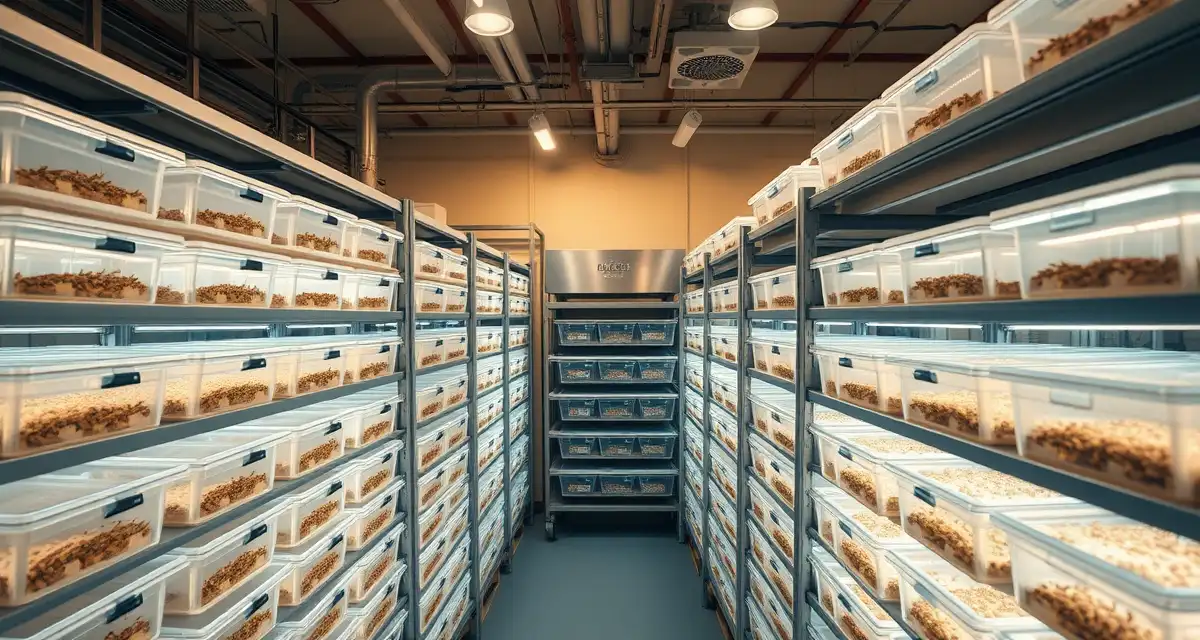
- At the 50-bin scale, purpose-built cricket bins or high-quality plastic storage totes are the standard. 66-quart totes (roughly 23" x 16" x 15") are the most widely used size for Acheta domesticus at commercial scale.
- Plan on $15-$30 per bin depending on quality.
- At 50 bins, commercial cricket bins (designed specifically for insect production) start showing ROI advantages in substrate cleaning time and longevity.
- Commercial bins can reduce substrate replacement cost by 30% over repurposed plastic totes over a 2-year horizon.
- Steel wire shelving rated for 500+ lbs per shelf.
Hatching trays:
Small shallow trays or specialty egg-laying substrates for your breeding bins.
- Size your mesh opening to match your current cricket life stage - finer mesh for pinheads, coarser for adults.
Commercial wire shelving (heavy-duty NSF-rated):
Steel wire shelving rated for 500+ lbs per shelf.
- At 50 bins on 4-tier shelving, you're looking at 12-13 shelving units at minimum.
- Cost: $150-$300 per shelving unit (4-tier, 48" wide).
- Expect to spend $2,000-$4,000 on shelving for a 50-bin operation.
Installation hardware:
Wall anchoring hardware for earthquake bracing and structural stability.
Installation hardware:
Wall anchoring hardware for earthquake bracing and structural stability.
- At 50 bins on 4-tier shelving, temperature varies by tier - you need sensors at low, mid, and high levels in each zone.
- Commercial-grade sensors with ±0.5F temperature accuracy and ±2% RH humidity accuracy, with wireless logging capability.
- Cost: $40-$200 per sensor depending on capability and integration options.
Central monitoring hub and alerting:
A system that aggregates sensor data and sends alerts when thresholds are breached.
Bins and Growing Containers
Primary production bins (66-quart plastic storage totes):
At the 50-bin scale, purpose-built cricket bins or high-quality plastic storage totes are the standard. 66-quart totes (roughly 23" x 16" x 15") are the most widely used size for Acheta domesticus at commercial scale. Plan on $15-$30 per bin depending on quality.
Buy bins with secure-fitting lids that allow ventilation modification. Avoid bins with flimsy lids that pop open or that don't seal cleanly around ventilation screening.
When to upgrade from totes to commercial bins: At 50 bins, commercial cricket bins (designed specifically for insect production) start showing ROI advantages in substrate cleaning time and longevity. Commercial bins can reduce substrate replacement cost by 30% over repurposed plastic totes over a 2-year horizon.
Hatching trays:
Small shallow trays or specialty egg-laying substrates for your breeding bins. Keep a separate hatching room with dedicated trays - don't use your main production bins for incubation.
Lid ventilation screens:
Fiberglass or aluminum mesh for converting solid lids to ventilated lids. Size your mesh opening to match your current cricket life stage - finer mesh for pinheads, coarser for adults.
Shelving
Commercial wire shelving (heavy-duty NSF-rated):
Steel wire shelving rated for 500+ lbs per shelf. At 50 bins on 4-tier shelving, you're looking at 12-13 shelving units at minimum. Buy commercial grade, not the consumer warehouse units - they flex and fail under sustained load.
Cost: $150-$300 per shelving unit (4-tier, 48" wide). Expect to spend $2,000-$4,000 on shelving for a 50-bin operation.
Installation hardware:
Wall anchoring hardware for earthquake bracing and structural stability. In a commercial facility, shelving should be anchored regardless of seismic zone.
HVAC and Climate Control
Mini-split heat pump systems:
At 50 bins, you need at least two independently controlled mini-split units in your production area - one as primary, one as backup (or zoned if your space is large enough to require zones). Size each unit for your room's heat load, not just the square footage.
Cost: $1,500-$3,500 per mini-split unit installed, depending on BTU capacity and efficiency rating.
Portable electric space heaters (backup):
Keep 2-3 portable electric space heaters for emergency backup if your primary heating fails. These won't maintain production temperature in extreme cold, but they prevent catastrophic die-offs while you arrange repair.
Evaporative cooling (option for dry climates):
In arid climates, evaporative coolers are much cheaper to operate than refrigerative AC for summer cooling. Not appropriate for humid climates where the added humidity creates mold risk.
Dehumidifiers:
In humid climates, you may need supplemental dehumidification despite running ventilation. Commercial-grade dehumidifiers rated for continuous operation (not consumer models) are necessary at the 50-bin scale.
Monitoring Equipment
Temperature and humidity sensor network:
You need sensors in every environmental zone of your facility. At 50 bins on 4-tier shelving, temperature varies by tier - you need sensors at low, mid, and high levels in each zone. Commercial-grade sensors with ±0.5F temperature accuracy and ±2% RH humidity accuracy, with wireless logging capability. Plan for 8-12 sensors minimum.
Cost: $40-$200 per sensor depending on capability and integration options.
Central monitoring hub and alerting:
A system that aggregates sensor data and sends alerts when thresholds are breached. This can be a standalone data logger, a smart home hub, or the sensor integration built into your farm management software. The critical requirement is automated alerts that reach you by phone, not just logged data you check manually.
CO2 monitor:
In enclosed production spaces, CO2 can reach levels that impair cricket growth and FCR. A CO2 monitor (300-400 ppm baseline, alert at 2,000 ppm) helps you manage ventilation appropriately.
Ammonia detector:
For larger enclosed operations, ammonia can build up from cricket waste to levels that affect health and FCR. A fixed ammonia detector with alerting capability should be installed in any enclosed space with 25+ bins.
Feed and Hydration Equipment
Feed storage containers:
Food-grade bins or barrels with secure lids for bulk feed storage. At 50 bins, you're consuming notable feed volume weekly. Proper sealed containers with pest prevention are necessary to avoid contamination and waste.
Feed mixing equipment:
If you're formulating your own feed blend, a feed mixer or large-capacity drill mixer speeds the process measurably vs. hand mixing.
Water gel production container:
A dedicated container for bulk water gel production rather than making gel bin-by-bin. A 30-gallon food-grade bin allows you to produce enough gel for all bins in a single batch.
Watering dishes/containers:
Shallow dishes or egg carton segments that crickets can climb over to access water gel without drowning. You'll need enough for all bins plus spares in rotation while others are being cleaned.
Harvest Equipment
Drum separator (motorized):
This is the single most time-saving equipment investment at the 50-bin scale. A motorized drum separator separates crickets from frass and substrate by size, reducing harvest time by 70% vs. manual sifting. Cost: $400-$800. At 50 bins, this pays for itself within a few harvest cycles.
Collection bins:
Large bins for receiving sorted crickets post-harvest and holding them for packaging.
Counting/weighing equipment:
A commercial kitchen scale accurate to 1 gram for weighing harvest yields. If you're selling by count, a counting board or counting scale. For production data tracking, harvest weight per bin is the most reliable metric.
Staging area:
A dedicated area with adequate ventilation for holding harvested crickets before packaging and delivery. Don't let harvested crickets sit in a warm enclosed space - they'll lose weight and start dying.
Processing Equipment (for Flour/Dried Production)
Commercial freezer:
For kill-freezing harvested crickets before processing. A commercial chest freezer at 0F is standard. Size appropriately for your harvest volume - you typically want to process batches of 10-20 lbs at minimum.
Commercial dehydrator or drying oven:
For drying whole or ground crickets. Commercial food dehydrators or convection ovens with precise temperature control (250-280F for cricket drying). At 50 bins producing flour, a unit with 50+ lb capacity per cycle becomes necessary.
Grain mill or flour grinder:
For cricket flour production, a commercial grain mill capable of grinding dried crickets to fine powder. Whisper Mill-style units work for small batches; at 50 bins producing flour regularly, a dedicated commercial grinder with higher throughput becomes justified.
Management Software
Cricket farm management software:
At 50 bins with staggered cohorts, you need bin-level tracking of hatch dates, feeding schedules, environmental logs, and harvest windows. CricketOps is purpose-built for this, providing the lifecycle tracking, FCR calculation, production forecasting, and compliance documentation that general tools can't replicate.
Cost: Subscription-based, typically $50-$200/month depending on plan tier and feature set.
Total Equipment Budget: 50-Bin Operation
| Category | Estimated Cost |
|----------|---------------|
| Bins (50 units) | $1,000-$1,500 |
| Shelving | $2,500-$4,000 |
| HVAC (2 mini-splits + backup) | $4,000-$7,500 |
| Monitoring equipment | $800-$1,500 |
| Feed/hydration equipment | $300-$600 |
| Harvest equipment | $600-$1,200 |
| Processing equipment (if applicable) | $2,000-$5,000 |
| Management software (annual) | $600-$2,400 |
| Total (non-processing) | $9,800-$16,300 |
| Total (with processing) | $11,800-$21,300 |
Frequently Asked Questions
What equipment do I need to run a 50-bin cricket farm?
The core equipment list for a 50-bin operation covers: 50 bins with ventilated lids, commercial shelving for 4-tier stacking, at minimum two mini-split HVAC units (one primary, one backup or zoned), a sensor network covering all environmental zones with automated alerting, bulk feed storage, water gel production containers, a motorized drum separator for harvesting, a commercial scale for yield tracking, and farm management software for bin-level lifecycle tracking. If you're producing food-grade product, add a commercial freezer, dehydrator, and grinder. Total non-processing equipment budget is typically $9,000-$16,000 for a well-equipped 50-bin setup.
When should I invest in commercial processing equipment for a cricket farm?
The decision to invest in processing equipment (freezer, dehydrator, grinder) depends on whether you're adding flour or dried cricket production to your revenue mix. For a feeder-only operation, processing equipment isn't needed. For flour production, the investment is justified when your weekly production volume generates enough flour revenue to cover the equipment cost within 12-18 months. At 50 bins fully dedicated to flour production, a basic processing setup ($2,000-$5,000) typically pays back within 6-12 months through the higher per-pound revenue of flour vs. live feeder sales.
What is the total equipment cost for a 100-bin commercial cricket farm?
A 100-bin commercial cricket farm equipped to professional standards typically requires $20,000-$40,000 in equipment investment, depending on HVAC scope, whether processing equipment is included, and the quality tier of each category. HVAC is the biggest variable - a well-designed zoned system for 100 bins in a cold climate can run $8,000-$15,000 installed. Shelving runs $5,000-$8,000. Sensors and monitoring add $1,500-$3,000. Processing equipment adds $4,000-$10,000 if applicable. Management software at this scale adds $1,200-$3,000 annually. Budget conservatively and plan for cricket farm management software from the beginning rather than retrofitting later.
What are the most common reasons cricket farm expansions fail?
Expanding before unit economics are proven is the most common cause of cricket farm expansion failure. If your FCR is not hitting target and mortality rates are above 10-15% per cycle, scaling up multiplies those problems rather than solving them. The second most common cause is underestimating facility and equipment costs for the new scale -- most operations underestimate energy infrastructure, climate control, and harvest equipment requirements by 30-50%.
How much capital is typically needed to scale from 10 to 50 bins?
A 10 to 50 bin expansion typically requires $8,000-$20,000 in direct costs depending on your existing infrastructure and whether you are expanding in your current facility or moving to a new space. The largest cost categories are shelving and bin systems, climate control upgrades, and any additional processing equipment required by the increased harvest volume. Working capital for feed and supplies during the expansion ramp-up should also be budgeted separately.
How long does it take to reach profitability when starting a commercial cricket farm?
Most commercial cricket operations that reach profitability do so within 12-24 months of starting production at commercial scale (20+ bins). The timeline depends on feed cost management, FCR achieved in early cycles, and the time required to establish buyer relationships that generate consistent revenue. Operations that start with committed buyers typically reach profitability faster than those that develop their market after production is running.
Sources
- Food and Agriculture Organization of the United Nations (FAO) -- Edible Insects: Future Prospects for Food and Feed Security
- North American Coalition for Insect Agriculture (NACIA)
- Entomological Society of America
- University of Georgia Cooperative Extension
- Journal of Insects as Food and Feed (Wageningen Academic Publishers)
Get Started with CricketOps
Scaling a cricket operation is much less risky when you have clear data on your unit economics before you expand. CricketOps gives you FCR by bin, cost per production cycle, and environmental performance records that make it clear whether your operation is ready to scale and where the constraints are. Try CricketOps and build the data foundation your expansion decisions should rest on.