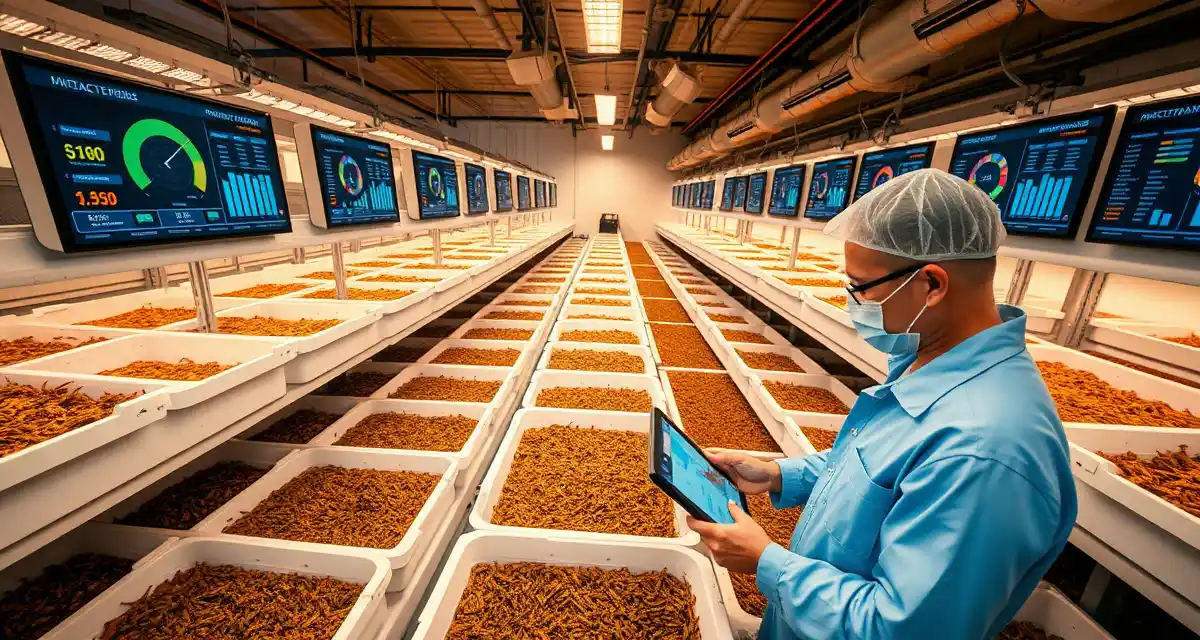
Best Cricket Farm Management Software 2026
If you're still running your cricket operation on spreadsheets, you're not alone. A 2025 industry survey found that 78% of small cricket farms still track bins, mortality, and feed in Excel or Google Sheets. That works fine at 5 bins. It starts breaking down at 20. By 50, you're losing real money to missed harvests, undetected die-offs, and feed waste you never see coming.
This guide covers every software option available to cricket farmers in 2026, what each does well, where each falls short, and which operations each is actually built for.
TL;DR
- A 2025 industry survey found that 78% of small cricket farms still track bins, mortality, and feed in Excel or Google Sheets.
- By 50, you're losing real money to missed harvests, undetected die-offs, and feed waste you never see coming.
- The metrics that matter, bins cycling every 6–8 weeks, FCR at 1.7:1, mortality tracked by cause, egg-to-harvest lifecycle status, don't exist in any off-the-shelf farm management tool.
- At the Starter tier ($69/month), you get up to 5 bins with full lifecycle tracking, FCR dashboards, and alert configuration.
- The Professional tier ($129/month) removes the bin limit and adds food safety templates.
- Average setup for a non-technical user runs 14+ hours before the system is usable for a cricket operation.
- Manual data entry is time-intensive, typically 10–12 hours per week at 30+ bins.
The Problem With Generic Farm Software
Cricket farming doesn't map cleanly onto cattle or row crop templates. The metrics that matter, bins cycling every 6–8 weeks, FCR at 1.7:1, mortality tracked by cause, egg-to-harvest lifecycle status, don't exist in any off-the-shelf farm management tool.
When cricket farmers try to force their operation into generic livestock software, they end up with a half-working system that requires constant workarounds. The data they actually need (hatch date per bin, temperature alerts by life stage, batch-level HACCP records) either gets entered into a separate spreadsheet anyway or doesn't get tracked at all.
What Cricket Farm Software Actually Needs to Do
Before comparing tools, it helps to know what a cricket-specific platform actually has to handle:
- Bin-level lifecycle tracking, hatch date, current instar estimate, projected harvest window
- FCR per bin, feed input vs. live weight output, tracked across each bin's grow-out cycle
- Environmental monitoring integration, temperature and humidity sensor data linked to bins
- Mortality logging by cause, temperature crash, disease, dehydration, cannibalism
- Automated daily plans, what needs feeding, checking, or harvesting today
- Food safety documentation. HACCP batch records, FDA-ready logs for cricket flour operations
- Alerts, push notifications when temperature drops outside your set range overnight
Most tools on the market cover two or three of these. Only one covers all of them.
Software Options Compared
CricketOps
CricketOps is the only platform built exclusively for commercial cricket operations. It handles bin-level lifecycle tracking for both Acheta domesticus and Gryllus bimaculatus, calculates FCR automatically per bin, integrates with IoT temperature and humidity sensors, and generates compliance documentation for USDA and FDA requirements.
At the Starter tier ($69/month), you get up to 5 bins with full lifecycle tracking, FCR dashboards, and alert configuration. The Professional tier ($129/month) removes the bin limit and adds food safety templates. Enterprise ($249/month) adds multi-site management, team permissions, and consolidated compliance reporting.
Best for: Any commercial cricket farm with 5+ bins that cares about FCR, food safety documentation, or catching environmental problems before they become die-offs.
Limitations: Overkill for a backyard operation with 2–3 bins and no plans to sell commercially.
FarmHack
FarmHack is an open-source toolkit originally designed for diversified small farms. It's free, flexible, and can technically be configured to track cricket bins, but it takes time. Average setup for a non-technical user runs 14+ hours before the system is usable for a cricket operation. You're building your own data schema, configuring your own fields, and writing your own reports.
Best for: Technical users who want a free option and have time to configure it. Not practical for most commercial cricket operations.
Limitations: No cricket-specific templates. No FCR module. No sensor integration out of the box. No food safety documentation. Ongoing maintenance required when you need to change your setup.
Google Sheets / Excel
Still the default for most small operations. A well-designed spreadsheet can handle bin tracking, feed logging, and basic FCR calculations. Several cricket farming communities share templates online.
Best for: Operations under 15 bins that aren't producing for food-grade markets and don't need compliance documentation.
Limitations: No automated alerts. No sensor integration. No pattern detection across bins. Manual data entry is time-intensive, typically 10–12 hours per week at 30+ bins. Version control issues when multiple people are entering data.
Generic Livestock Software (AgriWebb, FarmLogs, etc.)
These platforms were built for cattle, sheep, and row crops. They handle animal counts, feed records, and financial tracking well. They don't handle cricket lifecycle stages, per-bin FCR, or the kind of environmental monitoring a cricket operation needs.
Best for: Farms that also run conventional livestock and want a single platform for the non-cricket side of the operation.
Limitations: Won't track cricket bin lifecycles, hatch dates, or FCR without significant workarounds. No cricket-specific alerts or compliance templates.
Comparison Table
| Feature | CricketOps | FarmHack | Spreadsheets | Generic Livestock |
|---|---|---|---|---|
| Cricket-specific lifecycle tracking | Yes | Manual setup | Manual | No |
| FCR per bin | Automatic | Manual setup | Manual | No |
| Sensor integration | Yes | DIY | No | No |
| Mortality cause tracking | Yes | Manual setup | Manual | Limited |
| Food safety / HACCP templates | Yes | No | No | No |
| Automated daily plans | Yes | No | No | No |
| Push alerts | Yes | No | No | No |
| Setup time | < 1 hour | 14+ hours | 1–2 hours | Varies |
| Price | $69–$249/mo | Free | Free | $50–$200/mo |
Who Uses Each Platform
CricketOps users tend to be commercial operations producing feeder crickets or cricket flour at 10 bins or more. They've usually tried spreadsheets first, hit a wall somewhere between 15 and 30 bins, and switched when missed harvests or a die-off event cost them more than a year's software subscription.
FarmHack users are typically tech-savvy hobbyist farmers or research operations that want control over their data schema and don't mind the configuration work.
Spreadsheet users are usually in their first year of farming, under 15 bins, and not yet selling into food-grade markets.
FAQ
What software do cricket farmers use to manage their operations?
Most small cricket farms use Google Sheets or Excel for bin tracking and feed logs. As operations grow past 15–20 bins, many switch to purpose-built platforms like CricketOps that handle FCR calculations, environmental alerts, and food safety documentation automatically.
Is there a cricket-specific farm management app?
Yes. CricketOps is the only software platform built exclusively for commercial cricket farming. It covers bin-level lifecycle tracking, automatic FCR per bin, temperature and humidity alert integration, and USDA/FDA compliance documentation. It's available on both desktop and mobile.
How much does cricket farm software cost?
CricketOps starts at $69/month for farms with up to 5 bins. The Professional plan at $129/month covers unlimited bins. Enterprise pricing at $249/month adds multi-site management. FarmHack is free but requires significant technical setup time. Generic livestock software typically runs $50–$200/month and lacks cricket-specific features.
What data should a cricket farm management system track at minimum?
At minimum: bin identification, population counts by life stage, feed inputs and quantities, mortality events, temperature and humidity readings, and harvest dates and weights. These categories give you enough data to calculate FCR, identify underperforming bins, and audit any production batch. More advanced tracking adds environmental sensor integration, financial cost allocation, and buyer order fulfillment records.
How long does it take to see a return on investment from farm management software?
Operations that move from spreadsheets to purpose-built software typically see measurable FCR improvement within two to three production cycles, as patterns invisible in manual records become visible in aggregated data. The timeline depends on operation size -- larger farms benefit faster because there are more data points and more decisions that can be improved. The ROI accelerates when the software also reduces the time spent on manual data entry and reporting.
Can cricket farm management software integrate with environmental sensors?
Yes, platforms designed specifically for commercial insect production such as CricketOps support direct integration with temperature and humidity sensors via IoT protocols. This eliminates the need for manual environmental logging and enables automated alerts when readings fall outside set thresholds. When evaluating software, confirm which sensor brands and communication protocols (WiFi, Zigbee, 4G) are supported before purchasing equipment.
Sources
- Food and Agriculture Organization of the United Nations (FAO) -- Edible Insects: Future Prospects for Food and Feed Security
- North American Coalition for Insect Agriculture (NACIA)
- Entomological Society of America
- USDA Agricultural Research Service
- AgriNovus Indiana -- AgTech Industry Resources
Get Started with CricketOps
Managing a cricket operation with disconnected tools -- a spreadsheet for bins, a separate doc for feed logs, manual temperature notes -- creates gaps in your data that become costly blind spots. CricketOps brings bin tracking, environmental monitoring, FCR calculations, and harvest records into one place built specifically for insect agriculture. Try it and see how much clearer your production picture becomes.