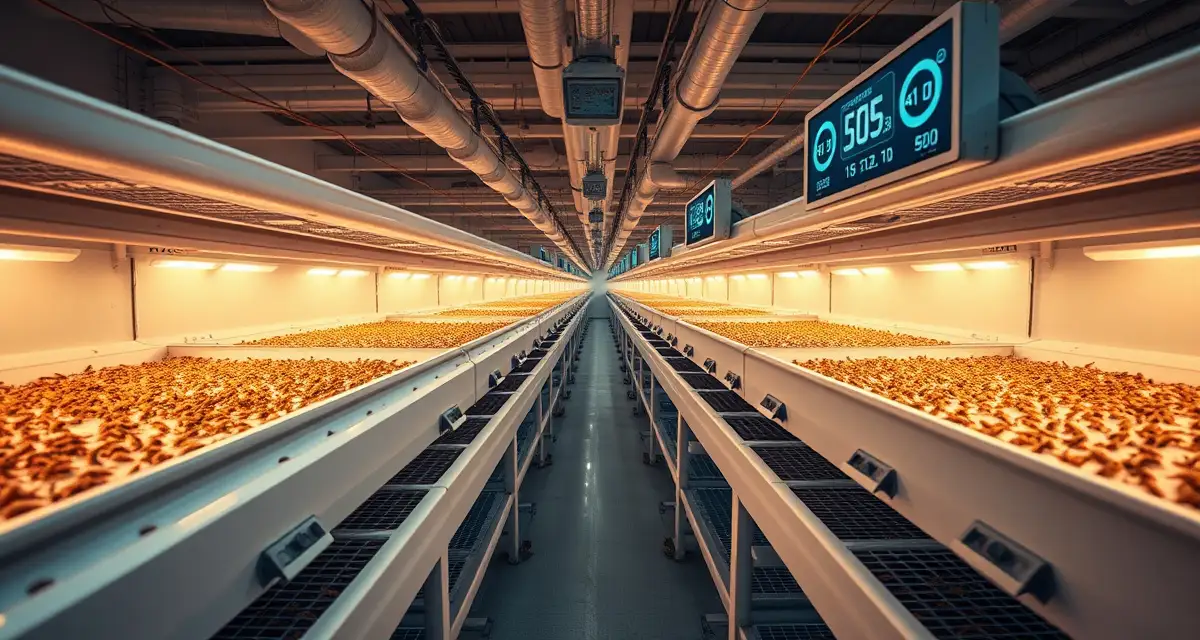
Case Study: Automating a 40-Bin Cricket Farm with Sensors and CricketOps
The farm recovered its sensor investment ($2,200) in reduced die-off losses within 4 months. That's a 4-month payback period on a capital investment, which is strong by any measure. This case study explains how a 40-bin operation went from reactive die-off management to proactive temperature control, and what the numbers looked like before and after.
TL;DR
- The farm recovered its sensor investment ($2,200) in reduced die-off losses within 4 months.
- That's a 4-month payback period on a capital investment, which is strong by any measure.
- Total losses from those 4 events: approximately $6,800 in production value.
- The most notable event occurred 3 weeks after installation: one of the mini-split units stopped heating properly on a cold night.
- The sensors caught the temperature dropping below 78F at 11:47 PM.
- By the time it was caught, temperatures would have been in the low-to-mid 60s for 6-7 hours - into the range where notable cricket mortality occurs.
- Additional ongoing cost is the CricketOps subscription (approximately $145/month at the Professional tier).
The Starting Point: A Reactive Operation
The farm had been running for about 14 months when the operator decided to automate. At that point, the setup was:
- 40 bins of Acheta domesticus in two production rooms
- Two mini-split HVAC units (one per room)
- One digital thermometer per room, checked manually 2-3 times daily
- Temperature logs recorded in a paper notebook
- No overnight monitoring
The operation was profitable, but the operator had experienced 4 notable die-off events in the previous 6 months - all of them overnight or over weekends when nobody was on-site. Total losses from those 4 events: approximately $6,800 in production value.
The pattern was the same each time: a temperature excursion happened (HVAC malfunction, power issue, or thermostat drift), went undetected for hours, and by the time anyone arrived the following morning or Monday, the damage was done.
The Automation Decision
After the fourth die-off event, the operator decided to invest in IoT sensor monitoring integrated with CricketOps. The investment:
- 12 wireless temperature and humidity sensors ($180 total)
- Hub and data aggregation hardware ($120)
- CricketOps Professional subscription with sensor integration ($145/month)
- One-time setup and configuration time (approximately 6 hours)
Total upfront hardware cost: $2,200 (including 6 months of CricketOps subscription prepaid).
Implementation: Sensor Placement and Alert Configuration
The 12 sensors were placed to capture the full environmental picture of both production rooms:
- 2 sensors per shelving unit (high tier and low tier), 4 shelving units per room = 8 production sensors
- 2 sensors in the hatching area
- 2 sensors in the common area near HVAC returns (to catch system-level changes before they affect the production zones)
Each sensor logged temperature and humidity every 5 minutes. CricketOps aggregated the data and displayed it in a production environment dashboard.
Alert configuration:
- Temperature alert: any sensor above 93F or below 78F
- Humidity alert: any sensor above 85% RH or below 50% RH
- System alert: if any sensor stops reporting for more than 15 minutes (indicates connectivity loss or sensor failure)
All alerts were configured to push to the operator's phone via text and app notification, with a secondary email contact if the primary wasn't acknowledged within 20 minutes.
The First 90 Days: Catching Problems Before They Became Die-Offs
In the 90 days after implementation, the system fired 14 temperature alerts. Each one represented a situation that, under the previous manual monitoring system, would have gone undetected for hours.
The most notable event occurred 3 weeks after installation: one of the mini-split units stopped heating properly on a cold night. The sensors caught the temperature dropping below 78F at 11:47 PM. The operator received an alert, diagnosed the issue remotely via the sensor data (one room dropping, the other stable), and dispatched a portable heater to the affected room before temperatures dropped below 72F.
Under the old system, that event would have been discovered the following morning. By the time it was caught, temperatures would have been in the low-to-mid 60s for 6-7 hours - into the range where notable cricket mortality occurs.
The estimated losses prevented by that single event: approximately $1,800 in production value from approximately 15 bins of late-stage crickets.
6-Month Results
At the 6-month mark, the operator ran a comparison of die-off rates before and after implementation:
| Metric | 6 Months Before | 6 Months After |
|--------|----------------|----------------|
| Average die-off rate per cycle | 9.4% | 3.3% |
| Major die-off events (>20% loss) | 4 | 1 |
| Production losses from die-offs | ~$6,800 | ~$950 |
| FCR (average across all bins) | 1.82 | 1.63 |
Die-off rate improved by 65% (from 9.4% to 3.3%). Major die-off events dropped from 4 to 1. FCR improved from 1.82 to 1.63 - a meaningful improvement that the operator attributed primarily to better humidity management (caught and corrected several high-humidity events that had previously been causing feed mold and reduced feeding rates).
Sensor investment recovery: At $1,850 in direct die-off losses prevented in 4 months (the $6,800 pace vs. the new $950 pace), the $2,200 hardware and subscription investment was recovered in approximately 4.3 months.
Beyond Die-Off Prevention: What Else the Data Revealed
The continuous sensor data revealed several patterns the operator hadn't known existed:
Tier temperature gradient: Top-shelf bins were running consistently 3-4 degrees warmer than bottom-shelf bins in the same room. After seeing this in the data, the operator started rotating bins between tiers to equalize exposure. FCR variance between bins decreased measurably after this change.
Humidity cycling pattern: Humidity in both rooms spiked measurably each time crickets were fed with fresh vegetables. The operator added a brief ventilation period post-feeding that reduced the humidity spike and the mold incidents that had been following it.
HVAC cycling behavior: The temperature logs revealed that the HVAC systems were cycling more frequently than expected, suggesting refrigerant issues. Catching this led to a preventive service call that avoided a potential failure mid-winter.
Frequently Asked Questions
How much does it cost to automate a 40-bin cricket farm?
The hardware and initial subscription cost for the setup described in this case study was approximately $2,200, covering 12 IoT temperature/humidity sensors, a data hub, and 6 months of CricketOps Professional subscription with sensor integration. Additional ongoing cost is the CricketOps subscription (approximately $145/month at the Professional tier). Total cost in year one: approximately $2,940. In year two, ongoing cost is approximately $1,740/year. The case study operation recovered the upfront investment in 4 months through reduced die-off losses. Your specific payback period depends on your current die-off rate and production value at risk.
What sensors do I need to automate cricket farm temperature monitoring?
Temperature and humidity sensors with wireless logging capability are the core requirement. Specifically: accuracy of ±0.5F for temperature and ±2% for humidity (consumer-grade sensors typically don't meet this standard), wireless connectivity to a central hub, logging intervals of 5-15 minutes, and battery life of 6+ months. For a 40-bin two-room operation, 10-12 sensors covering all shelving tiers and zones gives you complete coverage. Add sensors near HVAC returns to catch system-level changes before they affect production zones. Integrate your sensors with your farm management software to get automated alerts and historical trend data in the same system you use for production tracking.
How quickly do automated sensors pay for themselves on a cricket farm?
The payback period depends on your current die-off rate and the value of your production at risk. For the operation in this case study, with a pre-automation die-off rate of 9.4% and approximately $6,800 in annual die-off losses, the 4-month payback was faster than typical. For a well-run operation with a 4-5% die-off rate, the payback period would be longer - perhaps 12-18 months. But the payback calculation shouldn't only include prevented die-off losses. It should also include the value of improved FCR (as seen in this case), the operational cost of overnight manual checks that alerts eliminate, and the compliance value of continuous environmental logs that CricketOps maintains automatically.
What data should a cricket farm management system track at minimum?
At minimum: bin identification, population counts by life stage, feed inputs and quantities, mortality events, temperature and humidity readings, and harvest dates and weights. These categories give you enough data to calculate FCR, identify underperforming bins, and audit any production batch. More advanced tracking adds environmental sensor integration, financial cost allocation, and buyer order fulfillment records.
How long does it take to see a return on investment from farm management software?
Operations that move from spreadsheets to purpose-built software typically see measurable FCR improvement within two to three production cycles, as patterns invisible in manual records become visible in aggregated data. The timeline depends on operation size -- larger farms benefit faster because there are more data points and more decisions that can be improved. The ROI accelerates when the software also reduces the time spent on manual data entry and reporting.
Can cricket farm management software integrate with environmental sensors?
Yes, platforms designed specifically for commercial insect production such as CricketOps support direct integration with temperature and humidity sensors via IoT protocols. This eliminates the need for manual environmental logging and enables automated alerts when readings fall outside set thresholds. When evaluating software, confirm which sensor brands and communication protocols (WiFi, Zigbee, 4G) are supported before purchasing equipment.
Sources
- Food and Agriculture Organization of the United Nations (FAO) -- Edible Insects: Future Prospects for Food and Feed Security
- North American Coalition for Insect Agriculture (NACIA)
- Entomological Society of America
- USDA Agricultural Research Service
- AgriNovus Indiana -- AgTech Industry Resources
Get Started with CricketOps
Managing a cricket operation with disconnected tools -- a spreadsheet for bins, a separate doc for feed logs, manual temperature notes -- creates gaps in your data that become costly blind spots. CricketOps brings bin tracking, environmental monitoring, FCR calculations, and harvest records into one place built specifically for insect agriculture. Try it and see how much clearer your production picture becomes.