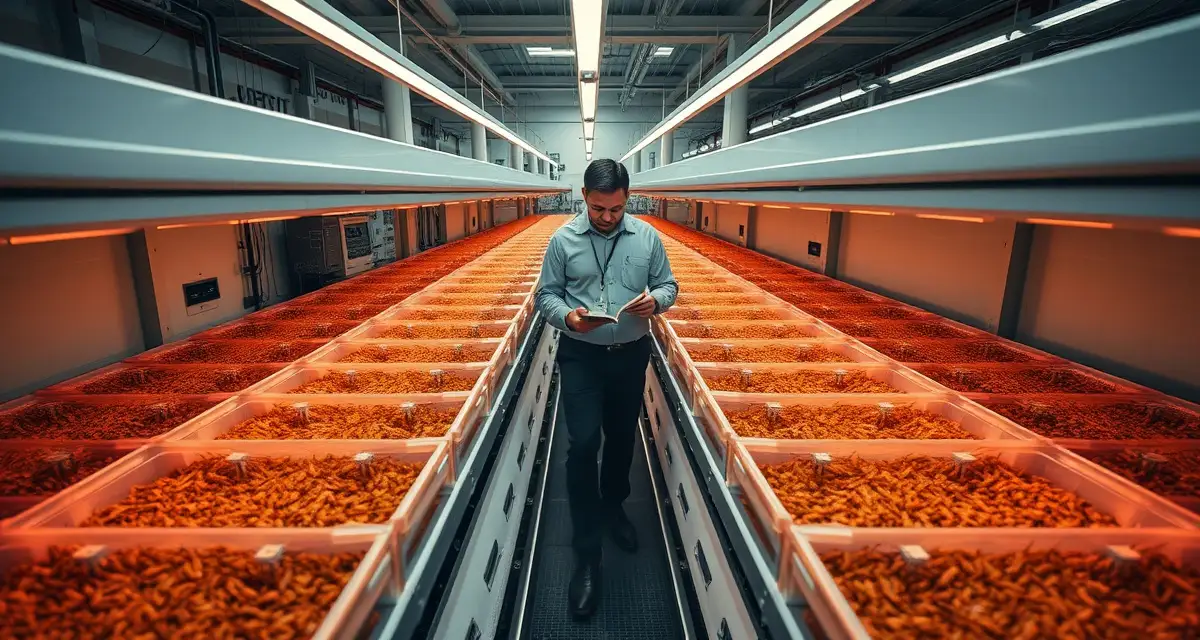
Case Study: Scaling a Cricket Farm from 10 to 100 Bins in 18 Months
Labor costs typically triple between 20 and 60 bins without a tracking system in place. That's what happened at the midpoint of this scale-up, and catching it early is what allowed the farm to reach 100 bins without the operational chaos that kills most scaling attempts.
This is an 18-month account of a real scale-up: what worked, what broke, and what the operation looked like at each milestone.
TL;DR
- Labor costs typically triple between 20 and 60 bins without a tracking system in place.
- That's what happened at the midpoint of this scale-up, and catching it early is what allowed the farm to reach 100 bins without the operational chaos that kills most scaling attempts.
- Revenue was minimal, selling mixed-size feeder crickets locally at $10/thousand.
- A heating element failure in month two caused an overnight temperature drop to 61°F.
- Five of ten bins had significant mortality (200–400 dead per bin).
- Cost: roughly $200 in dead crickets and 2 weeks of grow-out time.
- No more surprise crashes.
Month 4–6: 25 Bins, First Commercial Account
With stable operations at 10 bins, the operator expanded to 25 by converting an adjacent room.
Month 1–3: 10 Bins, Learning Mode
The operation started in a spare bedroom with 10 bins of Acheta domesticus, a space heater, and a Google Sheet with hatch dates. Revenue was minimal, selling mixed-size feeder crickets locally at $10/thousand.
What worked well: the operator had technical instincts. From month one, every bin had a hatch date logged. Feed was weighed and recorded. Harvest weights were tracked.
What didn't work: the spreadsheet wasn't linked to any alert system. A heating element failure in month two caused an overnight temperature drop to 61°F. The operator found it at 7 a.m. Five of ten bins had significant mortality (200–400 dead per bin). Two bins were total losses.
Cost: roughly $200 in dead crickets and 2 weeks of grow-out time.
After that event, the operator added two WiFi temperature sensors and configured overnight alerts. No more surprise crashes.
Month 4–6: 25 Bins, First Commercial Account
With stable operations at 10 bins, the operator expanded to 25 by converting an adjacent room. A regional pet store chain placed a standing weekly order, 20,000 mixed crickets per week.
The 25-bin operation generated approximately $800–$1,200/month net after costs. FCR at this stage was averaging 1.92, decent but not optimized.
The new room introduced new challenges: temperature distribution was uneven (one corner ran 7°F cooler), and the manual spreadsheet tracking that worked for 10 bins started feeling stretched at 25. Daily feeding rounds were taking 45 minutes. Harvest days took 4+ hours.
Key decision at month 5: Migrate to CricketOps. The operator's reasoning was simple, the data was already being collected in the spreadsheet. CricketOps just added automatic FCR calculation, alerts linked to bin records, and daily task routing. Setup took 45 minutes.
Within 30 days of switching, bin-level FCR data revealed the cold corner bins (3 bins running at FCR 2.4) that were dragging the farm average down. Fixed with a fan and heat tape in a weekend afternoon.
Month 7–10: 50 Bins, First Employee
Expanding to 50 bins required a third room (basement conversion) and the farm's first employee, part-time, 20 hours/week.
This is where tracking paid off most clearly. The employee used CricketOps for daily task routing. No need to remember what each bin needed, the platform told them which bins needed feeding, which were in the harvest window, and which had been flagged for mortality monitoring.
The labor reality at 50 bins without a system: A farm owner who'd tried a similar scale-up in the same region (without management software) reported that 50 bins required roughly 3 hours of daily management. With CricketOps task routing, the case study farm was managing 50 bins in 1.5–2 hours of combined labor daily.
The first employee handled about 60% of daily operations by month 8. The farm was generating $2,800–$3,400/month net.
FCR improved to 1.78 farm average by month 9.
Month 11–14: 75 Bins, Second Sales Channel
An opportunity came up to supply cricket flour to a small functional food brand. This required processing equipment (chest freezer upgrade, commercial dehydrator, moisture meter) and FDA food facility registration, both completed in month 12.
Expanding to 75 bins also revealed the next operational challenge: supply consistency. The pet store chain wanted 20,000 crickets per week. Some weeks 50 bins produced 25,000. Other weeks, clustered hatch timing produced shortfalls.
The fix: staggered hatch scheduling. CricketOps' lifecycle tracking showed which bins were set up to hatch simultaneously. The operator deliberately spread hatch dates across a 7-day window per "tier" of 10 bins. Harvest output smoothed from weekly variance of ±40% to weekly variance of ±15% within 6 weeks.
Revenue from flour: approximately $400–$600/month on top of feeder revenue. The food brand relationship required documentation (HACCP plan, FDA registration number, allergen declaration), all of which the operator had completed in month 12.
Month 15–18: 100 Bins, Full Commercial
Reaching 100 bins required a fourth production space (rented industrial unit) and a second part-time employee.
The key operational investment at this scale: dedicated HVAC in the industrial unit with two redundant heating zones. The operator had learned from the month-2 heating failure, at 10 bins, one failed heater cost $200. At 100 bins, the same event would cost $2,000+. Redundant heating at commercial scale is not optional.
At 100 bins, the farm was generating approximately $6,500–$8,000/month gross revenue ($4,500–$6,000 net). FCR had improved to 1.71 farm average. The operation had two employees running daily operations with the owner focused on sales and growth.
18-Month Scale-Up Summary
| Milestone | Bins | Monthly Net | FCR | Key System Change |
|---|---|---|---|---|
| Month 3 | 10 | $200–$400 | 2.1 | WiFi temp sensors + alerts |
| Month 6 | 25 | $800–$1,200 | 1.92 | CricketOps for bin tracking |
| Month 9 | 50 | $2,800–$3,400 | 1.78 | First employee + task routing |
| Month 12 | 75 | $3,500–$4,500 | 1.75 | Staggered hatch scheduling |
| Month 18 | 100 | $4,500–$6,000 | 1.71 | Commercial HVAC, second employee |
FAQ
What are the biggest challenges when scaling a cricket farm?
The most consistent challenges during this scale-up were: temperature management gaps revealed by bin-level sensors (not visible to a wall-mounted thermometer), labor efficiency breakdowns when tracking moved from one person's memory to a team-managed operation, and supply consistency problems solved by staggered hatch scheduling. Each challenge was data-visible before it became catastrophic.
How did the farm manage quality control during rapid bin expansion?
By keeping the same data fields per bin through every scale phase, hatch date, feed logs, FCR, mortality events. When new employees started, they worked from CricketOps daily task plans, which enforced consistent protocols regardless of the operator's presence. FCR per bin flagged quality problems in new production rooms before they became chronic.
What software tools were used to manage the scaling process?
CricketOps from month 5 onward, bin lifecycle tracking, automatic FCR calculation, temperature sensor integration, daily task routing for employees, and food safety documentation when flour production began at month 12. The platform scaled from 25 to 100 bins without requiring any changes to the operator's setup.
How does CricketOps help track the metrics described in this article?
CricketOps provides bin-level logging for the variables that drive production outcomes -- feed inputs, environmental conditions, mortality events, and harvest results. Rather than maintaining these records in separate spreadsheets, you can view performance trends across bins and over time to identify which operational variables correlate with better outcomes in your specific facility.
Where can I find industry benchmarks to compare my operation's performance?
The North American Coalition for Insect Agriculture (NACIA) publishes periodic industry reports with production benchmarks. University extension programs in agricultural states, including the University of Georgia and University of Florida IFAS, occasionally publish insect farming production data. Industry conferences hosted by the Entomological Society of America and the Insects to Feed the World symposium series are additional sources of peer benchmarking data.
What is the biggest operational mistake cricket farmers make in their first year?
Expanding bin count before achieving consistent FCR and mortality targets in existing bins is the most common and costly first-year mistake. At 5-10 bins, problems are manageable. At 30-50 bins, the same proportional problems represent much larger financial losses. Most experienced cricket farmers recommend holding expansion until you have three consecutive production cycles hitting your FCR and mortality targets.
Sources
- Food and Agriculture Organization of the United Nations (FAO) -- Edible Insects: Future Prospects for Food and Feed Security
- North American Coalition for Insect Agriculture (NACIA)
- Entomological Society of America
- Journal of Insects as Food and Feed (Wageningen Academic Publishers)
- USDA Agricultural Research Service
Get Started with CricketOps
The practices covered in this article are easier to apply consistently when they are supported by organized production data. CricketOps gives cricket farmers the tools to track what matters -- by bin, by batch, and over time. Start your next production cycle in CricketOps and see how organized data changes the way you manage your operation.