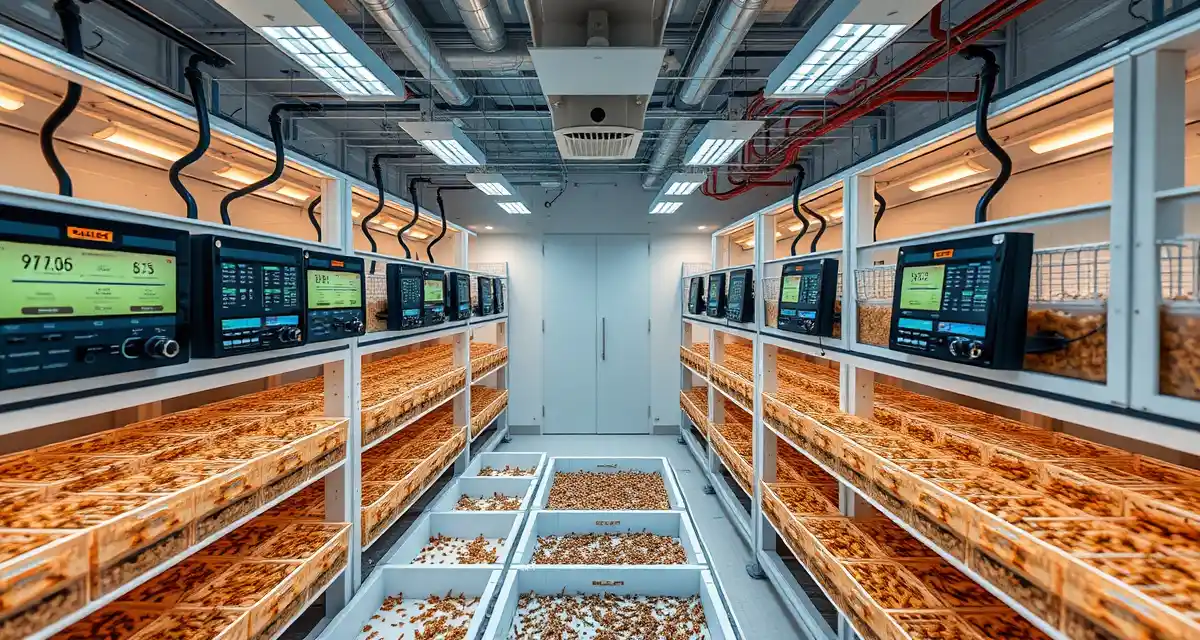
Cricket Farm Automation Guide: What to Automate and When
Automated feeding systems typically pay for themselves at 40+ bins when labor costs are factored in. That's a specific number with math behind it, not a vague threshold. Most automation guidance for farming is either too technical (hardware specifications and wiring diagrams) or too vague ("automate when you're ready to scale"). This guide gives you the specific ROI breakeven bin count for each automation category so you can make investment decisions based on your actual operation.
TL;DR
- Automated feeding systems typically pay for themselves at 40+ bins when labor costs are factored in.
- Automation that saves 30 minutes per day is worth different amounts depending on what else that 30 minutes could be doing.
- At 10 bins where you're also working a day job, 30 minutes might not be a meaningful bottleneck.
- At 80 bins where you have multiple staff and are constrained by hours, 30 minutes per task is real money.
- Environmental controllers (Inkbird ITC-308, Ranco ETC, or similar) take a temperature reading from a probe and automatically trigger heating or cooling devices when temperature moves outside your set range.
- Its value is primarily in preventing losses: a single temperature crash event that kills a batch of 1,000 large crickets at $0.012 each represents $120 in lost product plus the labor invested.
- A temperature controller that prevents one such event per year costs $40-70 and provides immediate positive ROI.
Break-even: At any bin count.
2.
- Automation that saves 30 minutes per day is worth different amounts depending on what else that 30 minutes could be doing.
- At 10 bins where you're also working a day job, 30 minutes might not be a meaningful bottleneck.
- At 80 bins where you have multiple staff and are constrained by hours, 30 minutes per task is real money.
- Its value is primarily in preventing losses: a single temperature crash event that kills a batch of 1,000 large crickets at $0.012 each represents $120 in lost product plus the labor invested.
- A temperature controller that prevents one such event per year costs $40-70 and provides immediate positive ROI.
Break-even: At any bin count.
The Automation Decision Framework
Every automation upgrade should be evaluated against two questions:
- What problem does this solve? (Labor cost, production variance, human error, monitoring gaps)
- At what scale does the investment pay back?
Automation that saves 30 minutes per day is worth different amounts depending on what else that 30 minutes could be doing. At 10 bins where you're also working a day job, 30 minutes might not be a meaningful bottleneck. At 80 bins where you have multiple staff and are constrained by hours, 30 minutes per task is real money.
Know your cost per hour of labor before making automation decisions. Include your own time at an honest rate if you're the owner-operator.
Temperature and Environmental Control Automation
What it replaces
Manual monitoring and manual adjustment of heating and cooling equipment.
How it works
Environmental controllers (Inkbird ITC-308, Ranco ETC, or similar) take a temperature reading from a probe and automatically trigger heating or cooling devices when temperature moves outside your set range. You plug your heater into the controller, set your target temperature, and the controller manages the rest.
Adding a multi-zone monitoring system (SensorPush, multiple Govee/Inkbird sensors) with smartphone alerts means you're notified any time any zone goes outside your parameters.
ROI breakeven
Temperature automation doesn't save labor time as dramatically as feeding or harvest automation. Its value is primarily in preventing losses: a single temperature crash event that kills a batch of 1,000 large crickets at $0.012 each represents $120 in lost product plus the labor invested. A temperature controller that prevents one such event per year costs $40-70 and provides immediate positive ROI.
Break-even: At any bin count. The cost is low enough that the first prevented event justifies the investment.
What to automate first
Temperature control for your production space should be one of your first automation upgrades, even at 5-10 bins. The asymmetry is clear: the cost of automation is small, the cost of a preventable failure is large.
Humidity Control Automation
What it replaces
Manual humidity checks and manual operation of dehumidifiers or humidifiers.
How it works
A humidity controller (combined with temperature in most dual-stage controllers) triggers your dehumidifier or humidifier when RH goes outside your target range. Set your range, plug in your equipment, and the controller manages the humidity.
ROI breakeven
Similar to temperature: low cost, primarily loss-prevention value rather than labor savings.
Break-even: At any bin count for the basic monitoring side. Automated dehumidifier control (about $40-70 for the controller) is worth it as soon as you have a dehumidifier.
Feed Delivery Automation
What it replaces
Manual feed distribution across bins, typically the most time-consuming daily task after monitoring.
How it works
At the farm level, "automated feeding" typically means:
- Pre-measured daily feeding allotments in labeled containers (semi-automation that reduces judgment variability)
- Timed dry feed dispensers for each bin (commercial scale)
- Feed carts with measured portions for efficient distribution (operational efficiency improvement)
True per-bin automated feed dispensers exist for commercial insect farming at the $5,000-15,000+ range for a full system. At the 20-50 bin level, the practical solution is pre-measured portions and a structured feeding round rather than individual bin automation.
ROI breakeven for true automation
At 40+ bins with a $15-20/hour labor cost:
- Manual feeding at 15 minutes per bin per day = 10 hours/day for 40 bins (unrealistic to maintain)
- Efficient manual feeding with pre-measured portions: 2-3 minutes per bin = 80-120 minutes/day for 40 bins
- Automated feeding system (eliminates most of this time): $3,000-8,000
At 40 bins, saving 100 minutes/day at $18/hour = $30/day = $900/month. A $5,000 automated feeding system breaks even in about 6 months. At higher bin counts, the payback period drops to 3-4 months.
Break-even: 40+ bins for true per-bin automated feeding. Below that threshold, structured pre-measured manual feeding is more cost-effective.
Harvest Scheduling Automation
What it replaces
Manual tracking of when each bin needs to be harvested, and manual judgment calls about harvest timing.
How it works
This is primarily a software automation rather than physical equipment. A farm management system that tracks hatch dates and bin ages, and surfaces harvest-ready bins with alerts, replaces the mental overhead (and inevitable human error) of tracking multiple bins on different schedules.
A bin management system that tells you "Bins 12, 17, and 23 are at harvest window this week" is automation that prevents both missed harvests (bins that get too old) and premature harvests (bins pulled before they're ready).
ROI breakeven
Software-based harvest scheduling is cost-effective at 15-20 bins, where the cognitive load of tracking multiple bin ages simultaneously becomes error-prone.
Break-even: 15-20 bins for harvest scheduling software. Below that, a simple spreadsheet handles it. Above that, a dedicated system reduces errors and saves the mental bandwidth of tracking multiple overlapping schedules.
What Is the Most Impactful Automation Upgrade for a 20-Bin Cricket Farm?
At 20 bins, you're not yet at the scale where labor automation (automated feeding, drum separator) pays off strongly. The highest-impact automation at this stage is:
- Temperature and humidity controllers with alerts. These prevent losses at very low cost.
- Harvest scheduling software. 20 bins on different hatch schedules is already challenging to track manually. Getting this wrong costs you in product quality and missed harvests.
- Pre-measured feeding portions. Not automation in the hardware sense, but systematizing your feeding process reduces variability and waste at a cost of essentially zero.
Does Automating a Cricket Farm Require Technical Expertise?
The basic level of automation (temperature controllers, humidity controllers, environmental sensors with phone apps) requires no technical expertise. Plug the device in, connect to your phone app, set your parameters. That's it.
Mid-level automation (multi-zone monitoring with alerts, custom environmental controllers, timed lighting systems) requires some comfort with electrical connections and basic troubleshooting. Still within the reach of most operators.
Full commercial automation (automated feeding systems, sensor integration with farm management software, custom data pipelines) benefits from technical expertise or a systems integrator. At commercial scale, this investment is appropriate. At small to medium scale, the basic automation layer provides most of the value without the complexity.
For the farm management software layer that handles harvest scheduling and production planning automation, see cricket farm management for how dedicated software changes the workflow. For the expansion context around when to invest in automation, the cricket farm expansion checklist ties automation investment to specific farm scale milestones.
FAQ
When should I automate my cricket farm?
Automate environmental control (temperature and humidity with alerts) from the beginning, at any bin count. The investment is small and the protection against loss events is immediate. Move to harvest scheduling software at 15-20 bins. Evaluate labor automation (automated feeding, drum separator) at 35-40+ bins where the hourly labor cost savings justify the equipment investment. Don't automate processes that aren't working consistently yet; solve the consistency problem first.
What is the most impactful automation upgrade for a 20-bin cricket farm?
Temperature and humidity monitoring with automated controllers and smartphone alerts. At 20 bins, loss prevention is a higher ROI than labor automation. A $150 investment in environmental control automation prevents losses that would cost 10x that amount. The second most impactful upgrade is harvest scheduling software that prevents the timing errors that cause oversized or undersized product.
Does automating a cricket farm require technical expertise?
Basic automation (plug-in temperature controllers, sensor apps) requires no technical expertise. Mid-level automation (multi-zone systems, custom controllers) needs some comfort with basic electrical connections. Full commercial automation benefits from technical expertise or professional integration. Most cricket farms can achieve 80% of the value of automation with the basic level, which is accessible to anyone.
What data should a cricket farm management system track at minimum?
At minimum: bin identification, population counts by life stage, feed inputs and quantities, mortality events, temperature and humidity readings, and harvest dates and weights. These categories give you enough data to calculate FCR, identify underperforming bins, and audit any production batch. More advanced tracking adds environmental sensor integration, financial cost allocation, and buyer order fulfillment records.
How long does it take to see a return on investment from farm management software?
Operations that move from spreadsheets to purpose-built software typically see measurable FCR improvement within two to three production cycles, as patterns invisible in manual records become visible in aggregated data. The timeline depends on operation size -- larger farms benefit faster because there are more data points and more decisions that can be improved. The ROI accelerates when the software also reduces the time spent on manual data entry and reporting.
Can cricket farm management software integrate with environmental sensors?
Yes, platforms designed specifically for commercial insect production such as CricketOps support direct integration with temperature and humidity sensors via IoT protocols. This eliminates the need for manual environmental logging and enables automated alerts when readings fall outside set thresholds. When evaluating software, confirm which sensor brands and communication protocols (WiFi, Zigbee, 4G) are supported before purchasing equipment.
Sources
- Food and Agriculture Organization of the United Nations (FAO) -- Edible Insects: Future Prospects for Food and Feed Security
- North American Coalition for Insect Agriculture (NACIA)
- Entomological Society of America
- USDA Agricultural Research Service
- AgriNovus Indiana -- AgTech Industry Resources
Automate the Right Things at the Right Time
The worst automation decisions are the ones made too early (before the process is stable enough that automation will actually help) and too late (after a preventable loss has already occurred).
Environmental monitoring and control automation is almost always "right now." Labor automation is "when the math says so." Make those decisions with your actual labor cost and your actual bin count, and the answer becomes clear.
Start with alerts. They cost almost nothing and give you the ability to respond to problems before they become disasters. Everything else builds from there.
Get Started with CricketOps
Managing a cricket operation with disconnected tools -- a spreadsheet for bins, a separate doc for feed logs, manual temperature notes -- creates gaps in your data that become costly blind spots. CricketOps brings bin tracking, environmental monitoring, FCR calculations, and harvest records into one place built specifically for insect agriculture. Try it and see how much clearer your production picture becomes.