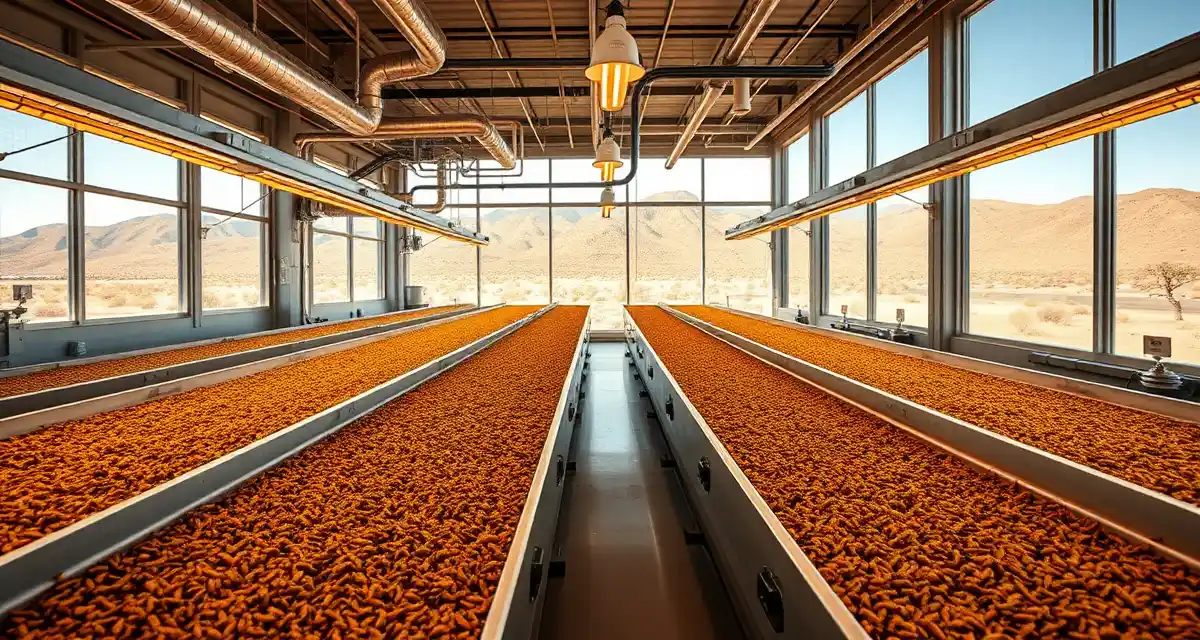
Cricket Farming in New Mexico: High Desert Challenges and NMDA Requirements
At Albuquerque's elevation, ambient RH averages just 30%, requiring continuous active humidification in cricket bins. That's the dominant operational fact for New Mexico cricket farming. Everything downstream of it, your equipment choices, your hydration protocols, your bin management schedule, flows from the recognition that New Mexico's high desert environment is the driest and among the most challenging ambient humidity conditions for cricket production in the US.
TL;DR
- At Albuquerque's elevation, ambient RH averages just 30%, requiring continuous active humidification in cricket bins.
- Las Cruces is lower (3,900 feet) but still measurably above sea level.
- Albuquerque averages 9 inches of annual rainfall.
- Ambient RH in Albuquerque averages 30% year-round, far below the 50-60% target for cricket bins.
- Challenging for cricket farming without substantial infrastructure investment.
Albuquerque (Zone 7a): The largest city and most practical location for commercial cricket farming.
- January average low 26°F, cold but manageable.
- Drier than almost anywhere else in the US.
Southern New Mexico (Las Cruces, Zone 8a-8b): The warmest and most favorable climate in New Mexico.
New Mexico Regulations for Cricket Farming
Cricket farming in New Mexico falls under the New Mexico Department of Agriculture (NMDA).
Key requirements:
- NMDA Division of Agricultural and Environmental Services registration: New Mexico insect farms register through NMDA's agricultural producer framework.
- NMDA Food and Drug Division food manufacturer license: Required for any cricket flour or human-consumption insect products.
- New Mexico Environment Department: May have additional requirements for food processing facilities.
- Local county permits: New Mexico's 33 counties have individual permit structures. Rural county agricultural zoning is permissive.
- Federal FSMA compliance: Required for interstate cricket flour shipments.
Contact NMDA for current requirements. See cricket farm zoning and permits guide for national context, and high-altitude-cricket-farm-management and arid-climate-cricket-farming for the management guides relevant to New Mexico's specific conditions.
New Mexico's Dual Climate Challenge: Altitude + Aridity
New Mexico combines two distinct climate challenges that, together, create a uniquely demanding environment for cricket farming:
Altitude: Albuquerque sits at 5,312 feet. Santa Fe is at 7,000 feet. Las Cruces is lower (3,900 feet) but still measurably above sea level. The altitude effects for cricket farming include: lower ambient RH at any given temperature, larger daily temperature swings, and modest reduction in combustion heating efficiency.
Aridity: New Mexico is among the driest states in the US. Albuquerque averages 9 inches of annual rainfall. Ambient RH in Albuquerque averages 30% year-round, far below the 50-60% target for cricket bins.
The combination means: the altitude drives humidity down and amplifies temperature swings, the aridity means even the moisture that does exist in the air is minimal, and the result is a cricket farm environment that requires some of the most intensive active humidification in the country.
Practical implications:
- Water gel must be refreshed every 24-36 hours rather than 48-72 hours (faster evaporation at low RH)
- Incubation containers must be nearly sealed with in-container moisture sources to maintain 70-80% RH when room ambient is 30%
- Combustion-based heating (propane, natural gas) should be sized 10-15% above sea-level BTU calculations
- Humidification equipment must be rated for continuous operation
New Mexico Climate by Region
Northern New Mexico (Santa Fe, Taos, Zone 5b-6a): Elevation-driven cold winters (Santa Fe January average low 22°F) and very dry conditions. notable heating costs. Challenging for cricket farming without substantial infrastructure investment.
Albuquerque (Zone 7a): The largest city and most practical location for commercial cricket farming. January average low 26°F, cold but manageable. Summer temperatures reach 92°F average high. Drier than almost anywhere else in the US.
Southern New Mexico (Las Cruces, Zone 8a-8b): The warmest and most favorable climate in New Mexico. Las Cruces January average low 36°F, low heating costs. Hot dry summers. The Mesilla Valley agricultural area has infrastructure.
Albuquerque and New Mexico Market Opportunities
Food scene: Albuquerque and Santa Fe have food cultures anchored by New Mexican cuisine (green and red chile). The unique regional food identity creates openness to novel ingredients when presented in culturally resonant ways.
Research market: University of New Mexico (Albuquerque) and New Mexico State University (Las Cruces) have biology, food science, and agriculture programs.
Southwest regional distribution: Albuquerque's position on I-25 and I-40 creates access to the broader Southwest market (Arizona, Colorado, Texas West Texas, and Utah) within 1-2 day ground shipping.
Track New Mexico operations in CricketOps.
Frequently Asked Questions
What permits does New Mexico require for a cricket farm?
New Mexico insect farms register with NMDA through the Division of Agricultural and Environmental Services. Human food production requires an NMDA Food and Drug Division food manufacturer license. Contact NMDA for current requirements.
How do I manage humidity in a high-altitude New Mexico cricket farm?
Active humidification is mandatory and must run continuously. At Albuquerque's ambient 30% RH, achieving 50-60% target requires adding 20-30 percentage points of humidity constantly. Use commercial-grade ultrasonic humidifiers with 2+ gallon/hour output capacity. Use distilled or RO-filtered water to prevent mineral deposits that accumulate quickly at high evaporation rates. Refresh water gel hydration sources every 24-36 hours rather than 48-72 hours. Seal incubation containers nearly completely with an internal moisture source to maintain 70-80% RH in the substrate.
Is there a market for cricket protein in New Mexico?
New Mexico's direct consumer market is modest due to smaller population. The primary opportunities are: the Albuquerque and Santa Fe specialty food markets (which support premium pricing despite small size), research supply to UNM and NMSU, and regional distribution to the broader Southwest market. New Mexico's unique regional food culture may support cricket protein integration into regional cuisine contexts that would be less accessible in other markets.
How does CricketOps help track the metrics described in this article?
CricketOps provides bin-level logging for the variables that drive production outcomes -- feed inputs, environmental conditions, mortality events, and harvest results. Rather than maintaining these records in separate spreadsheets, you can view performance trends across bins and over time to identify which operational variables correlate with better outcomes in your specific facility.
Where can I find industry benchmarks to compare my operation's performance?
The North American Coalition for Insect Agriculture (NACIA) publishes periodic industry reports with production benchmarks. University extension programs in agricultural states, including the University of Georgia and University of Florida IFAS, occasionally publish insect farming production data. Industry conferences hosted by the Entomological Society of America and the Insects to Feed the World symposium series are additional sources of peer benchmarking data.
What is the biggest operational mistake cricket farmers make in their first year?
Expanding bin count before achieving consistent FCR and mortality targets in existing bins is the most common and costly first-year mistake. At 5-10 bins, problems are manageable. At 30-50 bins, the same proportional problems represent much larger financial losses. Most experienced cricket farmers recommend holding expansion until you have three consecutive production cycles hitting your FCR and mortality targets.
Sources
- Food and Agriculture Organization of the United Nations (FAO) -- Edible Insects: Future Prospects for Food and Feed Security
- North American Coalition for Insect Agriculture (NACIA)
- Entomological Society of America
- University of Georgia Cooperative Extension
- Journal of Insects as Food and Feed (Wageningen Academic Publishers)
Get Started with CricketOps
The practices covered in this article are easier to apply consistently when they are supported by organized production data. CricketOps gives cricket farmers the tools to track what matters -- by bin, by batch, and over time. Start your next production cycle in CricketOps and see how organized data changes the way you manage your operation.