Cricket Farming Equipment Guide: What You Need at Every Stage
New cricket farmers often overspend on climate equipment before optimizing bin layout. It's a common pattern: you read about how temperature-sensitive crickets are, so you buy a commercial HVAC unit for a 10-bin room that would have been fine with a $40 space heater and better insulation.
This cricket farming equipment guide is organized by farm stage. The goal is to help you buy what you need now, not what you'll need in three years. Buying too early means overhead that doesn't produce return. Buying too late means production problems that cost more than the equipment would have.
TL;DR
- New cricket farmers often overspend on climate equipment before optimizing bin layout -- a space heater and good insulation often outperform commercial HVAC at small scale.
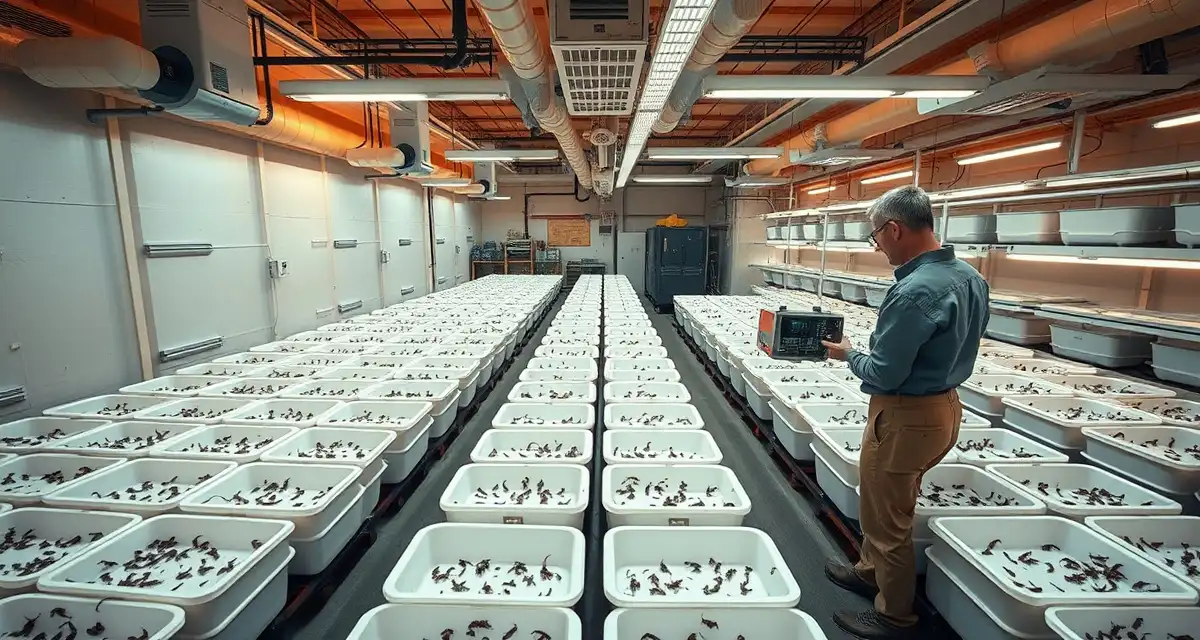
- A 27-gallon Sterilite tote is the standard bin for small to mid-size operations at $8-12 each; 45-gallon bins house approximately 1.5-2x the adults at slightly more floor space.
- Temperature monitoring equipment (data-logging sensors) should be purchased before production begins -- temperature problems cause more first-year losses than any other factor.
- A commercial harvest setup (chilling chamber, separator screen, scale) typically costs $500-$2,000 for a 20-bin operation.
- Shelving infrastructure for 20 bins requires approximately 30-40 linear feet of heavy-duty wire shelving -- custom welded systems become cost-effective above 50 bins.
- Stage your equipment purchases to match your actual production scale -- buying equipment for future scale before current scale is proven creates overhead without return.
Stage 1: Starter Farm (5-15 Bins)
At this stage, you're validating your operation.
- You need enough equipment to produce reliably, but not so much that a failed experiment costs you thousands.
Essential Equipment for a Starter Farm
Bins: 27-gallon storage totes
5-15 of them.
- Cost: $8-12 each.
Egg flats (paper)
Buy a case of 100.
- Cost: ~$50 per case.
Temperature/humidity sensor
One data-logging sensor (Govee or Inkbird) covering your cricket space.
- Cost: $15-25.
Supplemental heat source
A ceramic heat emitter on a thermostat, or a small oil-filled radiator, depending on your space.
- Cost: $30-80.
Water gel crystals
For hydration without drowning risk.
- A 1-pound bag lasts several weeks for a small farm.
Stage 1: Starter Farm (5-15 Bins)
At this stage, you're validating your operation. You need enough equipment to produce reliably, but not so much that a failed experiment costs you thousands.
Essential Equipment for a Starter Farm
Bins: 27-gallon storage totes
5-15 of them. Sterilite and Rubbermaid are the standard choices. Modify lids with mesh window panels for ventilation. Cost: $8-12 each.
Egg flats (paper)
Buy a case of 100. You'll use them faster than you think. Cost: ~$50 per case.
Temperature/humidity sensor
One data-logging sensor (Govee or Inkbird) covering your cricket space. You need to know your actual temperature range, not just what your thermostat says. Cost: $15-25.
Supplemental heat source
A ceramic heat emitter on a thermostat, or a small oil-filled radiator, depending on your space. You need to hold 84-88°F consistently. Cost: $30-80.
Water gel crystals
For hydration without drowning risk. A 1-pound bag lasts several weeks for a small farm. Cost: $10-15.
Feed ingredients
Wheat bran, cornmeal, and dried alfalfa or leafy greens as a baseline. A few pounds to start. Cost: $20-30.
Sifting screen
One or two hardware cloth screens in different mesh sizes for separating frass and harvest. Build your own with 1/4" hardware cloth and a wood frame for under $20.
Total estimated cost, Stage 1: $300-500
What You Don't Need Yet
Commercial climate controllers, automated feeding systems, freeze dryers, and specialty processing equipment. Solve your production fundamentals with simple gear before adding complexity.
Stage 2: Growing Farm (15-50 Bins)
At this stage, you've got consistent production and you're starting to see where your manual processes are creating bottlenecks. Equipment investments should be driven by what's costing you the most time or causing the most production variance.
Equipment to Add at Stage 2
Additional temperature sensors (one per zone)
As your farm expands, different areas of your space will have different temperature profiles. Add sensors so you have coverage in each section. Cost: $15-25 per unit.
Shelving or racking system
At 15+ bins, floor space management matters. Metal wire shelving (NSF-rated for food safety compliance) lets you stack bins vertically. 3-4 shelves per unit, load-rated for your bin weight. Cost: $60-120 per shelving unit.
Environmental controller for heat and cooling
An Inkbird or Ranco dual-stage controller lets your heating and cooling equipment respond automatically to temperature readings rather than running continuously. Cost: $40-70.
Dedicated cleaning station
A utility tub or outdoor cleaning setup with a hose connection. Cleaning bins between batches is non-negotiable at this scale. A proper station makes it faster and more consistent. Cost: $50-150.
Spray bottle or pump sprayer for sanitation
For applying bleach solution during bin cleaning. Cost: $10-20.
Basic harvest supplies (funnel, collection bags, scale)
A digital postal or kitchen scale for weighing harvest output by bin. A harvest funnel for transferring live crickets. Ventilated collection bags or boxes. Cost: $50-100.
Total estimated additions, Stage 2: $400-700
What Equipment Do You Need for Cricket Flour Processing?
If you're adding on-site processing at this stage, the minimum equipment list for cricket flour production is:
- Kill method equipment: A large chest freezer ($150-300) for freeze-killing before processing. Some operations use a food-grade oven for drying; others use both.
- Drying oven or food dehydrator: For reducing moisture content to shelf-stable levels (under 10% moisture). Commercial food dehydrators run $200-600. An oven works at small scale.
- Milling equipment: A grain mill or high-powered blender for processing dried crickets into flour. Grain mills start at $100-300 for basic models.
- Basic food safety equipment: Nitrile gloves, hairnets, food-grade surface sanitizer, and temperature probe for monitoring drying temperature.
For full FDA compliance documentation requirements for cricket flour processing, see the complete cricket farming guide.
Stage 3: Commercial Farm (50-100+ Bins)
At this stage, efficiency, consistency, and compliance documentation are the priorities. Manual processes that worked at 30 bins become bottlenecks at 100.
Equipment to Add at Stage 3
Multi-zone environmental monitoring system
Centralized monitoring with sensors in every bin section feeding into a single dashboard. Systems like Sensaphone or custom Raspberry Pi setups can trigger alerts when any zone goes outside target range. Cost: $200-800 depending on complexity.
Automated feeding system
Commercial insect farms use timed dry feed dispensers or manual feeding carts with pre-measured portions to reduce feeding time and increase consistency. Cost varies widely: $500-5,000+ depending on automation level.
Drum separator for harvest
A rotating drum separator with adjustable mesh separates crickets from frass and substrate far faster than manual sifting. Manual harvest takes 45-90 minutes per bin; drum separation reduces this to under 15 minutes. Cost: $800-3,000.
Commercial freeze-dryer or blast chiller
At commercial scale, processing speed and product quality require better equipment. A commercial freeze-dryer preserves more nutritional value and produces better flour quality than oven-drying. Cost: $2,000-15,000 depending on capacity.
At 50+ bins, manual spreadsheet tracking becomes unsustainable. Dedicated software that tracks bin lifecycles, calculates FCR automatically, logs mortality, and generates compliance documentation pays for itself quickly. See cricket farm management for how dedicated software changes operational workflow.
Total estimated additions, Stage 3: $3,000-20,000+
FAQ
What is the minimum equipment needed to start a cricket farm?
For a functional 5-10 bin starter farm, you need: bins (27-gallon totes, 5-10 units), egg flats, a temperature/humidity data logger, a supplemental heat source on a basic thermostat, water gel crystals, and feed ingredients. Budget $300-500 for the essentials. Add a sifting screen for harvest. You can produce crickets with this setup while you figure out where to invest next.
When should I invest in automated monitoring equipment?
Invest in environmental control automation when manual temperature management is causing production problems or when you have more zones than you can monitor manually. For most operations, that threshold is around 20-30 bins. Before that point, a single data-logging sensor and a basic thermostat-controlled heat source are sufficient. After that, automated environmental responses protect you from the temperature crashes that cause die-offs in your absence.
What equipment do you need for cricket flour processing?
The minimum equipment for on-farm cricket flour processing is: a freeze or heat kill method (chest freezer or oven), a drying system (food dehydrator or commercial drying oven), and a mill or high-powered blender. Plan for food safety equipment including gloves, hairnets, sanitizer, and a thermometer for monitoring drying temperature. For commercial volumes, upgrade to a commercial freeze-dryer and dedicated grain mill. FDA food facility registration is required before selling for human consumption.
How does CricketOps help track the metrics described in this article?
CricketOps provides bin-level logging for the variables that drive production outcomes -- feed inputs, environmental conditions, mortality events, and harvest results. Rather than maintaining these records in separate spreadsheets, you can view performance trends across bins and over time to identify which operational variables correlate with better outcomes in your specific facility.
Where can I find industry benchmarks to compare my operation's performance?
The North American Coalition for Insect Agriculture (NACIA) publishes periodic industry reports with production benchmarks. University extension programs in agricultural states, including the University of Georgia and University of Florida IFAS, occasionally publish insect farming production data. Industry conferences hosted by the Entomological Society of America and the Insects to Feed the World symposium series are additional sources of peer benchmarking data.
What is the biggest operational mistake cricket farmers make in their first year?
Expanding bin count before achieving consistent FCR and mortality targets in existing bins is the most common and costly first-year mistake. At 5-10 bins, problems are manageable. At 30-50 bins, the same proportional problems represent much larger financial losses. Most experienced cricket farmers recommend holding expansion until you have three consecutive production cycles hitting your FCR and mortality targets.
Sources
- Food and Agriculture Organization of the United Nations (FAO) -- Edible Insects: Future Prospects for Food and Feed Security
- North American Coalition for Insect Agriculture (NACIA)
- Entomological Society of America
- University of Georgia Cooperative Extension
- Journal of Insects as Food and Feed (Wageningen Academic Publishers)
Buy for Your Stage. Plan for the Next.
The best equipment decision at each stage is one that solves your current bottleneck, not one that anticipates a farm size you haven't reached yet.
Know your bottleneck. Buy the equipment that directly addresses it. Then reinvest from the production improvement. That's the path to building a farm that grows without becoming an equipment museum of over-investments that didn't pan out.
Get Started with CricketOps
The practices covered in this article are easier to apply consistently when they are supported by organized production data. CricketOps gives cricket farmers the tools to track what matters -- by bin, by batch, and over time. Start your next production cycle in CricketOps and see how organized data changes the way you manage your operation.