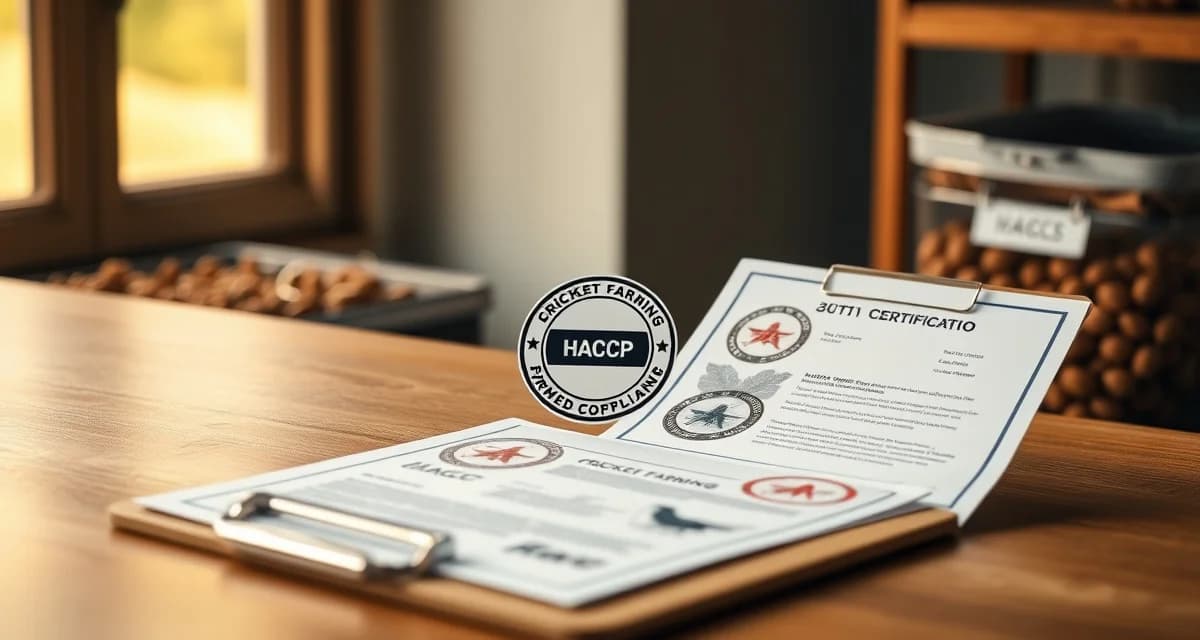
Cricket Farming Certifications: What Labels and Credentials Add Value
HACCP certification adds the most market value per dollar of compliance investment for cricket flour producers. That ranking matters because certification investment is limited, and pursuing the wrong certs first means spending money on credentials that don't move buyers.
This guide ranks certifications by market value and cost-to-obtain, so you know where to invest your compliance budget first.
TL;DR
- Cost: Minimal if you write your own plan using FDA templates; $500-$2,000 if you use a consultant.
- Market value: Required for food manufacturer buyers.
- Verified products command a 12-18% shelf premium in natural food retail.
- Not yet widely adopted in insect farming.
- If you're manufacturing, processing, packing, or holding food for human consumption (cricket flour), you're required to register your facility with FDA under 21 CFR 1.225.
- Minimal if you write your own plan using FDA templates; $500-$2,000 if you use a consultant.
- Third-party verification that your cricket flour and the feed ingredients used in production meet Non-GMO Project standards.
$500-$1,500 initial application fee plus annual renewal.
- Verified products command a 12-18% shelf premium in natural food retail.
- Third-party certification that your cricket flour meets FDA's <20 ppm gluten standard through testing and facility controls.
$500-$2,000 for initial certification plus ongoing testing costs.
Cost: Minimal if you write your own plan using FDA templates; $500-$2,000 if you use a consultant.
Market value: Required for food manufacturer buyers.
- Verified products command a 12-18% shelf premium in natural food retail.
- Not yet widely adopted in insect farming.
Market value: Limited in 2026 but developing.
- Non-GMO Project verified cricket flour commands an average 15% shelf premium in natural food retail, and natural food distributors frequently list Non-GMO as a buyer requirement for new ingredient suppliers.
- Budget 6-12 months for the full verification process.
- Sustainability and values credentials.
- Free. FDA facility registration has no fee.
Market value: Limited in 2026 but developing.
- Budget 6-12 months for the full verification process.
- You can write this yourself using FDA templates and PCQI training, or hire a food safety consultant for $500-$2,000.
- HACCP certification adds the most market value per dollar of compliance investment for cricket flour producers.
- That ranking matters because certification investment is limited, and pursuing the wrong certs first means spending money on credentials that don't move buyers.
- FDA facility registration has no fee.
Market value: Required, not optional.
The Certification Landscape for Cricket Farms
Cricket farm certifications fall into three categories:
Food safety credentials: HACCP certification, FDA facility registration, FSMA Preventive Controls compliance, SQF, BRC. These are requirements or near-requirements for selling to food manufacturers and major retailers.
Product attribute labels: Non-GMO Project, USDA Organic, Gluten-Free (certified). These are consumer-facing labels that command shelf premiums in natural food retail.
Sustainability and values credentials: B Corp, Certified Humane, sustainability claims, regenerative agriculture. These command premiums in specific premium channels but have limited value in mainstream retail.
Tier 1: Food Safety (Required for Commercial B2B Sales)
FDA Facility Registration (FSMA)
What it is: If you're manufacturing, processing, packing, or holding food for human consumption (cricket flour), you're required to register your facility with FDA under 21 CFR 1.225.
Cost: Free. FDA facility registration has no fee.
Market value: Required, not optional. Food manufacturers and major retailers won't buy from unregistered facilities. This isn't a differentiator -- it's table stakes.
Do this first, before any other certification, if you're selling for human consumption.
FSMA Preventive Controls Compliance
What it is: A written food safety plan that documents your hazard analysis, preventive controls, monitoring procedures, and corrective actions. Required for FDA-registered facilities under FSMA.
Cost: Minimal if you write your own plan using FDA templates; $500-$2,000 if you use a consultant.
Market value: Required for food manufacturer buyers. Your CricketOps account stores monitoring records that support your food safety plan documentation.
HACCP Certification
What it is: Third-party certification that your food safety plan meets HACCP (Hazard Analysis Critical Control Points) principles, conducted by an accredited certification body.
Cost: $1,500-$4,000 for initial certification; $500-$1,500/year for maintenance audits.
Market value: HACCP is the highest-value single certification for food manufacturer qualification. Many food manufacturers require third-party HACCP certification before approving new ingredient suppliers. The certification signals that an external auditor has verified your food safety controls, not just that you have a document on file.
Tier 2: Product Attribute Labels (Premium Shelf Position)
Non-GMO Project Verification
What it is: Third-party verification that your cricket flour and the feed ingredients used in production meet Non-GMO Project standards.
Cost: $500-$1,500 initial application fee plus annual renewal. Feed ingredient verification adds complexity and cost if your feed mix includes ingredients from multiple suppliers.
Market value: Non-GMO is the most common buyer request from natural food channel distributors and retailers. Verified products command a 12-18% shelf premium in natural food retail. See the Non-GMO Project guide for cricket flour for detailed process guidance.
Gluten-Free Certification
What it is: Third-party certification that your cricket flour meets FDA's <20 ppm gluten standard through testing and facility controls.
Cost: $500-$2,000 for initial certification plus ongoing testing costs.
Market value: Gluten-free is the second most common consumer label request for cricket flour (after non-GMO). Cricket flour is naturally gluten-free but the label claim requires documented testing and facility controls to make legally.
Tier 3: Sustainability and Values Credentials
B Corp Certification
What it is: Certification that your company meets B Lab's standards for social and environmental performance, accountability, and transparency.
Cost: $1,000-$3,000 annual fee (based on revenue) plus the time investment of the B Impact Assessment.
Market value: B Corp certification delivers the best premium in premium food service and specialty retail. Less value in mainstream grocery. See the B Corp certification guide for cricket farms for ROI analysis.
Certified Humane (Insect Welfare)
What it is: Emerging framework for certifying that insect production meets humane care standards. Not yet widely adopted in insect farming.
Market value: Limited in 2026 but developing. Watch this space.
Building Your Certification Roadmap
For most cricket flour producers, the right sequence is:
- FDA Registration: Free, mandatory, do immediately
- FSMA Food Safety Plan: Required for registered facilities, write it with consultant support if needed
- HACCP Certification: High value for food manufacturer qualification, pursue in year 1-2
- Non-GMO Project: Pursue in parallel with HACCP if natural food retail is a target channel
- B Corp or other values credentials: Pursue in year 2-3 once your core food safety credentials are solid
Frequently Asked Questions
What certifications add the most value for a cricket flour brand?
In order of market value per dollar invested: HACCP certification (required by many food manufacturers for ingredient supplier approval), Non-GMO Project verification (commands shelf premiums in natural food retail and is the most common buyer request in that channel), and Gluten-Free certification (second most common consumer label request for cricket flour). B Corp certification adds value specifically in premium food service and specialty retail channels. FDA facility registration is free and mandatory -- not a differentiator, but absence disqualifies you from all food manufacturer customers.
Is non-GMO certification worth it for a cricket farm?
Yes, if natural food retail is a target channel. Non-GMO Project verified cricket flour commands an average 15% shelf premium in natural food retail, and natural food distributors frequently list Non-GMO as a buyer requirement for new ingredient suppliers. The certification process for cricket flour requires verifying not just your production process but your feed ingredient supply chain -- feed ingredients must meet Non-GMO Project standards for the finished product to be certified. Budget 6-12 months for the full verification process. The cost ($500-$1,500 plus feed supplier verification) is typically recovered in the first year of premium pricing.
How do I get a food safety certification for my cricket flour operation?
Start with FDA facility registration (free, at fda.gov) if you're selling for human consumption. Then write an FSMA-compliant food safety plan -- FDA's preventive controls rule requires a written plan that covers your hazard analysis, preventive controls, monitoring procedures, and corrective actions. You can write this yourself using FDA templates and PCQI training, or hire a food safety consultant for $500-$2,000. For HACCP third-party certification, contact an accredited certification body (SQF Institute, NSF, DNV) for a quote and audit schedule. CricketOps stores your monitoring records and supports the documentation requirements for all three levels of food safety compliance.
Do federal regulations differ from state regulations for cricket farming?
Yes. Federal oversight of insect production for human food falls primarily under FDA authority, including Food Safety Modernization Act (FSMA) requirements. State regulations vary widely -- some states have specific insect production permits, others treat cricket farming under broader agricultural licensing frameworks. Operations selling across state lines must comply with both their state of production and the destination state's requirements. Check with your state department of agriculture and an attorney familiar with food law for current requirements.
What documentation should I keep to demonstrate regulatory compliance?
Maintain records of feed ingredient sourcing with supplier documentation, batch production records, environmental monitoring logs (temperature, humidity), mortality records, sanitation logs, and any third-party audit results. Buyers from food manufacturing companies increasingly require these records as part of their supplier qualification process, so keeping them organized from the start saves significant effort later.
How often should a cricket farm conduct internal food safety audits?
A minimum of one formal internal audit per quarter is a reasonable starting point for a commercial operation. The audit should cover environmental monitoring records, sanitation log completeness, pest control documentation, and critical control point records for your HACCP plan. Operations seeking third-party certification (SQF, BRC, or similar) should align internal audit frequency and format with the standard's requirements.
Sources
- Food and Agriculture Organization of the United Nations (FAO) -- Edible Insects: Future Prospects for Food and Feed Security
- North American Coalition for Insect Agriculture (NACIA)
- U.S. Food and Drug Administration (FDA) -- Food Safety Modernization Act (FSMA)
- USDA National Organic Program
- Global Food Safety Initiative (GFSI)
Get Started with CricketOps
Maintaining organized compliance records is much easier when you build the system from day one rather than reconstructing it before an audit. CricketOps keeps your batch records, environmental monitoring logs, and traceability data in one place so that responding to a buyer documentation request or a regulatory inquiry does not require hunting through spreadsheets and paper files.