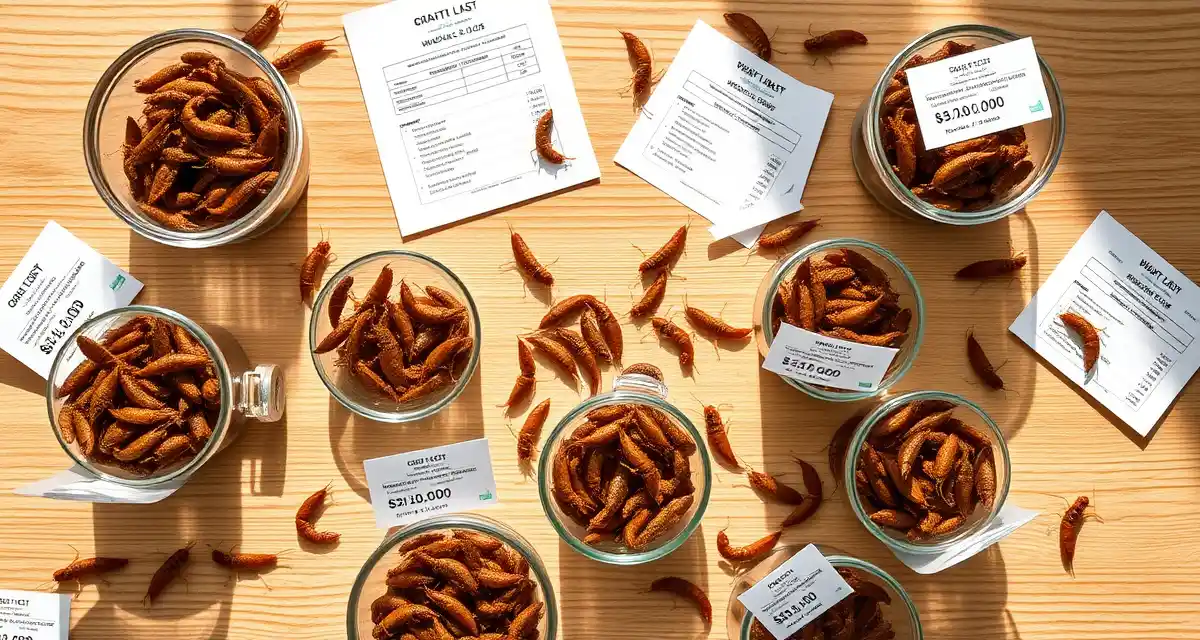
Cricket Price Per Pound: Wholesale and Retail Benchmarks for 2026
Whole dried crickets wholesale for $8-$15/lb; cricket flour wholesales for $12-$22/lb depending on grade. These are real market prices based on 2026 commercial transactions, not projections. For producers who've been pricing without market reference data, the comparison to your current price sheet may be either encouraging or clarifying.
This guide covers prices across all major product formats and market channels so you can benchmark your pricing against what the market is actually paying.
TL;DR
- Whole dried crickets wholesale for $8-$15/lb; cricket flour wholesales for $12-$22/lb depending on grade.
- These are real market prices based on 2026 commercial transactions, not projections.
- Live feeder cricket pricing is typically sold by count (per 100, per 250, per 1,000) rather than by pound, but per-pound conversion is possible at approximately 0.5-0.7 oz per adult cricket (species and hydration level dependent).
- DTC pricing for live feeder crickets is typically 40-80% above wholesale, reflecting the direct-to-buyer margin and shipping cost inclusion.
- A box of 250 large crickets that wholesales for $20-$30 typically sells DTC for $30-$50 including shipping.
- Dried crickets sold retail (under a brand, in consumer packaging) typically command $25-$50/lb equivalent, depending on packaging size and brand positioning.
- DTC cricket flour pricing typically runs $30-$60/lb equivalent, with subscription pricing often 10-15% below single-order pricing.
Live Feeder Cricket Pricing
Live feeder cricket pricing is typically sold by count (per 100, per 250, per 1,000) rather than by pound, but per-pound conversion is possible at approximately 0.5-0.7 oz per adult cricket (species and hydration level dependent).
Wholesale pricing to pet stores and distributors (2026 benchmarks):
| Size Grade | Per 100 Count | Per 250 Count | Per 1,000 Count |
|-----------|---------------|---------------|-----------------|
| Pinhead (1/16") | $3.50 - $5.50 | $8 - $13 | N/A |
| Small (1/8" - 1/4") | $5 - $8 | $11 - $18 | $38 - $60 |
| Medium (3/8" - 1/2") | $7 - $11 | $15 - $25 | $52 - $88 |
| Large (3/4" - 1") | $9 - $14 | $19 - $30 | $68 - $110 |
| Adult (1"+) | $10 - $16 | $22 - $35 | $80 - $130 |
Direct-to-consumer pricing:
DTC pricing for live feeder crickets is typically 40-80% above wholesale, reflecting the direct-to-buyer margin and shipping cost inclusion. A box of 250 large crickets that wholesales for $20-$30 typically sells DTC for $30-$50 including shipping.
Regional variation: These are national benchmark ranges. Actual market pricing in your region may be higher (e.g., Pacific Coast where production is lower relative to demand) or lower (Midwest where feeder cricket production is more concentrated).
Dried Whole Cricket Pricing
Dried whole crickets are typically sold by weight and are priced substantially higher per pound than live crickets due to the moisture removal (live crickets are roughly 70% water, so the dried weight is approximately 30% of the live weight).
Wholesale pricing (B2B, food ingredient buyers):
| Product Format | Wholesale Price Per Lb |
|----------------|----------------------|
| Dried whole crickets (unseasoned) | $8 - $15/lb |
| Dried whole crickets (food-grade, COA) | $12 - $18/lb |
| Dried whole crickets (roasted, seasoned) | $15 - $25/lb |
Retail pricing:
Dried crickets sold retail (under a brand, in consumer packaging) typically command $25-$50/lb equivalent, depending on packaging size and brand positioning.
Cricket Flour Pricing
Cricket flour pricing varies measurably based on processing method (full-fat vs. defatted), particle size (mesh grade), and market channel.
Wholesale pricing (B2B, food ingredient buyers):
| Product Format | Wholesale Price Per Lb |
|----------------|----------------------|
| Full-fat cricket flour, standard grade | $12 - $18/lb |
| Defatted cricket flour, standard grade | $16 - $22/lb |
| Fine-grind cricket flour (80+ mesh) | $18 - $25/lb |
| Cricket protein isolate (70%+ protein) | $22 - $32/lb |
Premium factors that move price toward the top of the range:
- Consistent COA documentation with 6+ months of batch history
- Third-party food safety certification (HACCP, FSSC 22000)
- Non-GMO Project verification
- Organic certification
- Sub-10 ppm heavy metals results
- Fine particle size (finer grinds command premiums in baked goods applications)
Retail pricing:
Cricket flour sold retail under a consumer brand typically runs $28-$55/lb equivalent (based on 1 lb or 500g retail packages), depending on brand positioning, retail channel, and formulation. Premium health food retail channels command the highest retail price.
Direct-to-consumer pricing:
DTC cricket flour pricing typically runs $30-$60/lb equivalent, with subscription pricing often 10-15% below single-order pricing.
Channel Price Comparison
The markup from wholesale to retail varies by channel:
| Channel | Typical Price as % of DTC |
|---------|--------------------------|
| Food manufacturer (bulk) | 20-35% |
| Food distributor (bulk) | 25-45% |
| Pet store/retailer wholesale | 35-55% |
| Natural food retail (your brand) | 60-80% |
| Direct-to-consumer, one-time | 100% |
| Direct-to-consumer, subscription | 85-90% |
This table illustrates why vertical integration - processing your own flour and selling it DTC rather than as bulk ingredient - can triple or quadruple your revenue per pound of cricket produced, at the cost of measurably more marketing and compliance investment.
What Determines Your Price Point
Documentation: Well-documented cricket flour with consistent COA records and a completed food safety plan commands the top of the wholesale price range. Undocumented product from an unaudited facility can only access the bottom of the range at best.
Processing quality: Moisture content, protein content, particle size, and color consistency all affect price. COA results outside buyer specifications result in either discounted pricing or rejection.
Volume and reliability: Buyers who can count on consistent volume at consistent quality pay more per pound and commit to longer-term relationships. Spot sales to buyers who aren't sure you'll be able to fill the next order command lower prices.
Market channel: Your choice of which channel to sell into is the single biggest price driver. The same cricket flour that sells for $14/lb wholesale to a food manufacturer can sell for $40/lb retail under your own brand to the same consumer who ends up eating it.
Track your production costs and per-pound revenue by channel in CricketOps to understand your actual margin structure across your channel mix. The cricket farm profitability guide and feeder cricket market guide cover the margin economics in detail.
Frequently Asked Questions
What is the current wholesale price of cricket flour per pound?
In 2026, bulk cricket flour wholesales at $12-$22/lb depending on grade and processing method. Full-fat cricket flour at standard grade runs $12-$18/lb. Defatted flour commands $16-$22/lb because of the additional processing. Fine-grind flour (80+ mesh) adds another $2-$5/lb over standard grade in most markets. Premium-positioned products with Non-GMO Project verification, HACCP certification, or organic certification trade at the top of these ranges or slightly above. Operations with undocumented production and no COA history typically can't access food-manufacturer buyers at any price until they build that documentation.
How much do live feeder crickets sell for per thousand?
Adult-size live feeder crickets wholesale for approximately $80-$130 per 1,000 in most US markets. Medium crickets run slightly lower at $52-$88 per 1,000; large (3/4"-1") run $68-$110 per 1,000. These are wholesale prices to pet stores and distributors, not retail prices. Direct-to-consumer pricing for live crickets is typically 40-80% higher than wholesale, reflecting the direct channel margin and shipping cost inclusion. Regional variation is notable - West Coast markets tend to run higher than Midwest markets due to lower local production relative to the reptile owner population.
What markup can I expect from wholesale to retail for cricket flour?
The markup from your wholesale price to the shelf retail price typically runs 2-3x your wholesale price at natural food retail. If you're selling bulk flour wholesale at $16/lb and a brand is packaging and reselling it, the retail price for a 1 lb bag might be $35-$45/lb equivalent. This markup covers the brand's processing, packaging, labeling, retail slotting, marketing, and margin. If you're selling your own branded product at retail (either DTC or through stores), you capture that full margin, but you also own all of those costs. The decision between selling bulk ingredient vs. your own branded product comes down to where your competitive advantages are - production quality and scale vs. brand and marketing capability.
How does CricketOps help track the metrics described in this article?
CricketOps provides bin-level logging for the variables that drive production outcomes -- feed inputs, environmental conditions, mortality events, and harvest results. Rather than maintaining these records in separate spreadsheets, you can view performance trends across bins and over time to identify which operational variables correlate with better outcomes in your specific facility.
Where can I find industry benchmarks to compare my operation's performance?
The North American Coalition for Insect Agriculture (NACIA) publishes periodic industry reports with production benchmarks. University extension programs in agricultural states, including the University of Georgia and University of Florida IFAS, occasionally publish insect farming production data. Industry conferences hosted by the Entomological Society of America and the Insects to Feed the World symposium series are additional sources of peer benchmarking data.
What is the biggest operational mistake cricket farmers make in their first year?
Expanding bin count before achieving consistent FCR and mortality targets in existing bins is the most common and costly first-year mistake. At 5-10 bins, problems are manageable. At 30-50 bins, the same proportional problems represent much larger financial losses. Most experienced cricket farmers recommend holding expansion until you have three consecutive production cycles hitting your FCR and mortality targets.
Sources
- Food and Agriculture Organization of the United Nations (FAO) -- Edible Insects: Future Prospects for Food and Feed Security
- North American Coalition for Insect Agriculture (NACIA)
- Entomological Society of America
- University of Georgia Cooperative Extension
- Journal of Insects as Food and Feed (Wageningen Academic Publishers)
Get Started with CricketOps
The practices covered in this article are easier to apply consistently when they are supported by organized production data. CricketOps gives cricket farmers the tools to track what matters -- by bin, by batch, and over time. Start your next production cycle in CricketOps and see how organized data changes the way you manage your operation.