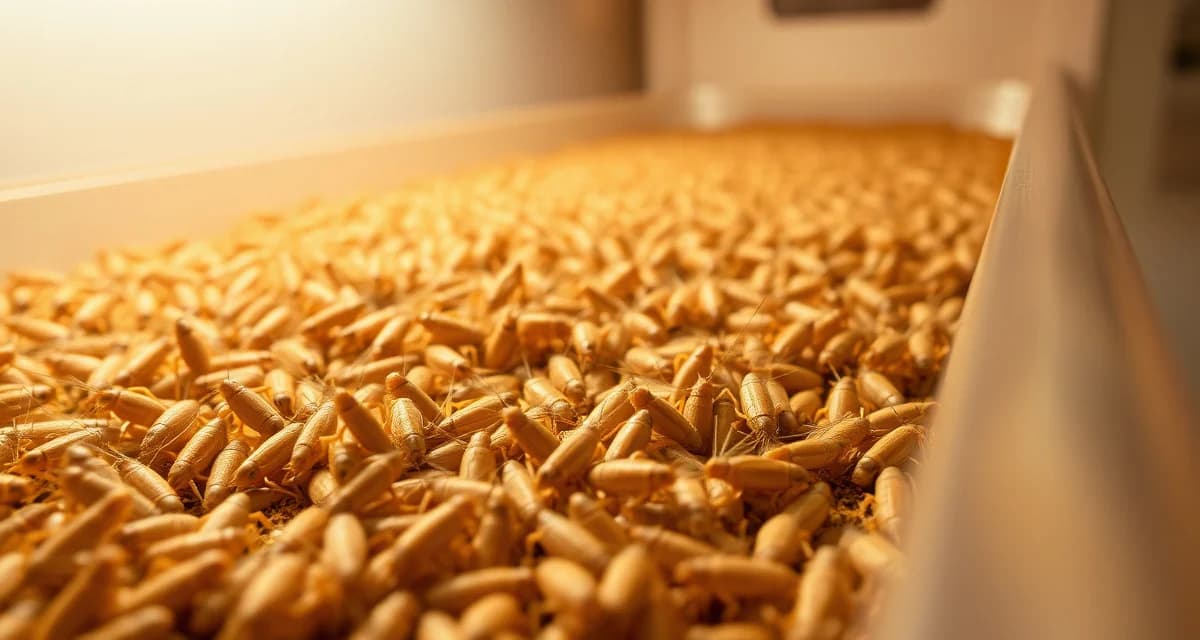
Optimal Temperature for Pinhead Crickets: Maximizing Early-Stage Survival
Pinhead crickets are where most farms lose the most money without knowing it. The die-offs happen quietly, a few percent here, a few percent there, before anyone thinks to look at the temperature log. But pinhead crickets (instars 1-2) require 88-92°F for optimal survival, and temperatures below 82°F increase mortality by more than 50%. That's not a minor management detail. That's the margin between a profitable batch and a failed one.
If you've written off early-stage losses as "just part of farming crickets," this guide will change how you think about those first two weeks of a bin's life.
TL;DR
- But pinhead crickets (instars 1-2) require 88-92°F for optimal survival, and temperatures below 82°F increase mortality by more than 50%
- At 90°F, instars 1-2 progress to instar 3 in roughly 7-10 days
- Drop to 82°F and that stretches to 14+ days, sometimes more
- Above 94°F becomes dangerous
- If you have the space, a separate small room with its own thermostat set to 90°F is the most effective approach
- This lets you run your main room at 84-86°F for adults while providing 90-92°F at the bin level for pinheads
- They're efficient for small zones and allow precise targeting of pinhead bins without heating the entire room to 90°F
88°F is the minimum for good development rates.
- You may not see mass die-offs, but your yield numbers will start quietly eroding.
90°F is the optimal midpoint.
- Growth rates peak, feed conversion in early instars is best, and stress mortality is minimal in well-managed bins.
92°F is the upper practical limit.
- High heat plus low humidity is a quick route to dehydration die-offs in pinheads.
Above 94°F becomes dangerous.
Why Pinheads Need More Heat Than Adults
This surprises a lot of first-time cricket farmers. You'd think the biggest crickets would need the most energy from their environment. But insect thermoregulation doesn't work that way.
Pinhead crickets have an extremely high surface-area-to-volume ratio. They lose heat to the environment much faster than adult crickets do. At the same ambient temperature, a pinhead cricket's body temperature drops closer to room temperature than an adult's does. They need a warmer room just to maintain the metabolic rate necessary for growth.
Beyond survival, temperature directly affects the speed of early development. At 90°F, instars 1-2 progress to instar 3 in roughly 7-10 days. Drop to 82°F and that stretches to 14+ days, sometimes more. Slower development means more days of exposure during the most vulnerable phase, higher feed consumption for no additional gain, and a batch that reaches harvest size later than projected.
The Target Range: 88-92°F
This is the sweet spot for Acheta domesticus pinheads. Break it down:
88°F is the minimum for good development rates. Below this, you'll see slower growth and increasing stress mortality, especially at the cluster level. You may not see mass die-offs, but your yield numbers will start quietly eroding.
90°F is the optimal midpoint. Growth rates peak, feed conversion in early instars is best, and stress mortality is minimal in well-managed bins.
92°F is the upper practical limit. Above this, you start to see heat stress indicators, especially if humidity is not well managed. High heat plus low humidity is a quick route to dehydration die-offs in pinheads.
Above 94°F becomes dangerous. Early-instar mortality climbs sharply. If you're seeing hot spots in your bin room, your pinhead trays should be nowhere near them.
Common Heat Sources for Pinhead Bins
Most cricket farms don't run separate climate zones for pinheads, but the ones with the lowest early-stage mortality rates usually do. Options:
Dedicated Pinhead Room or Zone
If you have the space, a separate small room with its own thermostat set to 90°F is the most effective approach. You're not fighting the temperature differential between pinhead needs and adult needs in the same air space.
Under-bin Heat Mats
Seedling heat mats placed under trays or bins can add 5-8°F of local warmth above ambient room temperature. This lets you run your main room at 84-86°F for adults while providing 90-92°F at the bin level for pinheads. Monitor carefully, heat mats can create hot spots if the mat is warmer than the surface temperature suggests.
Radiant Heat Panels
Mounted overhead, radiant panels heat objects rather than air. They're efficient for small zones and allow precise targeting of pinhead bins without heating the entire room to 90°F. The upfront cost is higher, but energy efficiency compensates over time.
Heat Lamps
The farm store staple. Effective, cheap, and easy to adjust. The risk is inconsistency. A heat lamp creates a gradient: very warm directly below, cooler at the edges. Pinheads will cluster under the warmest point, which can be fine or problematic depending on bin design.
See cricket farm temperature guide for a full comparison of heating equipment and cost data.
Maintaining Stable Temperature
Temperature spikes and crashes are more damaging to pinheads than a constant temperature at the lower end of the acceptable range. Stability matters.
Key practices:
Check the actual bin temperature, not just the room thermostat. If your thermostat is 8 feet off the floor and your pinhead trays are at floor level in a room with poor air circulation, the trays may be 5-8°F cooler than what the thermostat reads. Verify with a probe thermometer at bin level.
Protect against overnight drops. Ambient temperature drops overnight in most farm facilities, even heated ones. Set thermostat setpoints to account for overnight differentials. If your daytime setpoint is 90°F and you expect a 4°F overnight drop in room temperature, set your heating target at 92°F so that the floor-level pinhead temperature doesn't crash below 88°F.
Watch door drafts. Opening a farm room door to the outside pulls cold air across the floor. If your pinhead trays are near the door or at floor level near an exterior wall, that cold draft event can crash your pinhead temperature by 5-10°F in minutes. Brief, but enough to stress early instars.
Use redundant thermometers. At least one probe thermometer at bin level for every zone where pinheads are housed. Cross-check it against your thermostat regularly.
What the Acheta Domesticus Lifecycle Tells Us
The pinhead stage corresponds to the period immediately post-hatch when energy reserves are at their absolute minimum. A first-instar cricket hatches with essentially no body fat reserve. It must eat and drink within hours of hatching, and it must maintain metabolic function in the meantime.
Any temperature below the developmental threshold doesn't just slow growth, it forces the cricket to burn metabolic reserves faster to maintain basic function. A pinhead cricket at 80°F isn't comfortably growing slowly. It's fighting to stay alive and losing.
Understanding the full Acheta domesticus lifecycle helps you see why the pinhead phase deserves its own temperature protocol rather than being lumped in with general farm temperature management.
Signs of Temperature Stress in Pinheads
Early-instar crickets don't give you loud warning signals. By the time you see mass die-offs, the event is already over. Watch for:
- Slow movement across the bin. Pinheads at 90°F are active and fast. Sluggish pinheads are cold pinheads.
- Clustering behavior. Pinheads piling on top of each other, particularly in a corner or against a wall, are seeking shared warmth.
- Failure to eat. Check feed consumption in your youngest bins daily. A tray of pinheads at proper temperature will show obvious feed depletion within 24-48 hours.
- Abnormally low bin count at the day 7-10 check. If you know your hatch rate from incubation, you can estimate expected pinhead count at the first week mark. Numbers well below expectation usually point to either a temperature problem or a humidity problem.
Frequently Asked Questions
What temperature do pinhead crickets need to survive?
Pinhead crickets (instars 1-2) need a minimum of 82°F to avoid severe stress mortality, but 88-92°F is the recommended range for healthy development. Below 82°F, mortality increases by 50% or more. The ideal target is 90°F, which optimizes both survival rate and developmental speed.
How do I keep pinhead crickets warm enough in a multi-bin farm?
The most practical approach for most operations is a combination of setting your bin room temperature to the high end of your adult range (84-86°F) and using under-bin heat mats or overhead radiant panels to bring pinhead bin temperature up to 88-92°F. A dedicated pinhead room with its own thermostat is the most effective long-term solution if your volume justifies it.
What is the biggest cause of pinhead cricket mortality?
Temperature is the leading cause. Either direct cold stress mortality, or the secondary effects of cold stress, including dehydration (cold plus low humidity is especially deadly), reduced immune function, and inability to compete for resources within the bin. The second most common cause is drowning from inappropriate hydration methods. Pinheads require water gel or equivalent, never open water.
How do I recover a cricket bin after an accidental temperature spike?
First, restore the target temperature for that life stage immediately. Remove any dead crickets to prevent ammonia buildup and monitor the bin closely for the next 48-72 hours. If you see continued elevated mortality, assess whether the colony has enough healthy population to recover or whether early harvest is the better option. Maintaining a detailed temperature log makes it easier to understand how severe the event was and adjust heating protocols to prevent a repeat.
What is the best way to measure temperature inside a cricket bin accurately?
A digital probe thermometer placed at mid-bin height, away from heating elements and exterior walls, gives the most representative reading for the cricket population's actual environment. Infrared (non-contact) thermometers measure surface temperature only and frequently give misleading readings in bin environments. Data-logging sensors that record continuously are preferable to manual spot-checks, since swings between readings can go undetected.
How much does electricity cost to maintain target temperatures in a cricket facility?
Energy cost varies significantly by facility size, climate, and insulation quality. A well-insulated small operation (under 30 bins) in a moderate climate typically adds $40-$80/month to electricity costs for heating. Larger commercial facilities in cold climates can spend $300-$800/month or more during winter months. Improving building insulation is usually the highest-ROI investment for reducing heating costs compared to upgrading heating equipment.
Sources
- Food and Agriculture Organization of the United Nations (FAO) -- Edible Insects: Future Prospects for Food and Feed Security
- North American Coalition for Insect Agriculture (NACIA)
- Entomological Society of America
- University of Florida IFAS Extension -- Entomology and Nematology Department
- USDA Agricultural Research Service
Get Started with CricketOps
Maintaining the right environmental conditions in a cricket facility depends on having reliable data -- not just what your thermostat is set to, but what temperatures your bins actually experienced overnight and over the past week. CricketOps connects to temperature and humidity sensors, logs readings by bin, and alerts you when conditions drift outside your set thresholds. Try CricketOps and build the environmental record your operation needs.