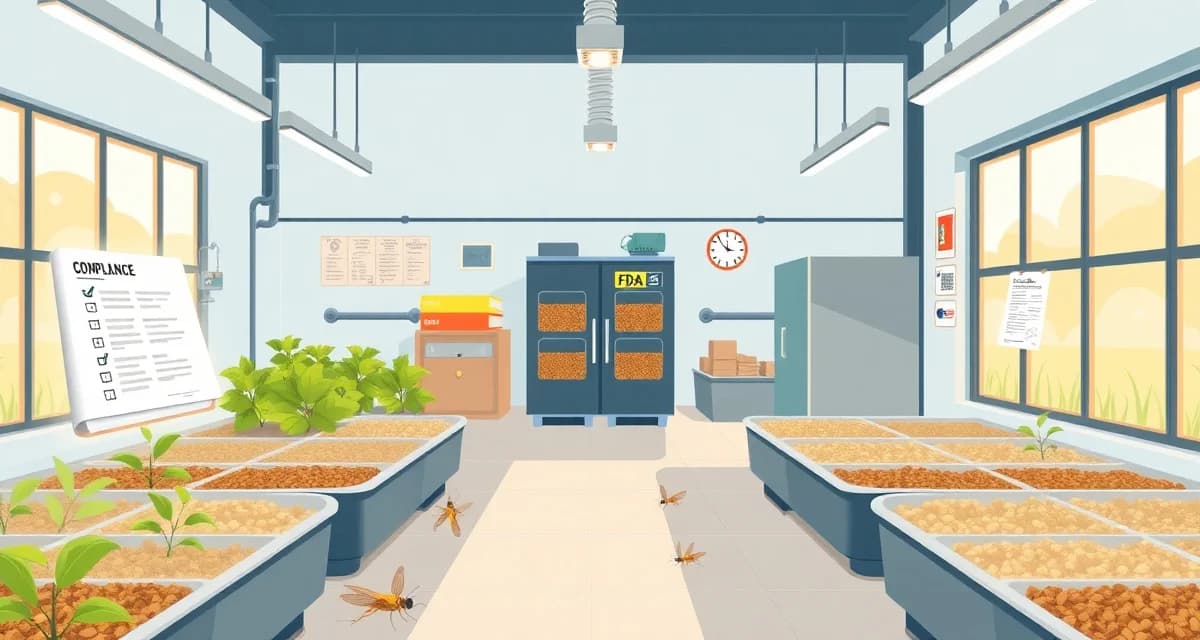
Cricket Farm Compliance Overview: Regulations Every Producer Should Know
A cricket flour producer who ships across state lines is subject to FDA food facility registration requirements. That's federal law, not an optional best practice. And yet a large share of small cricket flour operations are selling interstate without this registration. They're not avoiding it deliberately. They just never encountered a clear, plain-language explanation of what they're required to do.
Compliance content for cricket farms is buried in lengthy FDA guidance documents written for lawyers and large food companies, not for small farm operators. This guide pulls out the five most important compliance actions in order of legal urgency, with plain-language explanations of what each one means for your specific operation.
TL;DR
- What it is: Federal law (FDA Food Safety Modernization Act, Section 415) requires any facility that manufactures, processes, packs, or holds food for human consumption in the US to register with the FDA
- It's free and takes about 30 minutes
- After registration: You have ongoing obligations including FSMA compliance (see #2) and the ability to suspend your registration if FDA has reason to believe your facility poses a serious public health threat
- Who it applies to: All registered food facilities, with some exemptions for very small facilities (less than $1M in annual sales AND a qualified facility exemption)
- Feeder cricket producers (selling to pet stores, reptile owners)
- Cricket flour and food ingredient producers (selling for human consumption)
- Register at the FDA's registration portal (registrar.fda.gov). It's free and takes about 30 minutes. Registration renews every two years
The 5 Most Important Compliance Actions in Order of Legal Urgency
1.
- The Preventive Controls Alliance (formerly Michigan State University food safety group) provides free and low-cost training specifically for small food facilities.
3.
- A cricket flour producer who ships across state lines is subject to FDA food facility registration requirements.
- And yet a large share of small cricket flour operations are selling interstate without this registration.
- They just never encountered a clear, plain-language explanation of what they're required to do.
- Compliance content for cricket farms is buried in lengthy FDA guidance documents written for lawyers and large food companies, not for small farm operators.
- You're not producing for human consumption, so FDA food facility registration doesn't apply.
Who This Applies To
The compliance requirements you face depend on what you're producing and how you're selling it.
Feeder cricket producers (selling to pet stores, reptile owners): The lightest regulatory burden. You're not producing for human consumption, so FDA food facility registration doesn't apply. You may still need state agriculture permits and local business licenses, and some states require permits for commercial insect production regardless of market.
Cricket flour and food ingredient producers (selling for human consumption): FDA food facility registration and FSMA Preventive Controls for Human Food apply. This is the category with the most extensive compliance obligations.
Both: If you do both feeder and food-grade production from the same facility, your compliance requirements are governed by the food-grade side. You need to manage both product streams without cross-contamination issues.
The 5 Most Important Compliance Actions in Order of Legal Urgency
1. FDA Food Facility Registration (If Selling Food Ingredients)
What it is: Federal law (FDA Food Safety Modernization Act, Section 415) requires any facility that manufactures, processes, packs, or holds food for human consumption in the US to register with the FDA.
Who it applies to: If you produce cricket flour, whole roasted crickets, or any cricket-derived food product and sell it, you need to register. This applies to home-based operations selling online and to commercial facilities.
Why it's urgent: Operating a food facility without registration is a federal violation. More practically, it means you're not in compliance with FSMA, which makes everything else downstream harder.
How to register: Register at the FDA's registration portal (registrar.fda.gov). It's free and takes about 30 minutes. Registration renews every two years.
After registration: You have ongoing obligations including FSMA compliance (see #2) and the ability to suspend your registration if FDA has reason to believe your facility poses a serious public health threat.
2. FSMA Preventive Controls for Human Food
What it is: Under FSMA, registered food facilities are required to have a written food safety plan, conduct a hazard analysis, implement preventive controls, monitor those controls, and maintain records.
Who it applies to: All registered food facilities, with some exemptions for very small facilities (less than $1M in annual sales AND a qualified facility exemption). Check your specific eligibility for the qualified facility exemption.
What a food safety plan includes:
- Hazard analysis (identifying potential biological, chemical, and physical hazards in your process)
- Preventive controls (steps to prevent or reduce each identified hazard to an acceptable level)
- Monitoring procedures (how you check that controls are working)
- Corrective actions (what you do when monitoring shows a control isn't working)
- Verification (how you confirm the plan is effective)
- Records documenting all of the above
How to get there: FDA offers free FSMA training resources for small producers. The Preventive Controls Alliance (formerly Michigan State University food safety group) provides free and low-cost training specifically for small food facilities.
3. State Agriculture Permit
What it is: Most states require a permit or registration for commercial livestock or food production operations. How crickets are classified (livestock, aquaculture, or other) varies by state.
Who it applies to: Any commercial cricket producer, regardless of whether they're food-grade.
Why it's urgent: Producing commercially without the required state agriculture permit can result in enforcement action, fines, or required cessation of production.
How to find your requirement: Contact your state department of agriculture and ask specifically about commercial insect production licensing. Some states have clear answers; others are still figuring it out. Get the answer in writing.
4. State Food Processing License (If Processing for Human Consumption)
What it is: Separate from your state agriculture permit, most states require a food processing facility license if you're manufacturing food products for human consumption and sale.
Who it applies to: Cricket flour producers, processed food makers using cricket protein as an ingredient.
What it typically involves: A facility inspection by state agriculture or health department inspectors, documentation of your food safety program, and ongoing inspection requirements (usually annual).
5. Cricket Flour Labeling Requirements
What it is: Federal food labeling requirements apply to any packaged food product sold commercially.
Key requirements for cricket flour:
Ingredient declaration: "Cricket flour" or "whole cricket flour" as the ingredient name. If your product has multiple ingredients, list in descending order by weight.
Allergen declaration: Crickets are cross-reactive with shellfish allergens. The FDA has not yet mandated cricket as a labeled major allergen (shellfish is, but insects are in a different regulatory category), but responsible labeling practice includes a statement like "May contain: Tree nuts, Shellfish" or specifically noting cross-reactivity for shellfish-allergic consumers. This is both a legal exposure management question and an ethical one.
Net weight: Must be declared in US Customary and metric units.
Nutrition facts panel: Required for most packaged foods sold commercially, following FDA format.
Business contact information: Manufacturer name and address.
What Permits and Registrations Does a Cricket Farm Need?
Summary by operation type:
| Operation Type | FDA Registration | FSMA | State Ag Permit | State Food License |
|---------------|-----------------|------|-----------------|-------------------|
| Feeder only | No | No | Likely yes | No |
| Cricket flour (in-state only, small volume) | May qualify for exemption | Check exemption | Yes | Yes |
| Cricket flour (interstate) | Yes | Yes | Yes | Yes |
| Both feeder + flour | Yes (for flour) | Yes (for flour) | Yes | Yes |
Do I Need to Register with the FDA to Sell Cricket Flour?
Yes, if you're shipping across state lines. FDA food facility registration is required for any facility manufacturing, processing, packing, or holding food for interstate commerce. Even if you're a small operation, if you're selling on Shopify and shipping to customers in other states, that's interstate commerce.
The qualified facility exemption may apply if your total annual food sales are under $1 million AND more than half of your food sales are directly to consumers or to restaurants or retail establishments in the same state or within 275 miles of your facility. If you qualify, you still have food safety obligations but reduced requirements compared to a fully registered facility.
For the detailed compliance checklist mapped to your specific situation, see the FDA compliance checklist for cricket flour. For ongoing record-keeping that supports compliance documentation, the cricket farm management platform generates batch records and operational documentation that maps to FSMA requirements.
FAQ
What permits and registrations does a cricket farm need?
At minimum: a local business license (all operations), a state agriculture permit (most states, feeder and food-grade), and for food-grade production, FDA food facility registration plus a state food processing license. The specific combination depends on your state and what you're producing. Contact your state department of agriculture to confirm what's required in your jurisdiction.
Do I need to register with the FDA to sell cricket flour?
Yes, if you're selling across state lines. FDA food facility registration is federally required for facilities that manufacture or process food for interstate commerce. Registration is free and done online. If all your sales are in-state and you meet the qualified facility exemption thresholds (under $1M annual food sales, majority of sales local), you may have reduced FSMA requirements, but you should verify this with FDA guidance or a food safety consultant.
What labeling is required on cricket flour products?
At minimum: the ingredient declaration (cricket flour or whole cricket flour), net weight in US Customary and metric, a nutrition facts panel, business name and address, and allergen information addressing cross-reactivity with shellfish allergens. Check FDA's updated labeling guidance for any changes to insect allergen declaration requirements, as this regulatory area is actively developing. Voluntary disclosure of shellfish cross-reactivity is strongly recommended regardless of current mandatory requirements.
Do federal regulations differ from state regulations for cricket farming?
Yes. Federal oversight of insect production for human food falls primarily under FDA authority, including Food Safety Modernization Act (FSMA) requirements. State regulations vary widely -- some states have specific insect production permits, others treat cricket farming under broader agricultural licensing frameworks. Operations selling across state lines must comply with both their state of production and the destination state's requirements. Check with your state department of agriculture and an attorney familiar with food law for current requirements.
What documentation should I keep to demonstrate regulatory compliance?
Maintain records of feed ingredient sourcing with supplier documentation, batch production records, environmental monitoring logs (temperature, humidity), mortality records, sanitation logs, and any third-party audit results. Buyers from food manufacturing companies increasingly require these records as part of their supplier qualification process, so keeping them organized from the start saves significant effort later.
How often should a cricket farm conduct internal food safety audits?
A minimum of one formal internal audit per quarter is a reasonable starting point for a commercial operation. The audit should cover environmental monitoring records, sanitation log completeness, pest control documentation, and critical control point records for your HACCP plan. Operations seeking third-party certification (SQF, BRC, or similar) should align internal audit frequency and format with the standard's requirements.
Sources
- Food and Agriculture Organization of the United Nations (FAO) -- Edible Insects: Future Prospects for Food and Feed Security
- North American Coalition for Insect Agriculture (NACIA)
- U.S. Food and Drug Administration (FDA) -- Food Safety Modernization Act (FSMA)
- USDA National Organic Program
- Global Food Safety Initiative (GFSI)
Compliance Before Commerce
The farmers who get compliance in order before they start selling are the ones who build durable businesses. The ones who sell first and figure out compliance later often face forced changes to their operations that are more expensive and disruptive than doing it right from the start.
Start with your state agriculture permit and FDA food facility registration (if food-grade). Get those in place before your first commercial sale. Build your food safety plan with whatever production scale you have. And treat compliance documentation not as overhead but as the foundation of a business that can sell to serious buyers, pass audits, and grow with confidence.
Get Started with CricketOps
Maintaining organized compliance records is much easier when you build the system from day one rather than reconstructing it before an audit. CricketOps keeps your batch records, environmental monitoring logs, and traceability data in one place so that responding to a buyer documentation request or a regulatory inquiry does not require hunting through spreadsheets and paper files.