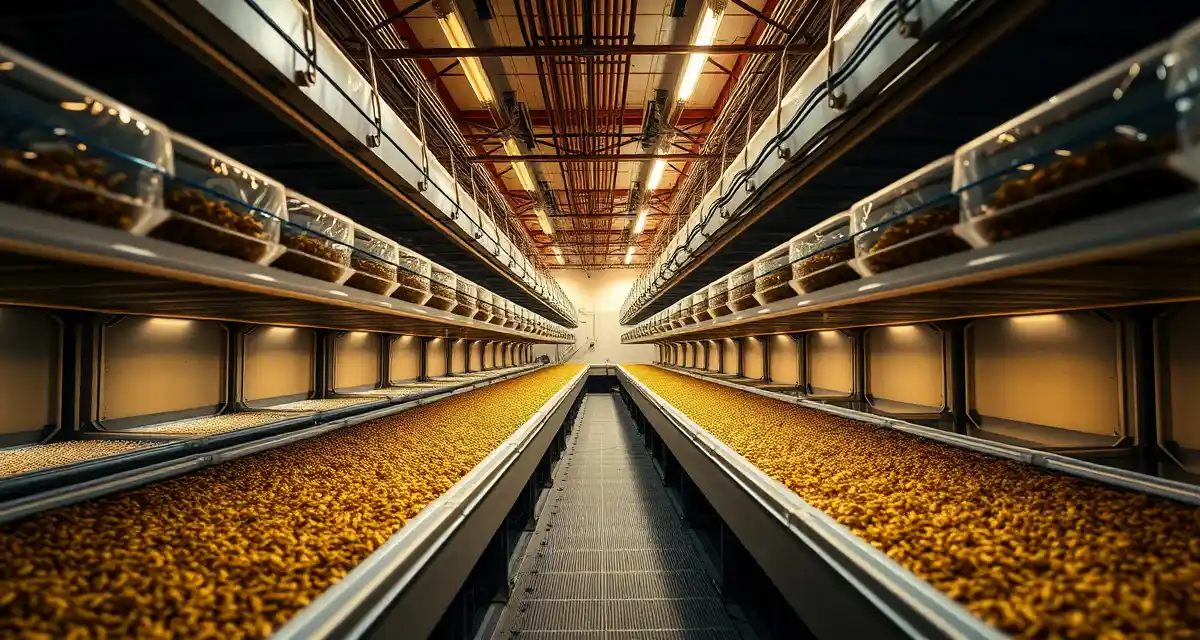
Cricket Farming in Oregon: Pacific Northwest Challenges and Portland Market
Portland-area specialty food stores report the highest per-store cricket flour sales of any US metro outside San Francisco. That's the market signal that makes Oregon worth serious consideration for cricket protein producers, even though the Pacific Northwest climate creates genuine management challenges around moisture and temperature.
TL;DR
- Portland averages 36 inches of annual rainfall, but the real challenge for cricket farms is the ambient humidity: western Oregon averages 75-85% RH for much of the year.
- High desert, low humidity (30-50% RH), cold winters (Bend Zone 5, averages 20°F January low), and dry summers.
- Size your dehumidifier for 70-90 pint/day capacity for a 500 sq ft facility, with continuous drain connection.
- At 5-10 bins, problems are manageable.
- At 30-50 bins, the same proportional problems represent much larger financial losses.
- ODA animal identification and registration.
- Department of Consumer and Business Services.
Oregon Regulations for Cricket Farming
Cricket farming in Oregon falls under the Oregon Department of Agriculture (ODA).
Key requirements:
- ODA animal identification and registration: Oregon commercial cricket operations register with ODA's Animal Health and Identification Division.
- ODA Food Safety Division license: Required for any facility producing or packaging cricket products for human consumption.
- Department of Consumer and Business Services: May have additional food manufacturing facility requirements.
- Local county permits: Oregon's counties (particularly Washington, Multnomah, and Clackamas counties in the Portland metro) have individual food manufacturing and agricultural permit processes.
- Federal FSMA compliance: Required for interstate cricket flour shipments.
Contact ODA for current requirements, as Oregon has been updating its agricultural regulations to address the growing insect farming sector. See cricket farm zoning and permits guide for national context and humid-climate-cricket-farming for the Pacific Northwest climate management guide.
Managing Oregon's Climate
Oregon's climate varies dramatically from west to east:
Western Oregon (Portland, Salem, Eugene, Zone 7-8): The marine climate west of the Cascades is characterized by mild temperatures (40-60°F in winter, 65-80°F in summer) and persistent moisture. Portland averages 36 inches of annual rainfall, but the real challenge for cricket farms is the ambient humidity: western Oregon averages 75-85% RH for much of the year.
This means:
- Dehumidification is required year-round, not just in summer
- Mold management is the primary environmental challenge
- Year-round heating is needed (outdoor temperatures are consistently 10-25°F below your 88°F target)
- Summer cooling is minimal, Portland rarely exceeds 85°F outdoors
Eastern Oregon (Bend, La Grande, Zone 4-6): East of the Cascades, Oregon is a completely different environment. High desert, low humidity (30-50% RH), cold winters (Bend Zone 5, averages 20°F January low), and dry summers. The challenge here is active humidification and cold climate heating, the opposite of western Oregon.
Oregon's Farm-to-Table Culture
Portland has one of the strongest farm-to-table food cultures in the United States. The characteristics that make it a strong market for cricket protein:
- Local sourcing premium: Portland restaurants and retailers actively seek and pay premium for locally-produced food products. A Portland-area cricket farm benefits from this sourcing priority.
- First-mover history: Portland farmers' markets were among the first in the US to accept cricket flour as a vendor category, establishing early consumer familiarity with the product.
- Environmental values: Oregon's environmentally conscious consumer culture aligns well with the sustainability narrative of insect protein.
- Specialty retail density: The Portland metro has the highest density of specialty and natural food retailers per capita among US mid-size cities.
Beyond Portland, Eugene's University of Oregon creates research demand, and the Willamette Valley's food innovation scene has been growing.
Eastern Oregon opportunity: Bend's growth as a food and outdoor culture hub has created a premium specialty food market comparable to Boulder, Colorado. Eastern Oregon farms could supply both Bend's local market and Portland via I-84.
Track your Oregon operation's environmental monitoring and compliance records in CricketOps.
Frequently Asked Questions
What does Oregon require to operate a cricket farm?
Oregon cricket farms register with ODA's Animal Health and Identification Division and require an ODA Food Safety Division license for human food production. Local county permits apply, particularly in the Portland metro counties. Contact ODA for current registration requirements.
How do I manage high humidity in an Oregon cricket farm?
Western Oregon cricket farms need continuous dehumidification year-round, not just in summer. Size your dehumidifier for 70-90 pint/day capacity for a 500 sq ft facility, with continuous drain connection. Use water gel rather than fresh vegetables as your primary hydration source to minimize additional moisture input. Increase bin cleanout frequency compared to temperate climate baselines. Ventilate for ammonia control, but carefully, western Oregon outdoor air is already at 75-85% RH and every air exchange imports moisture.
Is Portland a good market for selling cricket flour?
Portland is one of the best US markets for locally-produced cricket flour. Per-store cricket flour sales at Portland specialty retailers are among the highest in the US outside San Francisco. The combination of Portland's farm-to-table culture, environmental consumer values, premium local food spending, and early familiarity with cricket products (Portland farmers' markets adopted cricket vendors early) makes it a genuinely strong market. The main production challenge is managing western Oregon's moisture, but the market premium you can command helps offset the higher management costs.
How does CricketOps help track the metrics described in this article?
CricketOps provides bin-level logging for the variables that drive production outcomes -- feed inputs, environmental conditions, mortality events, and harvest results. Rather than maintaining these records in separate spreadsheets, you can view performance trends across bins and over time to identify which operational variables correlate with better outcomes in your specific facility.
Where can I find industry benchmarks to compare my operation's performance?
The North American Coalition for Insect Agriculture (NACIA) publishes periodic industry reports with production benchmarks. University extension programs in agricultural states, including the University of Georgia and University of Florida IFAS, occasionally publish insect farming production data. Industry conferences hosted by the Entomological Society of America and the Insects to Feed the World symposium series are additional sources of peer benchmarking data.
What is the biggest operational mistake cricket farmers make in their first year?
Expanding bin count before achieving consistent FCR and mortality targets in existing bins is the most common and costly first-year mistake. At 5-10 bins, problems are manageable. At 30-50 bins, the same proportional problems represent much larger financial losses. Most experienced cricket farmers recommend holding expansion until you have three consecutive production cycles hitting your FCR and mortality targets.
Sources
- Food and Agriculture Organization of the United Nations (FAO) -- Edible Insects: Future Prospects for Food and Feed Security
- North American Coalition for Insect Agriculture (NACIA)
- Entomological Society of America
- University of Georgia Cooperative Extension
- Journal of Insects as Food and Feed (Wageningen Academic Publishers)
Get Started with CricketOps
The practices covered in this article are easier to apply consistently when they are supported by organized production data. CricketOps gives cricket farmers the tools to track what matters -- by bin, by batch, and over time. Start your next production cycle in CricketOps and see how organized data changes the way you manage your operation.