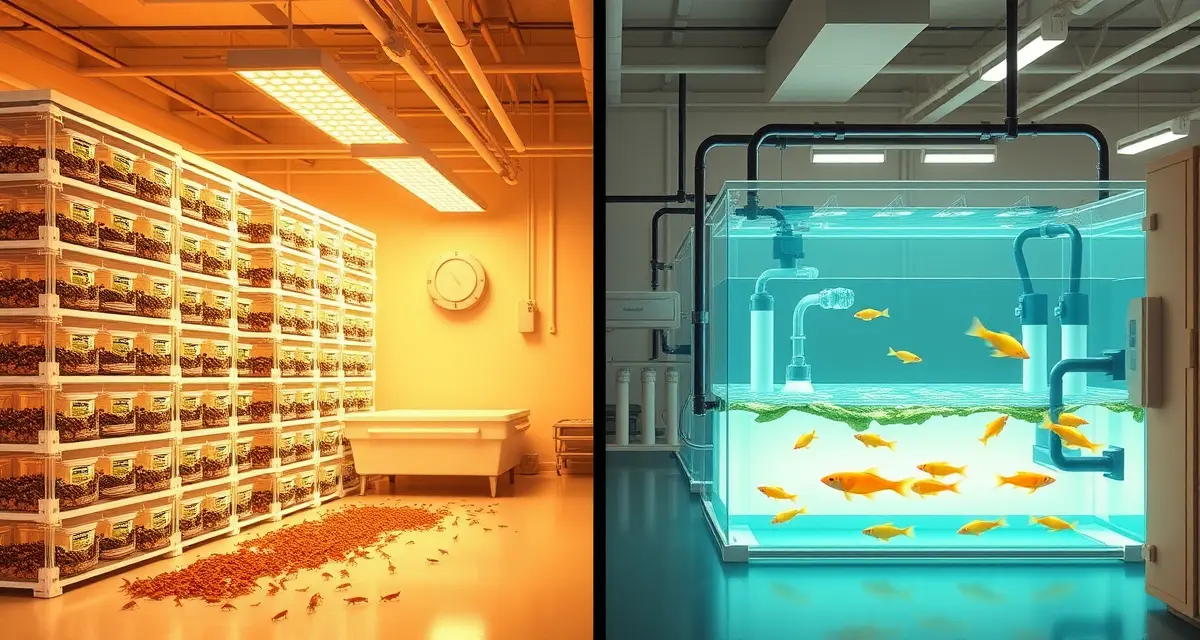
Insect Farming vs Aquaculture: Comparing Investment and Returns
Alternative protein is attracting serious investment. Farmers and investors alike are evaluating which systems deliver real returns, not just theoretical sustainability wins. Two options keep coming up side by side: insect farming (particularly cricket operations) and aquaculture (particularly recirculating aquaculture systems, or RAS).
The insect farming vs aquaculture comparison barely exists in written form. This guide fills that gap, with real numbers on capital requirements, water use, regulatory burden, and profit potential.
Start with this: a 50-bin cricket farm requires 100x less water than an equivalent-output tilapia farm. That's not a rounding difference. It shapes where each business can operate, what it costs to run, and how exposed you are to input price risk.
TL;DR
- Start with this: a 50-bin cricket farm requires 100x less water than an equivalent-output tilapia farm.
- A 50-bin cricket operation can be launched for $10,000-$20,000.
- You can scale modularly, add 10 bins, see what the economics look like, add 10 more.
- A 50-bin cricket farm producing equivalent protein output uses a fraction of that.
- We're not talking about 10% less water.
- This matters for three reasons:
- Location constraints: Aquaculture requires reliable, affordable water access.
- Cricket farming doesn't.
- Operational cost: Water utility bills and wastewater handling are real costs in aquaculture.
- They're negligible in cricket farming.
- Drought risk: Climate change is making water access harder in many US regions.
- Location constraints: Aquaculture requires reliable, affordable water access.
- Cricket farming doesn't.
- Operational cost: Water utility bills and wastewater handling are real costs in aquaculture.
- They're negligible in cricket farming.
- Drought risk: Climate change is making water access harder in many US regions.
- Cricket farms are almost entirely insulated from that risk.
Capital Requirements: The Startup Gap
Cricket Farming
A 50-bin cricket operation can be launched for $10,000-$20,000.
- You can scale modularly, add 10 bins, see what the economics look like, add 10 more.
TL;DR Verdict
| Factor | Cricket Farming (50-bin) | Aquaculture (RAS Tilapia) |
|---|---|---|
| Startup capital | $10,000-$20,000 | $50,000-$250,000+ |
| Water use (relative) | Very low | Very high |
| Time to first revenue | 8-12 weeks | 6-18 months |
| Protein price/lb | $8-$40 (food grade) | $2-$5 (tilapia whole) |
| Regulatory burden | Moderate | High |
| Payback period | 18-36 months | 3-7 years |
| Scale ceiling | High (modular) | High (but capital intensive) |
Cricket farming has a dramatically lower capital barrier and faster payback. Aquaculture has more established institutional buyers at large scale.
The Water Problem No One Talks About
Water is the hidden variable that makes this comparison more interesting than it looks.
A recirculating tilapia system producing 10,000 pounds of fish per year needs tens of thousands of gallons of water in the system at any time, even with recirculation, evaporation and water quality management create ongoing water demand. A 50-bin cricket farm producing equivalent protein output uses a fraction of that. We're not talking about 10% less water. We're talking orders of magnitude less.
This matters for three reasons:
- Location constraints: Aquaculture requires reliable, affordable water access. Cricket farming doesn't.
- Operational cost: Water utility bills and wastewater handling are real costs in aquaculture. They're negligible in cricket farming.
- Drought risk: Climate change is making water access harder in many US regions. Cricket farms are almost entirely insulated from that risk.
Capital Requirements: The Startup Gap
Cricket Farming
A 50-bin cricket operation can be launched for $10,000-$20,000. The core costs are bins, shelving, climate control, and your initial colony. You can scale modularly, add 10 bins, see what the economics look like, add 10 more. The capital commitment at each stage is manageable.
Land requirements are minimal. A 1,000 square foot space can house a serious cricket operation. You don't need industrial water infrastructure or specialized fish-handling equipment.
Aquaculture (RAS)
A small recirculating aquaculture system producing anything meaningful starts at $50,000 and quickly scales to $250,000+ for a commercially viable operation. The tanks, filtration systems, aeration equipment, water quality monitoring, and climate systems are all capital-intensive.
You also need specialized knowledge or staff. Fish health management, water chemistry, and biosecurity in aquaculture are genuinely complex disciplines. Hiring for that expertise adds to operating costs.
The payback period for a well-run RAS tilapia operation is typically 3-7 years. For a cricket farm of comparable protein output, you're looking at 18-36 months.
Regulatory Burden: What You're Signing Up For
Cricket Farming Regulation
Cricket farming sits in an interesting regulatory space. The FDA has guidance on food-grade insect production, but the day-to-day regulatory burden for a small-to-mid-size cricket farm is manageable. If you're selling feeder insects, regulatory requirements are lighter. If you're producing cricket flour for human consumption, you'll need food safety protocols, but these are achievable without a dedicated compliance team.
State-level regulations vary, with some states requiring biocontainment plans and farm registration. But compared to aquaculture, the overall compliance infrastructure is leaner.
Aquaculture Regulation
Aquaculture, particularly anything involving live fish and water discharge, is heavily regulated at federal, state, and local levels. EPA wastewater permits, state fish and wildlife department licensing, water rights documentation, and facility inspection requirements stack up quickly.
If you want to produce any non-native fish species, the regulatory pathway is even more complex. A tilapia farm in a northern state may require specific permits just to hold the species.
The regulatory cost for aquaculture isn't just compliance time. It's legal fees, permitting delays, and the risk of a permit denial after notable capital investment.
Protein Output and Pricing
Cricket Protein Economics
Cricket protein for human consumption commands $8-$40 per pound depending on form and certification. Bulk whole dried crickets sell for $5-$12 per pound wholesale. Even at bulk pricing, the per-pound value exceeds most aquaculture species.
The cricket farming profitability guide shows that a well-run 100-bin operation can generate $50,000-$120,000 in annual revenue depending on market mix. That's a real business at a fraction of aquaculture's capital base.
Aquaculture Protein Economics
Tilapia wholesale prices have been under sustained pressure from imports, hovering at $2-$5 per pound for whole fish. Higher-value species (salmon, shrimp, sea bass) command better pricing, but require more capital, more expertise, and more regulatory navigation.
Premium positioning, organic, local, humane, can improve margins, but even premium tilapia rarely approaches the per-pound values available in cricket protein for food markets.
Risk Comparison
Disease Risk
Both operations face disease risk. Cricket farming's biggest threat is AdDNV, which can devastate a colony in days. Aquaculture faces bacterial, viral, and parasitic threats that can kill entire fish populations. Both require biosecurity investment.
Cricket disease outbreaks are faster but more contained, if you have good isolation protocols, you can lose one bin without losing the farm. Aquaculture disease events in a connected RAS system can be catastrophic.
Market Risk
Cricket protein markets are still developing. The human food market is growing but not yet at commodity scale, which means buyer concentration risk. Aquaculture has more established buyer relationships but lower prices.
Who Should Choose Cricket Farming?
Cricket farming is the better investment if you:
- Have limited startup capital ($20,000 or less to deploy)
- Want faster payback and earlier cash flow
- Operate in a water-limited region
- Want access to premium human food protein markets
- Prefer a modular, scalable operation without heavy infrastructure
Who Should Choose Aquaculture?
Aquaculture makes more sense if you:
- Have substantial capital to deploy ($100,000+)
- Already have water access and appropriate land
- Have aquaculture expertise or can hire it
- Want to supply established large-volume protein buyers
- Are in a region with strong existing aquaculture buyer networks
FAQ
Is a cricket farm a better investment than a fish farm?
For most operators at small-to-medium scale, yes. Lower startup costs, faster time to first revenue, and higher protein pricing in food markets give cricket farming a meaningful financial edge. At very large industrial scale, aquaculture has more established buyer infrastructure, but the capital requirement is a serious barrier for most new entrants.
How does the regulatory burden of cricket farming compare to aquaculture?
Cricket farming has a lighter regulatory footprint for most operations. Aquaculture involves water discharge permits, fish and wildlife licensing, and in some cases EPA oversight, none of which apply to cricket farming. Food-grade cricket production does require FDA compliance for human consumption products, but the overall compliance infrastructure is less burdensome than aquaculture.
Which produces more protein per square foot: a cricket farm or an aquaculture system?
On a pure square footage basis, cricket farms, especially vertically stacked bin systems, compare favorably to aquaculture. RAS aquaculture uses vertical space too, but the tank and filtration infrastructure takes notable floor space. A well-designed cricket operation can produce more protein per square foot than a RAS fish farm of comparable capital cost.
How does CricketOps help track the metrics described in this article?
CricketOps provides bin-level logging for the variables that drive production outcomes -- feed inputs, environmental conditions, mortality events, and harvest results. Rather than maintaining these records in separate spreadsheets, you can view performance trends across bins and over time to identify which operational variables correlate with better outcomes in your specific facility.
Where can I find industry benchmarks to compare my operation's performance?
The North American Coalition for Insect Agriculture (NACIA) publishes periodic industry reports with production benchmarks. University extension programs in agricultural states, including the University of Georgia and University of Florida IFAS, occasionally publish insect farming production data. Industry conferences hosted by the Entomological Society of America and the Insects to Feed the World symposium series are additional sources of peer benchmarking data.
What is the biggest operational mistake cricket farmers make in their first year?
Expanding bin count before achieving consistent FCR and mortality targets in existing bins is the most common and costly first-year mistake. At 5-10 bins, problems are manageable. At 30-50 bins, the same proportional problems represent much larger financial losses. Most experienced cricket farmers recommend holding expansion until you have three consecutive production cycles hitting your FCR and mortality targets.
Sources
- Food and Agriculture Organization of the United Nations (FAO) -- Edible Insects: Future Prospects for Food and Feed Security
- North American Coalition for Insect Agriculture (NACIA)
- Entomological Society of America
- Journal of Insects as Food and Feed (Wageningen Academic Publishers)
- USDA Agricultural Research Service
The Bottom Line
Aquaculture is a proven industry with real institutional infrastructure. But for most new entrants evaluating alternative protein investments, cricket farming offers a more accessible capital requirement, faster payback, and meaningfully better per-pound pricing in food markets.
The water use comparison alone should give pause to anyone in a drought-prone region considering aquaculture. A 100x difference in water consumption isn't a minor operational detail, it's a fundamental difference in business risk.
Want to see what a cricket farm could actually return on your capital? The cricket farm profitability guide walks through the full financial model with real cost and revenue assumptions.
Get Started with CricketOps
The practices covered in this article are easier to apply consistently when they are supported by organized production data. CricketOps gives cricket farmers the tools to track what matters -- by bin, by batch, and over time. Start your next production cycle in CricketOps and see how organized data changes the way you manage your operation.