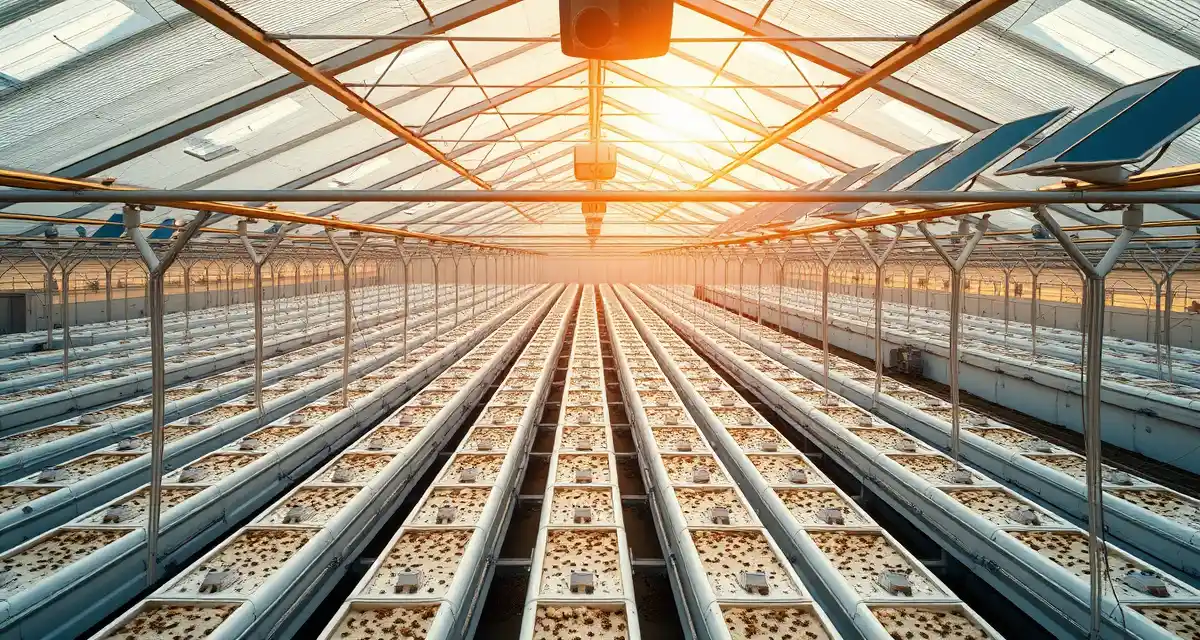
Solar Power for Cricket Farms: Reducing Energy Costs with Renewable Energy
A 50-bin cricket farm in a zone 7 climate can offset 40-60% of its energy cost with a 10kW solar system. Energy is one of the largest operating costs for an indoor cricket farm -- heating, lighting, and ventilation run year-round. Solar is one of the few capital investments that directly reduces that cost permanently.
This guide covers how to size a solar system for a cricket farm, what the ROI looks like, and how to decide between grid-tied and off-grid configurations.
TL;DR
- A 50-bin cricket farm in a zone 7 climate can offset 40-60% of its energy cost with a 10kW solar system.
- Crickets require 85-90F year-round.
- This isn't a crop that goes dormant in winter -- your production runs 365 days a year.
- Solar system sizing starts with your monthly energy consumption from your utility bills.
- Multiply by 12 for annual consumption.
- Solar production factor: In zone 7 (most of the continental US South and mid-Atlantic), a 1kW solar system produces approximately 1,200-1,400 kWh per year.
- In zone 5 (northern US), production drops to 900-1,100 kWh per year.
- The reasons:
Year-round heating. Crickets require 85-90F year-round.
- This isn't a crop that goes dormant in winter -- your production runs 365 days a year.
Ventilation. Ammonia management and CO2 control require active ventilation.
- A 30-50 bin cricket farm typically draws 1.5-3 kW on a continuous basis, with higher peaks during heating cycles.
Year-round heating. Crickets require 85-90F year-round.
- This isn't a crop that goes dormant in winter -- your production runs 365 days a year.
Ventilation. Ammonia management and CO2 control require active ventilation.
- A 30-50 bin cricket farm typically draws 1.5-3 kW on a continuous basis, with higher peaks during heating cycles.
- Annual energy cost is commonly $3,000-$8,000 for this scale.
Year-round heating. Crickets require 85-90F year-round.
- This isn't a crop that goes dormant in winter -- your production runs 365 days a year.
Ventilation. Ammonia management and CO2 control require active ventilation.
- A 30-50 bin cricket farm typically draws 1.5-3 kW on a continuous basis, with higher peaks during heating cycles.
- Annual energy cost is commonly $3,000-$8,000 for this scale.
Sizing a Solar System for Your Cricket Farm
Solar system sizing starts with your monthly energy consumption from your utility bills.
- Multiply by 12 for annual consumption.
Solar production factor: In zone 7 (most of the continental US South and mid-Atlantic), a 1kW solar system produces approximately 1,200-1,400 kWh per year.
- In zone 5 (northern US), production drops to 900-1,100 kWh per year.
System sizing formula: Annual consumption ÷ annual production per kW = kW of panels needed.
Why Cricket Farms Have High Energy Loads
Cricket farms are energy-intensive operations compared to other small agricultural businesses. The reasons:
Year-round heating. Crickets require 85-90F year-round. In any climate with seasonal temperature variation, you're running heating equipment continuously. This isn't a crop that goes dormant in winter -- your production runs 365 days a year.
Ventilation. Ammonia management and CO2 control require active ventilation. Fans and exhaust systems run constantly.
Lighting. While crickets don't require grow lights the way plants do, photoperiod matters for breeding performance. Lighting runs on a controlled schedule.
Processing equipment (integrated farms). Dryers, mills, and packaging equipment add substantial load if you're processing your own flour.
A 30-50 bin cricket farm typically draws 1.5-3 kW on a continuous basis, with higher peaks during heating cycles. Annual energy cost is commonly $3,000-$8,000 for this scale.
Sizing a Solar System for Your Cricket Farm
Solar system sizing starts with your monthly energy consumption from your utility bills. A few key inputs:
Annual kWh consumption: Find your average monthly usage from your electric bills (typically printed on the bill). Multiply by 12 for annual consumption.
Solar production factor: In zone 7 (most of the continental US South and mid-Atlantic), a 1kW solar system produces approximately 1,200-1,400 kWh per year. In zone 5 (northern US), production drops to 900-1,100 kWh per year.
System sizing formula: Annual consumption ÷ annual production per kW = kW of panels needed.
Example: A 50-bin farm using 12,000 kWh/year in zone 7 needs approximately 12,000 ÷ 1,300 = 9.2 kW of solar to fully offset consumption. A 10kW system would cover 90%+ of usage.
Not every farm needs full offset. A partial system (offsetting 40-60% of consumption) has a lower upfront cost and still delivers meaningful bill reduction. The optimal system size depends on your budget, your available roof or ground space, and your utility's net metering policy.
Grid-Tied vs Off-Grid for Cricket Farms
Grid-tied (recommended for most farms): Your solar panels connect to the grid through an inverter. When the panels produce more than you're using, the excess sells back to your utility (net metering). When you need more than the panels produce (overnight, cloudy days), you draw from the grid. You don't need batteries. This is the standard solar installation and typically has the best ROI.
Grid-tied with battery backup: Adds battery storage to provide power during grid outages. This is worth considering for cricket farms because a power outage that knocks out heating can cause rapid die-offs. A battery bank that can power your heating system for 4-8 hours buys time to resolve an outage or deploy backup generators.
Off-grid: Only viable if utility power isn't available at your farm location. Off-grid systems require measurably larger battery banks to cover overnight and cloudy-day production gaps, which substantially increases system cost.
For most cricket farms, grid-tied with a modest battery backup is the best balance of protection and cost.
ROI Calculation
Solar economics in 2026:
- Installed cost: $2.50-$3.50/watt for a commercial-quality grid-tied system, including panels, inverter, and installation. A 10kW system runs $25,000-$35,000 before incentives.
- Federal Investment Tax Credit: 30% federal tax credit reduces effective cost to $17,500-$24,500.
- Annual savings: At $0.12/kWh average rate, 12,000 kWh offset = $1,440/year. At higher commercial rates ($0.15-$0.20/kWh), savings improve proportionally.
- Payback period: $17,500-$24,500 ÷ $1,440-$2,400/year = 7-17 years at standard rates.
Solar ROI improves measurably if you're in a high-electricity-cost area (California, Northeast), have high annual consumption, or can take advantage of state-level incentives beyond the federal credit.
CricketOps tracks energy cost per pound of production, which lets you measure the direct impact of solar installation on your operational efficiency metrics.
Frequently Asked Questions
Is solar power worth it for a cricket farm?
In most cases, yes -- particularly for farms in high-electricity-cost markets or climates with high solar production potential. Cricket farms have continuous energy loads (heating, ventilation, lighting) that make them good solar candidates: the panels don't sit idle during the day while you use power only at night. The 30% federal Investment Tax Credit substantially improves the economics. Payback periods of 7-12 years are typical after the federal credit, with 25-year panel life expectancies. The risk-reduction benefit of battery backup for protecting against die-off-causing power outages adds value beyond the pure financial return.
How big a solar system do I need for a 30-bin cricket farm?
Pull your average monthly energy bill to get your monthly kWh consumption. A 30-bin operation in a typical indoor facility draws roughly 800-1,200 kWh/month (9,600-14,400 kWh/year). In a zone 6-7 climate, a 1kW solar system produces approximately 1,200-1,400 kWh/year. So a 30-bin farm needing full offset would require an 8-12 kW system. If you're targeting 50% offset (a common starting point for smaller farms), a 4-6 kW system works. Get a solar site assessment from a local installer -- they'll measure your roof or ground space, check your utility's net metering policy, and provide a site-specific size recommendation.
What is the payback period for solar panels on a cricket farm?
With the 30% federal Investment Tax Credit applied, payback periods for cricket farm solar installations typically run 7-12 years depending on system size, local electricity rates, and solar production in your climate. High-electricity-cost markets (California, New England) see faster payback -- sometimes 5-7 years. Lower-cost electricity markets (parts of the Southeast and Midwest) see longer paybacks. State incentives, local utility rebates, and accelerated depreciation for agricultural businesses can improve economics further. The 25+ year lifespan of solar panels means most installations pay back multiple times over their service life.
How does CricketOps help track the metrics described in this article?
CricketOps provides bin-level logging for the variables that drive production outcomes -- feed inputs, environmental conditions, mortality events, and harvest results. Rather than maintaining these records in separate spreadsheets, you can view performance trends across bins and over time to identify which operational variables correlate with better outcomes in your specific facility.
Where can I find industry benchmarks to compare my operation's performance?
The North American Coalition for Insect Agriculture (NACIA) publishes periodic industry reports with production benchmarks. University extension programs in agricultural states, including the University of Georgia and University of Florida IFAS, occasionally publish insect farming production data. Industry conferences hosted by the Entomological Society of America and the Insects to Feed the World symposium series are additional sources of peer benchmarking data.
What is the biggest operational mistake cricket farmers make in their first year?
Expanding bin count before achieving consistent FCR and mortality targets in existing bins is the most common and costly first-year mistake. At 5-10 bins, problems are manageable. At 30-50 bins, the same proportional problems represent much larger financial losses. Most experienced cricket farmers recommend holding expansion until you have three consecutive production cycles hitting your FCR and mortality targets.
Sources
- Food and Agriculture Organization of the United Nations (FAO) -- Edible Insects: Future Prospects for Food and Feed Security
- North American Coalition for Insect Agriculture (NACIA)
- Entomological Society of America
- University of Georgia Cooperative Extension
- Journal of Insects as Food and Feed (Wageningen Academic Publishers)
Get Started with CricketOps
The practices covered in this article are easier to apply consistently when they are supported by organized production data. CricketOps gives cricket farmers the tools to track what matters -- by bin, by batch, and over time. Start your next production cycle in CricketOps and see how organized data changes the way you manage your operation.