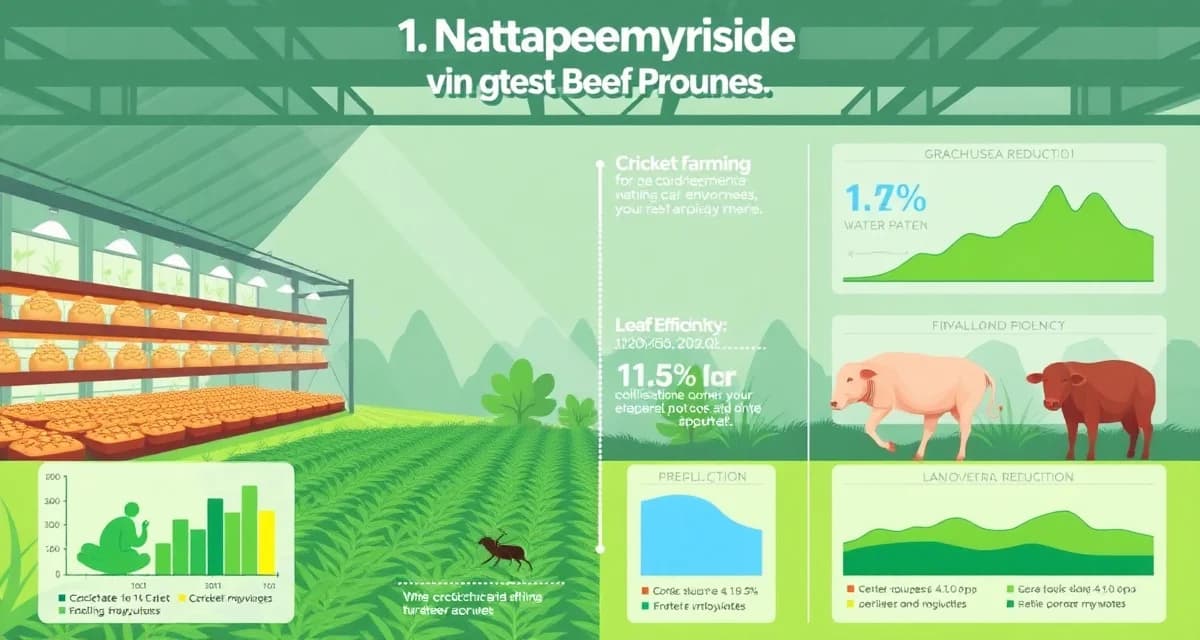
Cricket Farm Lifecycle Assessment: Environmental Impact from Cradle to Gate
Crickets produce 100x less greenhouse gas per kilogram of protein than beef under published lifecycle assessment models. That number is striking, and it's real - but the way you use it in marketing determines whether it helps your brand or creates problems when sophisticated buyers ask for the methodology behind it.
This guide covers the actual LCA data for cricket farming, where it comes from, what it means, and how to use it accurately in your sustainability marketing without overstating or misrepresenting the environmental picture.
TL;DR
- Crickets produce 100x less greenhouse gas per kilogram of protein than beef under published lifecycle assessment models.
- LCA data is not marketing copy - it's a scientific analysis that follows ISO 14040 and 14044 methodologies.
- This means LCA comparisons require context. "100x less greenhouse gas per kg of protein than beef" is true under certain model assumptions.
- The primary drivers of cricket farming GHG emissions:
- Feed production: 50-70% of total GHG footprint.
- Published figures typically show 10-20x less land per kg of protein for crickets versus beef, and 3-5x less than poultry.
- Published figures range from 10-50 liters per kg of cricket protein compared to 50-200 liters per kg for poultry and 1,700-15,000 liters per kg for beef.
- For buyers who ask for your specific LCA: you don't need to have commissioned a facility-specific LCA (which costs $5,000-20,000) for your marketing to be credible.
What a Lifecycle Assessment Is
A lifecycle assessment (LCA) is a systematic analysis of the environmental impacts associated with all stages of a product's life from raw material extraction through production, use, and disposal. For cricket farming, "cradle to gate" is the standard scope: from feed inputs through production to the point when cricket protein leaves the farm as finished product.
LCA data is not marketing copy - it's a scientific analysis that follows ISO 14040 and 14044 methodologies. The numbers you see in published comparisons are outputs of these analyses, and the specific values depend heavily on assumptions: what feed is used, what the energy mix is in the production region, how co-products are handled, and whether land use is included.
This means LCA comparisons require context. "100x less greenhouse gas per kg of protein than beef" is true under certain model assumptions. Under different assumptions (a highly efficient grass-fed beef operation in a region with low methane emissions), the ratio narrows. For marketing, use ranges from published peer-reviewed sources rather than treating single-study values as universal facts.
GHG Emissions: The Primary Sustainability Claim
Published LCA studies on Acheta domesticus production consistently find GHG emissions per kg of protein in the range of 1-5 kg CO2-equivalent, compared to 60-100 kg CO2-equivalent per kg of protein for beef.
The primary drivers of cricket farming GHG emissions:
- Feed production: 50-70% of total GHG footprint. Feed choice significantly affects this. A farm using byproduct feeds (vegetable scraps, spent grain) has a dramatically lower feed-related footprint than one using conventional grain-based commercial feed.
- Energy for temperature control: 15-30% of total footprint. Climate affects this significantly - a farm in a naturally warm climate uses less heating energy than one in a cold climate.
- Waste management: Relatively minor in cricket farming compared to conventional livestock due to small land footprint and manageable waste volumes.
For marketing: "Cricket farming produces 2-5 kg CO2-equivalent per kg of protein, compared to 60-100 kg for beef" is a defensible, sourced claim. "Crickets are 100x better for the environment than beef" is an oversimplification that invites scrutiny.
Land Use
Cricket farming's land use advantage over conventional livestock is real and consistent across published studies. Published figures typically show 10-20x less land per kg of protein for crickets versus beef, and 3-5x less than poultry.
The land use advantage comes from: high feed conversion efficiency (less feed required per unit of output), dense vertical production that doesn't require pasture or large growing areas, and feed inputs that can often use already-cultivated byproduct streams.
Important caveat: These comparisons assume conventional beef production. Grass-fed beef on non-arable land has a different land use calculation. Be careful about overstating land use benefits in marketing contexts where sophisticated buyers will probe the comparison.
Water Use
Cricket farming's water use is significantly lower than beef per unit of protein (typically 2-4x less) but comparable to or slightly higher than some plant proteins depending on production method. Published figures range from 10-50 liters per kg of cricket protein compared to 50-200 liters per kg for poultry and 1,700-15,000 liters per kg for beef.
Cricket farming's water use is modest because it doesn't require irrigation of large pastures or feed crops (assuming feed is sourced rather than grown). The water inputs are primarily drinking water and humidity management in the production facility.
Using LCA Data in Your Marketing
The cleanest way to use LCA data is with specific citations. "According to a 2023 lifecycle assessment published in the Journal of Cleaner Production, cricket farming produces approximately 2 kg CO2-equivalent per kg of protein, compared to 60-100 kg for beef." This is verifiable, specific, and defensible.
Avoid: unsourced single numbers ("crickets produce 100x less CO2"), absolute superlatives ("the most sustainable protein"), and comparisons that don't specify the baseline ("better for the environment than conventional protein").
For buyers who ask for your specific LCA: you don't need to have commissioned a facility-specific LCA (which costs $5,000-20,000) for your marketing to be credible. Reference published peer-reviewed LCAs from similar production systems. If you want to commission a facility-specific LCA to support premium claims, organizations like PRé Sustainability, Quantis, and Four Twenty Seven can provide this service.
For the industry context around sustainability positioning, see insect protein industry overview. For marketing your sustainability credentials, see cricket farm marketing guide.
Frequently Asked Questions
How does cricket farming compare to beef on greenhouse gas emissions?
Published lifecycle assessments consistently find that cricket farming produces approximately 1-5 kg CO2-equivalent per kg of protein, compared to 60-100 kg CO2-equivalent for beef. The ratio varies depending on the production system modeled, the feed inputs used, and the energy mix in the production region. The GHG advantage of cricket farming is primarily driven by insects' high feed conversion efficiency (less feed needed per kg of output) and the absence of the enteric fermentation (methane from ruminant digestion) that accounts for a large fraction of beef's climate footprint. For marketing, use published peer-reviewed LCA studies from the Journal of Insects as Food and Feed or the Journal of Cleaner Production as sources for any specific claims.
What is the water footprint of cricket farming?
Cricket farming's water use per kg of protein is significantly lower than beef (typically 10-50 liters per kg of cricket protein versus 1,700-15,000 liters per kg for beef) and broadly comparable to poultry (50-200 liters per kg). The water advantage over beef comes from not needing to irrigate large feed crop areas or maintain pastures. Cricket farming water use consists primarily of drinking water for the colony and humidity management in the production facility. Published estimates vary depending on production location and feed sourcing assumptions, so use ranges with citations when making water use claims rather than single-point figures.
Can I use LCA data in my cricket flour sustainability marketing?
Yes. Published lifecycle assessment data from peer-reviewed academic journals is the most credible basis for sustainability claims. The most defensible approach is to cite the specific study and its specific finding rather than using simplified ratios without context. "According to [citation], cricket farming produces approximately [X] kg CO2-equivalent per kg of protein, compared to [Y] for beef" is verifiable. "Cricket flour is [X] times more sustainable than beef" is a simplification that invites challenge. For more detailed sustainability positioning including how to structure claims that meet FTC green marketing guidelines, consult with a sustainability communications specialist or your legal counsel before printing label claims.
How do I identify failed egg pods before they waste incubation space?
Failed or infertile egg pods often show visible discoloration (yellowing or darkening) by days 5-7 of incubation rather than the consistent cream color of viable eggs. Some operations do a test hatch by removing a small egg sample and incubating it separately at optimal temperature for 3-4 days. Tracking hatch rates by breeding colony over time identifies which adult colonies produce the most viable eggs and which may need to be replaced.
At what life stage are crickets most vulnerable to die-offs?
The pinhead stage (days 0-7 post-hatch) carries the highest baseline mortality rate in well-managed Acheta domesticus production. Pinheads are highly susceptible to desiccation, temperature extremes, overcrowding, and starvation if feed particles are too large to consume. The second highest-risk period is the final molt from nymph to adult. Tracking mortality separately by life stage is the most direct way to identify where your losses are concentrated.
How many breeding adults are needed per production bin?
A common guideline for Acheta domesticus is maintaining one breeding bin for every 3-5 production grow-out bins, though the right ratio depends on your egg collection schedule, incubation timeline, and target stocking density. Fewer breeding bins with very productive colonies can support more grow-out bins than a larger number of low-output colonies. Tracking eggs collected per breeding colony is the data that lets you optimize this ratio.
Sources
- Food and Agriculture Organization of the United Nations (FAO) -- Edible Insects: Future Prospects for Food and Feed Security
- North American Coalition for Insect Agriculture (NACIA)
- Entomological Society of America
- Journal of Insects as Food and Feed (Wageningen Academic Publishers)
- University of Florida IFAS Extension -- Entomology and Nematology Department
Get Started with CricketOps
Optimizing your breeding program requires knowing which colonies are performing and which are not. CricketOps lets you log egg collection by colony, track hatch rates by batch, and connect breeding performance to downstream grow-out outcomes. Start tracking your breeding program in CricketOps and identify your highest-performing colonies.