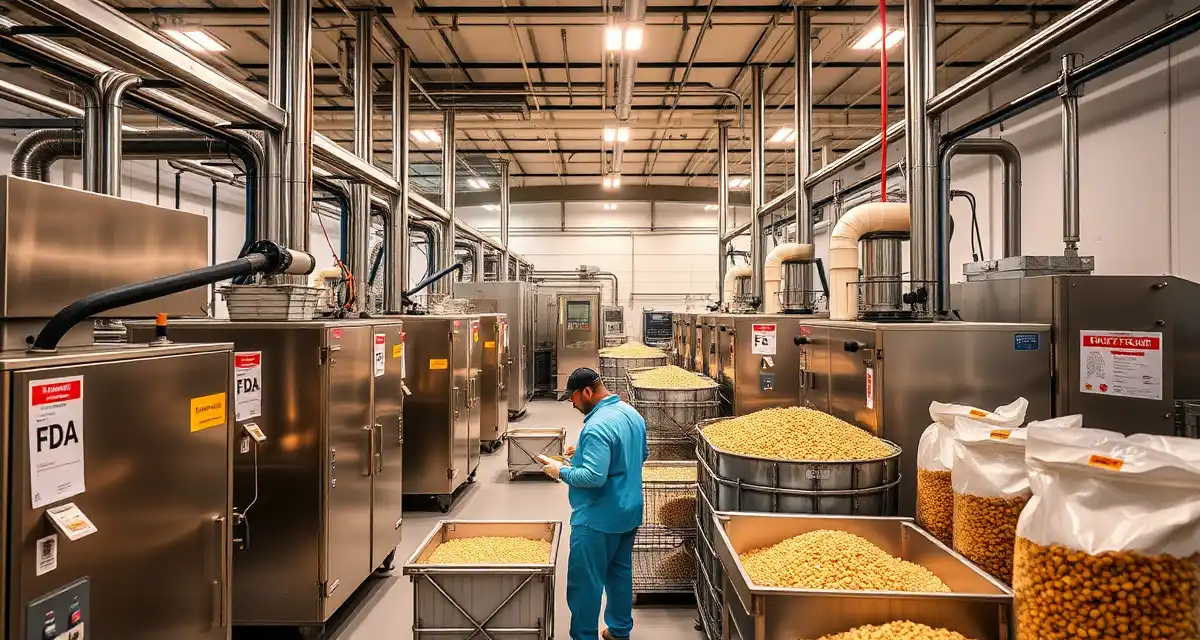
Cricket Flour Co-Packing: Using a Co-Packer to Scale Your Production
FDA requires that a co-packer processing your cricket flour be listed as a contracted facility in your food safety plan. That's the first thing to understand about co-packing: it's not just a business arrangement, it's a regulatory one. You can't simply hand your dried crickets to a toll processor and expect your food safety compliance to remain intact. The co-packer needs to be integrated into your food safety documentation.
If you've outgrown your on-farm processing capacity but aren't ready to invest in a full processing facility expansion, co-packing is the right bridge. This guide covers how to find a co-packer who can handle cricket flour, what to require from them, how to price the relationship, and how to maintain quality control through the co-packing process.
TL;DR
- Typical toll milling for dry protein ingredients runs $0.50-2.00 per pound depending on complexity and volume.
- Finishing and packaging adds $0.25-1.00 per unit.
- At 5-10 bins, problems are manageable.
- At 30-50 bins, the same proportional problems represent much larger financial losses.
- You supply dried cricket biomass, they mill it to your specification and return finished flour
-
- You supply live or blanched crickets, they handle kill step, drying, milling, and packaging
-
- Can I use a co-packer to produce my cricket flour?
-
- You supply live or blanched crickets, they handle kill step, drying, milling, and packaging
-
- Can I use a co-packer to produce my cricket flour?
2.
- Has appropriate sanitation controls for a novel allergen ingredient
3.
- Is FDA-registered and FSMA-compliant (or has equivalent BRC/SQF certification)
4.
- Typical toll milling for dry protein ingredients runs $0.50-2.00 per pound depending on complexity and volume.
- FDA requires that a co-packer processing your cricket flour be listed as a contracted facility in your food safety plan.
- That's the first thing to understand about co-packing: it's not just a business arrangement, it's a regulatory one.
- You can't simply hand your dried crickets to a toll processor and expect your food safety compliance to remain intact.
What a Cricket Flour Co-Packer Does
A co-packer (also called a contract packer or toll processor) is a food manufacturing facility that processes your product using their equipment and labor. For cricket flour, the co-packer might handle:
- Toll milling: You supply dried cricket biomass, they mill it to your specification and return finished flour
- Full processing: You supply live or blanched crickets, they handle kill step, drying, milling, and packaging
- Finishing and packaging: You supply bulk cricket flour, they portion, package, and label for retail
The scope depends on what you need. If your farm handles the kill step and drying but you don't have a commercial mill, you might use a co-packer only for milling and metal detection. If your farm produces live crickets only, a co-packer handles the entire processing chain.
Finding a Co-Packer for Cricket Flour
Cricket flour is still novel enough that most conventional food co-packers don't have an established protocol for it. You're looking for a facility that:
- Has experience with dry protein ingredients (soy protein, pea protein, wheat flour, similar)
- Has appropriate sanitation controls for a novel allergen ingredient
- Is FDA-registered and FSMA-compliant (or has equivalent BRC/SQF certification)
- Can scale to your volume without being too large to care about a small account
Search for co-packers through:
- The Contract Packaging Association (contractpackaging.org) member directory
- NACIA (North American Coalition for Insect Agriculture) member directory for insect-specific processors
- Direct outreach to food processing equipment companies who know who's running their machines
- State agricultural development offices that maintain lists of food processors for agricultural producers
When you contact a potential co-packer, be upfront about what you're asking them to process. Some facilities will decline due to allergen cross-contact concerns (if their primary customers have strict allergen programs, adding a novel allergen like cricket may not be feasible). Others will be interested in the novelty and the developing market.
What to Require from Your Co-Packer
Before signing any co-packing agreement, verify and document:
Regulatory documentation:
- FDA facility registration number
- FSMA Preventive Controls compliance documentation or equivalent
- Insurance certificate (commercial general liability, product liability)
Quality documentation:
- Their allergen control program (cricket is a novel allergen; you need to understand how they prevent cross-contact)
- Their pest control program
- Their sanitation procedures for between-run cleanouts
- Their employee food safety training documentation
Operational requirements:
- Minimum run size (many co-packers have minimums of 200-500 lbs per run)
- Lead time (2-4 weeks is typical)
- Turn time (how long between your material arriving and finished product returning)
- Metal detection capability (essential for cricket flour)
- Quality control testing before release
Pricing:
Co-packing is typically priced per pound of finished product, including tolling fee, packaging materials (if they supply), and storage. Typical toll milling for dry protein ingredients runs $0.50-2.00 per pound depending on complexity and volume. Finishing and packaging adds $0.25-1.00 per unit.
FDA Requirements When Using a Co-Packer
Your food safety plan must list your co-packer as a contracted facility and describe the division of food safety responsibilities between your operation and theirs. If your co-packer is performing the kill step, their validated process records need to be incorporated into your HACCP documentation or referenced as a supplier control.
Your co-packer should provide you with their food safety plan documentation covering the processes they perform on your behalf. You review it and retain a copy. This is your evidence that the hazard control for those processing steps is in place.
Annual supplier verification (audit or document review) of your co-packer is a standard FSMA supply chain verification requirement. Build this into your annual compliance calendar. See cricket flour FDA compliance for the broader compliance picture, and cricket flour production guide for production specifics.
Frequently Asked Questions
Can I use a co-packer to produce my cricket flour?
Yes. Co-packing arrangements for cricket flour are legally permissible and increasingly common as small farms scale production beyond their on-farm processing capacity. The key requirements are: the co-packer must be registered with FDA as a food facility, they must be listed as a contracted facility in your food safety plan, and you must have documentation of their food safety procedures for the steps they perform on your product. Some co-packers have experience with insect protein; others will be working with cricket flour for the first time. The co-packing arrangement doesn't eliminate your compliance obligations - it divides them between your facility and theirs.
How do I find a co-packer for cricket flour?
Search the Contract Packaging Association member directory for food processors specializing in dry protein or bulk ingredient processing. Contact NACIA members who may have insect-specific processing experience. Reach out directly to food processing equipment manufacturers (hammer mills, tray dryers) who can identify who operates their equipment for contract work. State agricultural development offices often maintain lists of food processors for agricultural producers. When evaluating potential co-packers, ask specifically about their experience with novel allergens, their allergen control program, and their minimum run size. Be transparent about what you're bringing to them - some facilities can't handle the allergen implications of cricket flour alongside their existing customer base.
Does using a co-packer require updating my FDA food safety plan?
Yes. When you begin using a co-packer for any processing step covered by your food safety plan, you need to update your plan to list the co-packer as a contracted facility and describe which food safety controls they're responsible for versus which you control. FSMA's Preventive Controls rule requires that when a co-manufacturer or co-packer controls a significant hazard on your behalf, you have documentation of their controls and you verify those controls periodically through audit or document review. This is the supply chain verification element of your food safety plan. If your co-packer is performing your kill step, their thermal process validation records effectively become part of your food safety documentation through the supplier control mechanism.
How does CricketOps help track the metrics described in this article?
CricketOps provides bin-level logging for the variables that drive production outcomes -- feed inputs, environmental conditions, mortality events, and harvest results. Rather than maintaining these records in separate spreadsheets, you can view performance trends across bins and over time to identify which operational variables correlate with better outcomes in your specific facility.
Where can I find industry benchmarks to compare my operation's performance?
The North American Coalition for Insect Agriculture (NACIA) publishes periodic industry reports with production benchmarks. University extension programs in agricultural states, including the University of Georgia and University of Florida IFAS, occasionally publish insect farming production data. Industry conferences hosted by the Entomological Society of America and the Insects to Feed the World symposium series are additional sources of peer benchmarking data.
What is the biggest operational mistake cricket farmers make in their first year?
Expanding bin count before achieving consistent FCR and mortality targets in existing bins is the most common and costly first-year mistake. At 5-10 bins, problems are manageable. At 30-50 bins, the same proportional problems represent much larger financial losses. Most experienced cricket farmers recommend holding expansion until you have three consecutive production cycles hitting your FCR and mortality targets.
Sources
- Food and Agriculture Organization of the United Nations (FAO) -- Edible Insects: Future Prospects for Food and Feed Security
- North American Coalition for Insect Agriculture (NACIA)
- Entomological Society of America
- University of Georgia Cooperative Extension
- Journal of Insects as Food and Feed (Wageningen Academic Publishers)
Get Started with CricketOps
The practices covered in this article are easier to apply consistently when they are supported by organized production data. CricketOps gives cricket farmers the tools to track what matters -- by bin, by batch, and over time. Start your next production cycle in CricketOps and see how organized data changes the way you manage your operation.