Certified Humane Insect Farming: What It Means and Whether It Matters
Five EU countries now include minimum welfare standards for farmed insects in their national food safety regulations. That number is likely to grow. And while the US has no equivalent federal requirement, leading food safety auditors have begun including insect welfare criteria in their audit programs, which means large food company buyers are starting to ask about it.
This guide covers what humane insect farming means in practice, what certification options exist, and whether pursuing any welfare certification makes commercial sense for your operation.
TL;DR
- Maximum density guidelines for cricket farming typically fall in the range of 3,000-4,000 crickets per square foot of bin floor area.
- Five EU countries now include minimum welfare standards for farmed insects in their national food safety regulations.
- The scientific debate about insect sentience is genuinely unsettled.
- From a commercial standpoint, the question isn't just scientific, it's what your buyers believe and what standards they're starting to require.
- The trend in EU regulation and in major food company supply chain audits is toward including minimum insect welfare criteria, even while the science is debated.
- The practical areas where "humane" farming matters for insects:
Population density. Overcrowding increases stress, disease transmission, and cannibalism.
- Temperature-based euthanasia, chilling crickets to torpor in a cold room, then freezing or blanching, is the most widely accepted method in welfare frameworks.
Do Insects Need to Be Raised Humanely?
The scientific debate about insect sentience is genuinely unsettled. There's no scientific consensus that insects experience pain in the way vertebrates do, but there's also growing evidence that insects have nociceptive responses (reactions to harmful stimuli) that suggest some form of aversive experience.
From a commercial standpoint, the question isn't just scientific, it's what your buyers believe and what standards they're starting to require. The trend in EU regulation and in major food company supply chain audits is toward including minimum insect welfare criteria, even while the science is debated.
The practical areas where "humane" farming matters for insects:
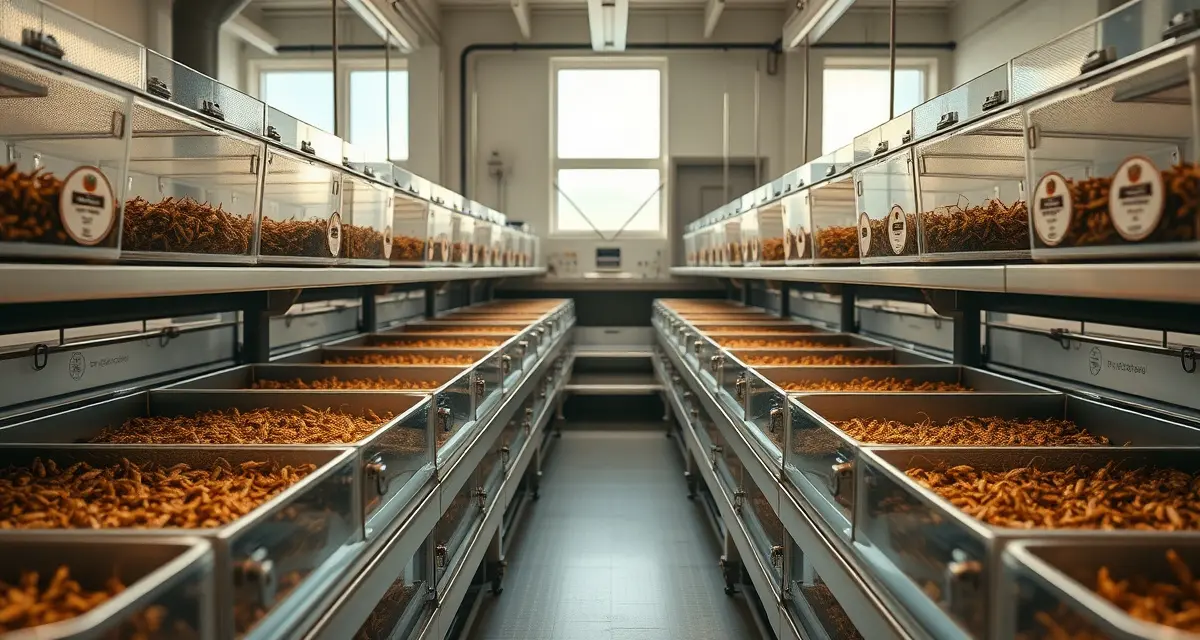
Population density. Overcrowding increases stress, disease transmission, and cannibalism. It's also bad for your production metrics. Maximum density guidelines for cricket farming typically fall in the range of 3,000-4,000 crickets per square foot of bin floor area. This is where welfare and production performance align, overcrowded crickets perform worse and die at higher rates.
Environmental conditions. Maintaining temperature, humidity, and ventilation within species-appropriate ranges is both a welfare consideration and a production necessity. Crickets under thermal stress exhibit abnormal behavior, reduced feed conversion, and elevated mortality.
Harvest and euthanasia method. How you end the crickets' lives matters in welfare frameworks. Temperature-based euthanasia, chilling crickets to torpor in a cold room, then freezing or blanching, is the most widely accepted method in welfare frameworks. It's also the most practical method for batch harvesting in a commercial operation. High-temperature direct immersion without prior chilling is considered less welfare-aligned.
Current Certification Options
There is no widely recognized standalone certification program for insect farming welfare in the US market as of 2025. The certification landscape is emerging:
Certified Humane (Humane Farm Animal Care). HFAC's Certified Humane program currently covers poultry, beef, pork, lamb, and dairy. HFAC has publicly stated that insect certification standards are under development. No timeline has been confirmed. If and when HFAC releases an insect standard, it would likely be the highest-profile welfare certification available in the US market.
Global Food Safety Initiative (GFSI) audit schemes. SQF, BRC, and other GFSI-recognized audit schemes are beginning to incorporate insect welfare criteria. For operations selling to large food manufacturers, your buyer may require a GFSI-recognized audit, and those audits are increasingly including welfare-adjacent criteria like density management, environmental conditions, and euthanasia methods.
B Corp certification. B Corp's complete social and environmental assessment includes animal welfare as a component. Some insect protein companies have pursued B Corp certification as a way to signal values-alignment to buyers, though B Corp is a company-level certification rather than a product-level one.
Self-declared welfare practices. In the absence of formal certification, some operations document and communicate their welfare practices directly to buyers. A documented welfare policy covering density limits, environmental standards, and euthanasia methods can satisfy buyer due diligence requirements even without third-party certification.
Does Welfare Certification Affect Your Pricing?
In current US market conditions, no established welfare certification premium exists for insect protein specifically. The premium associated with "humane" claims is well-established for eggs (cage-free, pasture-raised) and to some extent for poultry and pork, but the insect protein market hasn't developed the consumer-facing welfare differentiation that drives those premiums.
That could change. As cricket flour moves from a novelty ingredient to a mainstream food category, consumer-facing welfare claims may develop commercial value. The operations that have established welfare practices and documentation now will be positioned to credibly make those claims.
For operations selling to large food companies rather than direct-to-consumer, the relevant question is what welfare criteria your buyers are starting to require in their supply chain audits. That's worth asking your buyer contacts directly.
What Good Practice Looks Like Today
Even without formal certification, adopting and documenting welfare-aligned practices positions you for future buyer requirements:
- Maintain population density logs showing bin counts within welfare guidelines
- Document temperature and humidity records demonstrating crickets are maintained in species-appropriate conditions
- Adopt and document a temperature-based euthanasia protocol for harvest
- Train all farm staff on humane handling practices
These practices improve your production performance at the same time they satisfy welfare criteria, which makes them worth adopting regardless of certification status.
See the cricket flour production guide for the broader production context, and cricket flour FDA compliance overview for the regulatory framework surrounding cricket flour production.
Frequently Asked Questions
Do insects need to be raised humanely for food certification?
In the US, there is no federal legal requirement for humane insect farming practices. However, five EU countries have national regulations including minimum insect welfare standards, and leading food safety audit programs used by large food companies are beginning to incorporate welfare criteria. For operations selling to major food manufacturers, welfare practices may be part of upcoming supply chain audit requirements even without a formal legal mandate.
Is there a certified humane program for insect farms?
No widely recognized standalone humane certification for insect farming currently exists in the US. HFAC (Certified Humane) has indicated insect standards are in development. GFSI-recognized audit programs (SQF, BRC) are incorporating welfare-adjacent criteria. In the absence of formal certification, well-documented welfare practices, density management, environmental standards documentation, and temperature-based euthanasia protocols, can satisfy buyer due diligence requirements and position operations for formal certification when programs become available.
Does humane certification affect the price I can charge for cricket flour?
In current US market conditions, no established welfare certification premium exists specifically for cricket flour. The consumer-facing welfare premium that drives price differences in eggs and poultry hasn't fully developed for insect protein. For direct-to-consumer or premium retail operations, welfare claims may support price positioning. For operations selling to food manufacturers, the more immediate commercial value of welfare practices is in satisfying supply chain audit requirements from large buyers who are beginning to incorporate welfare criteria.
Do federal regulations differ from state regulations for cricket farming?
Yes. Federal oversight of insect production for human food falls primarily under FDA authority, including Food Safety Modernization Act (FSMA) requirements. State regulations vary widely -- some states have specific insect production permits, others treat cricket farming under broader agricultural licensing frameworks. Operations selling across state lines must comply with both their state of production and the destination state's requirements. Check with your state department of agriculture and an attorney familiar with food law for current requirements.
What documentation should I keep to demonstrate regulatory compliance?
Maintain records of feed ingredient sourcing with supplier documentation, batch production records, environmental monitoring logs (temperature, humidity), mortality records, sanitation logs, and any third-party audit results. Buyers from food manufacturing companies increasingly require these records as part of their supplier qualification process, so keeping them organized from the start saves significant effort later.
How often should a cricket farm conduct internal food safety audits?
A minimum of one formal internal audit per quarter is a reasonable starting point for a commercial operation. The audit should cover environmental monitoring records, sanitation log completeness, pest control documentation, and critical control point records for your HACCP plan. Operations seeking third-party certification (SQF, BRC, or similar) should align internal audit frequency and format with the standard's requirements.
Sources
- Food and Agriculture Organization of the United Nations (FAO) -- Edible Insects: Future Prospects for Food and Feed Security
- North American Coalition for Insect Agriculture (NACIA)
- U.S. Food and Drug Administration (FDA) -- Food Safety Modernization Act (FSMA)
- USDA National Organic Program
- Global Food Safety Initiative (GFSI)
Get Started with CricketOps
Maintaining organized compliance records is much easier when you build the system from day one rather than reconstructing it before an audit. CricketOps keeps your batch records, environmental monitoring logs, and traceability data in one place so that responding to a buyer documentation request or a regulatory inquiry does not require hunting through spreadsheets and paper files.