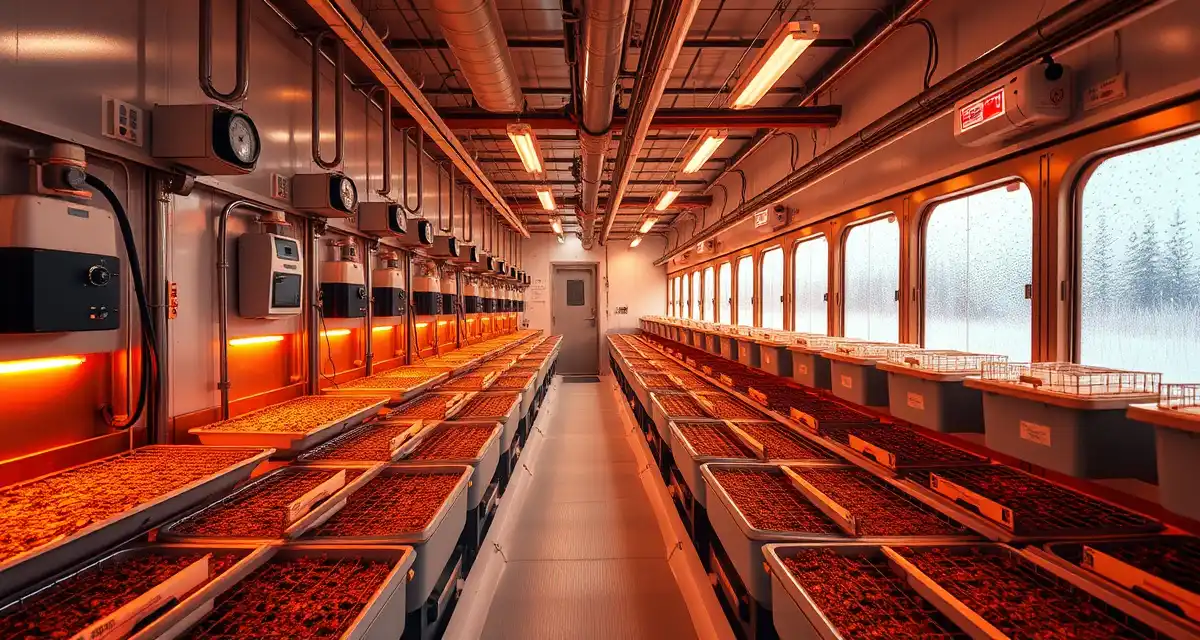
Winter Heating Strategies for Cricket Farms: A Seasonal Guide
Winter heating failures are responsible for 40% of total cricket farm closure events in northern US states. That's not a statistic about bad luck - it's a statistic about unpreparedness. Operations that fail in winter typically didn't have backup heating systems, didn't have monitoring with overnight alerts, or discovered their primary heating was inadequate for their local climate after it was too late to fix it affordably.
This guide walks you through how to prepare for winter before it arrives, manage your farm through the coldest months, and respond when something goes wrong at 2 AM.
TL;DR
- Winter heating failures are responsible for 40% of total cricket farm closure events in northern US states
- This guide walks you through how to prepare for winter before it arrives, manage your farm through the coldest months, and respond when something goes wrong at 2 AM
- At minimum, have several portable electric space heaters that can maintain your space above 70F if your primary system fails overnight
- If outdoor temperature is above freezing and indoor temperature is still above 75F, you have some time
- Acheta domesticus stops feeding at temperatures below 70F and begins dying rapidly below 60F
- Your target production range is 85-90F - which means you're often trying to maintain a 50-75 degree differential between your facility interior and the outdoor temperature on the coldest nights
- Your propane runs out, or a heating unit's igniter fails, or a power outage takes your system offline - and by morning, you're looking at a $5,000-$20,000 die-off event
Propane or natural gas forced air: Reliable and powerful, but fuel management is critical.
- At minimum, have several portable electric space heaters that can maintain your space above 70F if your primary system fails overnight.
- If outdoor temperature is above freezing and indoor temperature is still above 75F, you have some time.
- That's not a statistic about bad luck - it's a statistic about unpreparedness.
The Winter Risk Profile
Acheta domesticus stops feeding at temperatures below 70F and begins dying rapidly below 60F. Your target production range is 85-90F - which means you're often trying to maintain a 50-75 degree differential between your facility interior and the outdoor temperature on the coldest nights. That's a notable heating load, and it doesn't forgive equipment failures.
The risk isn't just a single cold night. Extended cold snaps over multiple days, combined with equipment that was already running at capacity, are when failures cascade. Your propane runs out, or a heating unit's igniter fails, or a power outage takes your system offline - and by morning, you're looking at a $5,000-$20,000 die-off event.
November Through February Operational Checklist
October: Pre-winter preparation
October is when you should be doing your most important winter work:
- Have all heating systems serviced professionally. Replace any parts showing wear.
- Test your backup heating system, not just your primary. A backup that doesn't start when you need it is useless.
- Check your insulation and weatherstripping. Every heat leak is money - and in extreme cold, it's production risk.
- Stock spare heating elements, thermostats, and igniters for your primary system.
- Calibrate and test all temperature sensors. Replace any with questionable accuracy.
- Configure winter alert thresholds: alert at 80F (2-3 hours before crickets are in danger), not at 70F when damage is already occurring.
- If you're on propane, calculate your winter consumption and arrange a contract for regular deliveries. Running out of propane in February is completely avoidable.
November and December: Transition management
These months bring variable conditions - cold nights mixed with milder days. This is actually a more challenging management environment than consistent deep cold because your systems are cycling on and off more frequently, which stresses equipment.
- Watch for temperature swings within your facility during system cycling. If your space is heating unevenly, adjust thermostat placement or add supplemental heat to cold spots.
- Note your energy consumption as temperatures drop. If you're already at the edge of your heating capacity and it's only 20F outside, you need to add capacity before it's -10F.
- This is your last chance to make notable equipment additions before the worst of winter.
January and February: Deep winter management
These are your highest-risk months for extended cold events. Management intensity should be highest:
- Check overnight temperatures every morning. Review your sensor logs, not just your morning walkthrough temperature.
- Reduce ventilation to the minimum necessary for air quality - every cubic foot of cold air you're bringing in has to be reheated.
- Keep a log of your daily propane or energy consumption. An unexpected spike often signals a heating system problem before failure occurs.
- Don't add new bins or change your environmental settings in January. This is not the month to experiment.
- Have a phone number for an emergency HVAC contractor that you've pre-vetted - one who will come same-day.
Heating System Selection
Mini-split heat pumps: The most energy-efficient option in USDA zones 6-8. The limitation is that heat pumps lose efficiency as outdoor temperatures drop below 20-25F. In zones 5 and colder, heat pump efficiency degrades measurably and you need supplemental heating.
Propane or natural gas forced air: Reliable and powerful, but fuel management is critical. Propane tanks that aren't monitored and refilled proactively are a major failure risk. Gas-fired systems also require regular maintenance to ensure igniter reliability.
Electric resistance heat: Works in any climate and has no fuel supply risk, but operating costs are measurably higher than heat pump or gas in most electricity markets. Used most often as backup or supplemental heat.
Radiant heat panels: A good option for providing localized heat to specific bin areas. Lower energy use than forced air for localized application. Often used to create a warm zone within a larger space that's heated less intensively.
The redundancy question: Whatever your primary system, have a backup. At minimum, have several portable electric space heaters that can maintain your space above 70F if your primary system fails overnight. That's a minimum - a proper backup system for any serious commercial operation is a second independent heating unit.
Overnight Protection
Most winter die-off events happen overnight, when you're not on site and temperatures are at their lowest. Your overnight monitoring setup is your most important investment for winter:
- Temperature sensors with continuous logging and overnight alerts configured to reach you by text or phone
- Alert thresholds set conservatively - 80F, not 70F
- A contact person who can respond if your phone is off or you're unavailable
- A documented emergency protocol your staff can execute without you
CricketOps integrated with commercial temperature sensors gives you the continuous monitoring and alert capability to catch problems before they become die-offs. The cricket farm winter management guide covers specific sensor placement and overnight monitoring configuration in more detail.
Energy Cost Management
Heating a cricket farm in a northern climate is expensive. Here are the main levers for managing cost without compromising production:
- Insulation: Every dollar spent on insulation pays dividends for years. Foam board, spray foam, and vapor barriers all reduce your heating load. Audit your facility for heat leaks annually.
- Zone heating: If you're running bins in a larger space, consider partitioning your production area so you're heating a smaller volume to production temperature. Store empty bins in a colder zone rather than heating unoccupied space.
- Thermal mass: Insulated bins and thermally dense flooring (concrete rather than wood) absorb heat during the day and release it slowly at night, reducing temperature swings and heating load.
- Waste heat integration: If you have processing equipment (dryers, sterilizers), their waste heat can supplement your growing area's heating. See the guide on cricket farm energy efficiency for specifics.
Frequently Asked Questions
How do I prepare my cricket farm for winter?
October is your key preparation month. Service all heating equipment professionally, test your backup heating system (not just your primary), check insulation and weatherstripping for heat leaks, stock spare parts for your heating system, calibrate temperature sensors, and configure winter alert thresholds at 80F rather than 70F. If you're on propane, arrange a delivery contract for the season rather than relying on call-in refills. The goal is to identify every weak point before the first hard freeze, not after. Review your energy consumption baseline from the previous winter to project whether your current heating capacity is adequate for your current production scale.
What is the cheapest way to keep a cricket farm warm through winter?
The cheapest long-term approach is good insulation, which reduces the energy needed to maintain temperature. Foam board insulation on walls and ceiling, vapor barriers to reduce moisture infiltration, and careful management of ventilation (minimizing cold air intake while maintaining air quality) are your highest-ROI investments. For heating itself, mini-split heat pumps are the most efficient option in zones 6 and warmer; gas or propane forced air is usually more cost-effective in zones 5 and colder where heat pump efficiency degrades. Zone-heating strategies - heating only the area where production is active rather than an entire large building - can cut heating costs by 30-40% in underutilized facilities.
What should I do if my cricket farm heater fails overnight in winter?
If you get an alert that temperatures are dropping: call your emergency HVAC contact immediately (pre-vet this number in October). While waiting for service, deploy portable electric space heaters to the most critical areas - breeding bins and young nymph bins are highest priority. If outdoor temperature is above freezing and indoor temperature is still above 75F, you have some time. If you're already below 75F, work fast. Document the start time and temperatures throughout the event in your management records - this matters for insurance claims and for understanding your vulnerability. After the event, do a full audit of your backup heating readiness and make the investments you clearly needed before this happened.
How do I manage large daily temperature swings in my facility?
Thermal mass and building insulation are your primary buffers against external temperature swings. Concrete floors, thick walls, and insulated ceiling panels absorb heat during the day and release it overnight, smoothing the delta your HVAC equipment has to compensate for. Secondary heating and cooling systems then hold bins within target range against whatever residual swing the building allows. Facilities in climates with large diurnal variation often find that insulation upgrades pay back faster than running more HVAC equipment.
What is the minimum facility insulation standard for year-round cricket production?
Most commercial operations targeting year-round production in non-tropical climates aim for at least R-19 in walls and R-30 in ceilings. This level of insulation reduces heating and cooling loads enough to make climate control economically practical. In climates with below-freezing winters, higher R-values and positive-pressure ventilation systems with heat recovery are common in facilities that run production year-round without seasonal shutdowns.
How do I handle humidity control during wet seasons or in high-humidity climates?
Dehumidifiers placed in the production space are the standard tool for controlling humidity in warm, wet conditions. Target 50-60% relative humidity for most life stages to balance the risk of desiccation against the risk of mold growth on feed and substrate. Adequate ventilation is equally important -- stale, humid air with poor circulation elevates pathogen risk even if overall humidity is in the target range. Monitor humidity at bin level, not just room level, since bins create microclimates.
Sources
- Food and Agriculture Organization of the United Nations (FAO) -- Edible Insects: Future Prospects for Food and Feed Security
- North American Coalition for Insect Agriculture (NACIA)
- Entomological Society of America
- University of Florida IFAS Extension -- Entomology and Nematology Department
- USDA Agricultural Research Service
Get Started with CricketOps
Maintaining the right environmental conditions in a cricket facility depends on having reliable data -- not just what your thermostat is set to, but what temperatures your bins actually experienced overnight and over the past week. CricketOps connects to temperature and humidity sensors, logs readings by bin, and alerts you when conditions drift outside your set thresholds. Try CricketOps and build the environmental record your operation needs.