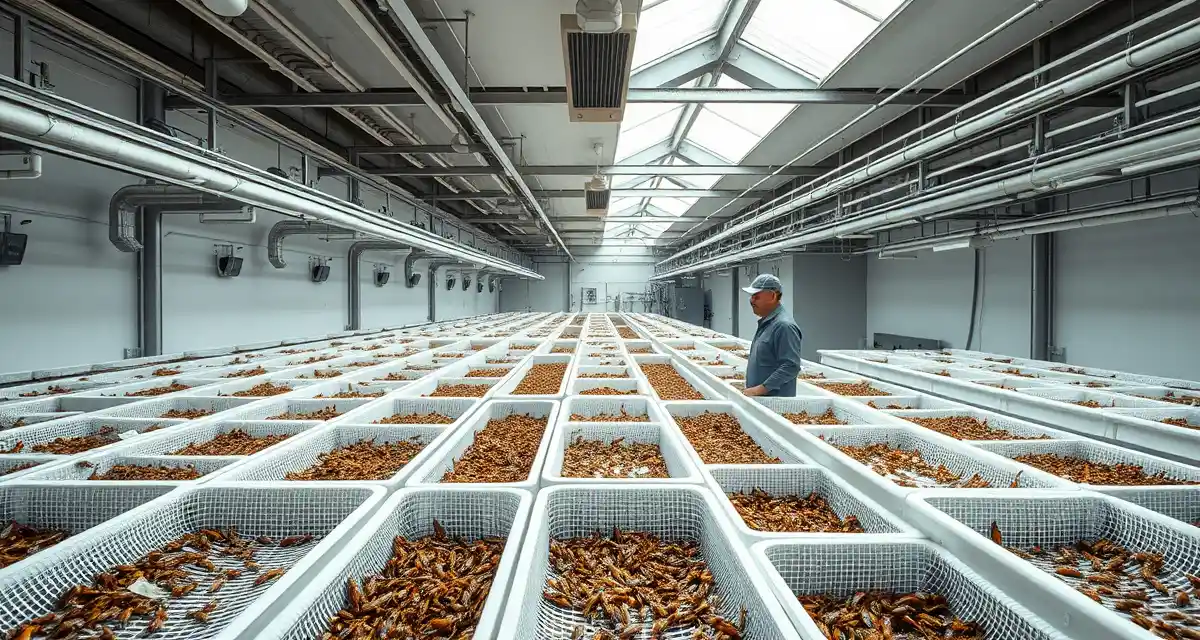
Scaling to Commercial Cricket Production: 100+ Bins and Beyond
Commercial-scale cricket farms - those operating 100+ bins - qualify for FDA Preventive Controls registration requirements under FSMA. That's not the only thing that changes at this scale, but it's a useful marker of where the regulatory and operational environment shifts from "small farm" to "food production facility" in the eyes of the law.
This guide provides a practical scaling roadmap for operators moving from the 50-bin mid-scale range to 100, 200, and 500+ bins, covering the facility, staffing, compliance, and financial milestones that define each stage.
TL;DR
- Commercial-scale cricket farms - those operating 100+ bins - qualify for FDA Preventive Controls registration requirements under FSMA.
- At 50 bins, a single owner-operator with one part-time employee can manage daily operations.
- You have potentially 30-50 different production cohorts in progress simultaneously.
- At a 7-week cycle time, that's roughly 7-8 harvest cycles per year per bin.
- The facility design reflects food manufacturing standards, not agricultural informality.
Compliance at 500 bins:
Full FDA FSMA Preventive Controls compliance is required.
- Third-party audits (FSSC 22000, SQF, or similar food safety certification) are increasingly demanded by food manufacturer buyers at this scale.
- The cricket farm automation tools comparison covers the options in detail.
- Centralized feeding and watering: Labor saving at 100+ bins is notable.
The 50 to 100 Bin Transition
Moving from 50 to 100 bins is the most operationally demanding scaling step for most operators. At 50 bins, a single owner-operator with one part-time employee can manage daily operations. At 100 bins, you need proper staffing, documented SOPs, and infrastructure that doesn't depend on any single person knowing where everything is.
Facility requirements at 100 bins:
- Dedicated production space of at least 1,200-1,500 sq ft (assuming 4-tier shelving at 3.2 bins per sq ft)
- Zoned environmental control with redundant heating and cooling in each zone
- Separate hatching area with more precise temperature/humidity control than your grow area
- Feed and supply storage area separate from production
- Harvest and processing area if you're producing flour or selling dried product
Staffing at 100 bins:
A 100-bin operation cannot be run solo at any meaningful production cadence. You need at minimum one full-time equivalent employee on daily operations (feeding, watering, bin checks, environment monitoring). More realistically, two people splitting the work reliably.
Your first employee needs written SOPs - not because they're incompetent, but because production quality consistency requires that the same tasks be done the same way regardless of who's on shift.
Compliance at 100 bins:
If you're producing cricket flour, a 100-bin operation processing for human food consumption likely crosses the threshold for FDA facility registration. Commercial-scale cricket farms at this level qualify for FDA Preventive Controls registration requirements. This means you need a written food safety plan, a designated Preventive Controls Qualified Individual (PCQI), and records retention that meets FSMA requirements. This is manageable - but it needs to be planned and implemented, not discovered during an unannounced inspection.
The 100 to 200 Bin Milestone
At 200 bins, you're operating a facility that requires real management infrastructure. The key changes:
Automation investment:
- Centralized water delivery system supplying all bins from a single source
- Automated temperature and humidity logging across all zones feeding into a central dashboard
- Possibly automated feeding systems for labor efficiency
- Harvest drum separator is now critical, not optional
Management system requirements:
At 200 bins, CricketOps (or equivalent) is not optional. You have potentially 30-50 different production cohorts in progress simultaneously. Your management system needs to handle harvest scheduling, production forecasting, die-off logging, environmental data correlation, and buyer reporting simultaneously. The operations dashboard you're reviewing daily needs to show you which bins need attention today - you can't manually review 200 bins worth of individual notes.
Financial milestone:
A well-run 200-bin Acheta domesticus feeder operation at full utilization should generate $120-$180/bin per harvest cycle. At a 7-week cycle time, that's roughly 7-8 harvest cycles per year per bin. Across 200 bins, a top-performing operation can generate $170,000-$290,000 in annual revenue from feeder sales alone, before any flour production or premium pricing.
Staff at 200 bins:
2-3 full-time employees with clear role definitions. You need someone who's specifically responsible for environmental monitoring and system maintenance, not just "whoever notices something is wrong."
The 200 to 500 Bin Scale
At 500 bins, you're operating at a scale where capital investment, professional management, and formal compliance infrastructure are all required. Operations at this scale are typically:
- Dedicated commercial facilities in industrial or agricultural-industrial zones
- Employing 5-8 full-time staff plus part-time harvest support
- Operating under FDA registration with a documented FSMA food safety plan
- Potentially producing multiple product forms (live feeder, dried whole, flour)
- Working with food brokers and formal distributor relationships
Facility design at 500 bins:
Purpose-designed facilities at this scale separate the building into distinct zones: hatching room, juvenile grow rooms, adult/breeding rooms, processing area, and packaging/cold storage. Each zone has its own environmental control. HVAC is commercial-grade with redundancy. The facility design reflects food manufacturing standards, not agricultural informality.
Compliance at 500 bins:
Full FDA FSMA Preventive Controls compliance is required. Third-party audits (FSSC 22000, SQF, or similar food safety certification) are increasingly demanded by food manufacturer buyers at this scale. Your compliance documentation is a competitive asset, not just a regulatory checkbox.
Automation and Technology at Commercial Scale
As you scale beyond 100 bins, the ROI on automation improves dramatically:
- IoT sensor networks: Real-time environmental monitoring across hundreds of bins, with automated alerts and trend analysis. The cricket farm automation tools comparison covers the options in detail.
- Centralized feeding and watering: Labor saving at 100+ bins is notable. Automated feed distribution and centralized water gel production can reduce daily labor requirements by 30-40%.
- Harvest automation: Motorized drum separators are standard at 100 bins; at 500 bins, conveyor-based systems and automated kill/freeze stages become economically justified.
- Management software integration: CricketOps API integrations allow production data to flow into accounting systems, buyer reporting dashboards, and compliance documentation automatically.
Frequently Asked Questions
What changes when I scale my cricket farm to 100 bins?
At 100 bins, you cross several notable thresholds simultaneously. Operationally, the operation can no longer run on the knowledge of one person - you need documented SOPs, a trained staff member, and a management system that tracks all cohorts systematically. Compliance-wise, if you're producing food-grade product, FDA facility registration and a written FSMA food safety plan become required. Financially, you need proper business accounting, regular cash flow planning, and buyer contracts rather than informal relationships. And physically, your facility needs dedicated zoned space for hatching, growing, and processing rather than a single room that serves all purposes. These changes are manageable if you plan for them - they're painful if they arrive as surprises.
What automation is required for a 100-bin commercial cricket farm?
At 100 bins, the automation investments that deliver the most ROI are: a continuous temperature and humidity monitoring system with automated alerts (critical for overnight protection and compliance documentation), a motorized drum separator for harvesting (saves 3-4 hours per harvest session vs. manual sifting), and a centralized water delivery system (reduces daily labor measurably compared to bin-level water gel management). These three systems together can reduce your daily labor requirement by 30-40% compared to fully manual operations. Full automation of feeding and environmental control becomes cost-justified at 200+ bins.
At what bin count does FDA Preventive Controls apply to my cricket operation?
FDA Preventive Controls for Human Food applies to "registered food facilities" that manufacture, process, pack, or hold food for human consumption. If you're producing cricket flour or any processed cricket product for human consumption and your annual food sales exceed $1 million (or you sell to buyers who resell across state lines), you likely meet the registration threshold. The exact qualifying criteria depend on your annual revenue and distribution - smaller operations may qualify for the Qualified Facility exemption, which has reduced requirements. Rather than guessing, assess your specific situation against FDA's exemption criteria early and document your determination. The cricket flour FDA compliance guide covers the registration requirements in detail.
What are the most common reasons cricket farm expansions fail?
Expanding before unit economics are proven is the most common cause of cricket farm expansion failure. If your FCR is not hitting target and mortality rates are above 10-15% per cycle, scaling up multiplies those problems rather than solving them. The second most common cause is underestimating facility and equipment costs for the new scale -- most operations underestimate energy infrastructure, climate control, and harvest equipment requirements by 30-50%.
How much capital is typically needed to scale from 10 to 50 bins?
A 10 to 50 bin expansion typically requires $8,000-$20,000 in direct costs depending on your existing infrastructure and whether you are expanding in your current facility or moving to a new space. The largest cost categories are shelving and bin systems, climate control upgrades, and any additional processing equipment required by the increased harvest volume. Working capital for feed and supplies during the expansion ramp-up should also be budgeted separately.
How long does it take to reach profitability when starting a commercial cricket farm?
Most commercial cricket operations that reach profitability do so within 12-24 months of starting production at commercial scale (20+ bins). The timeline depends on feed cost management, FCR achieved in early cycles, and the time required to establish buyer relationships that generate consistent revenue. Operations that start with committed buyers typically reach profitability faster than those that develop their market after production is running.
Sources
- Food and Agriculture Organization of the United Nations (FAO) -- Edible Insects: Future Prospects for Food and Feed Security
- North American Coalition for Insect Agriculture (NACIA)
- Entomological Society of America
- Journal of Insects as Food and Feed (Wageningen Academic Publishers)
- USDA Agricultural Research Service
Get Started with CricketOps
Scaling a cricket operation is much less risky when you have clear data on your unit economics before you expand. CricketOps gives you FCR by bin, cost per production cycle, and environmental performance records that make it clear whether your operation is ready to scale and where the constraints are. Try CricketOps and build the data foundation your expansion decisions should rest on.