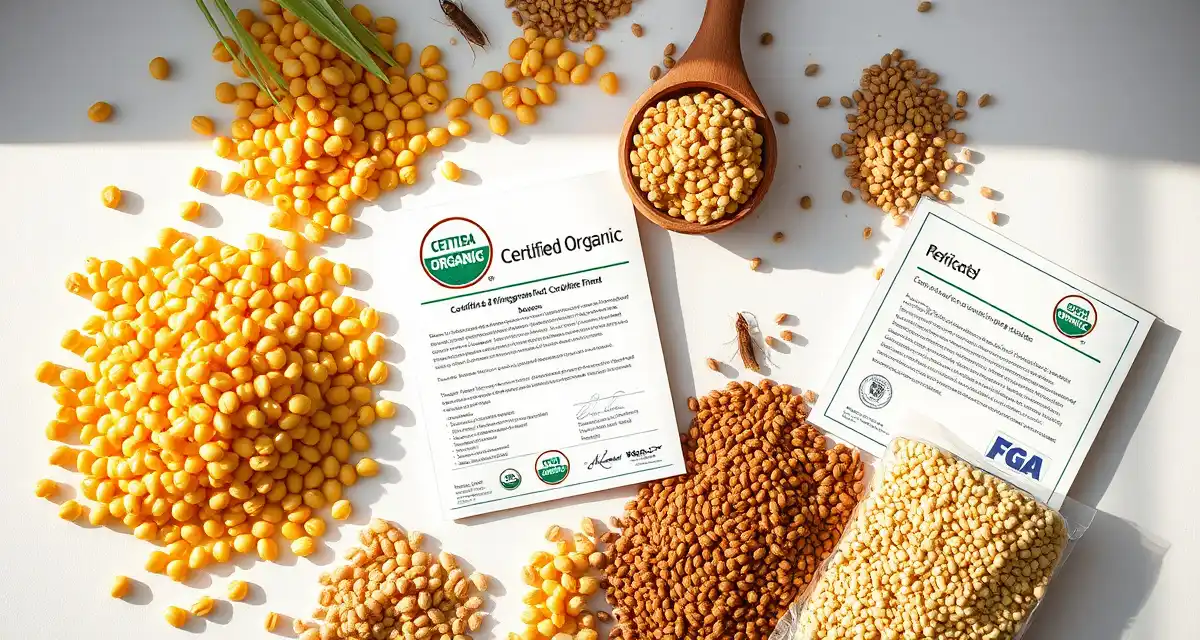
Organic Feed Sourcing for Cricket Farms: Finding Certified Inputs
Organic corn and soy are the most widely available certified organic feed inputs for cricket farms. That's the good news. The challenging part is that availability doesn't mean easy procurement, organic feed for cricket farming requires supplier qualification, lot-level documentation, and ongoing certificate management that conventional feed sourcing doesn't.
This guide covers how to find and qualify organic feed suppliers, what documentation you need, and how to build a feed sourcing program that satisfies organic certification requirements.
TL;DR
- Organic corn and soy are the most widely available certified organic feed inputs for cricket farms.
- Organic feed for cricket farming requires supplier qualification, lot-level documentation, and ongoing certificate management that conventional feed sourcing does not.
- Your organic feed suppliers must hold a current USDA National Organic Program (NOP) certificate -- verify this certificate independently before each new lot.
- Lot-level documentation (certificate of origin, handler certificate) must accompany each feed delivery and be retained as part of your organic system plan.
- Organic feed cost premium runs 40-80% above conventional feed -- this cost must be built into your pricing model before pursuing organic certification.
- The NOP allows a 30-day non-organic feed emergency exception when organic feed is unavailable -- this must be documented and reported to your certifier.
The Five Core Organic Feed Ingredients
Most cricket feed formulations are built around five ingredient categories. These are the organic inputs you'll need to source:
1. Organic corn (whole or coarse ground). The grain base for most cricket feed formulations. Widely available from certified organic grain farmers and distributors. Organic corn costs approximately 35-50% more than conventional at comparable quality grades. This is your highest-volume ingredient, so its price premium has the biggest impact on your feed cost.
2. Organic soybean products. Soy-based ingredients provide the protein supplement in cricket feed. Organic soybean meal and organic roasted soybeans are both used. Availability is generally good in Midwest and Southeast agricultural regions. Prices track organic corn closely (30-50% premium over conventional).
3. Organic wheat bran. Used as a feed texture and fiber component. Organic wheat bran is widely available from organic flour mills and grain processors. The premium over conventional is typically 20-35%.
4. Organic dried vegetables. Carrots, beets, greens, and similar vegetables are used as hydration sources and to diversify the nutritional profile. Organic dried vegetables can be sourced from organic produce distributors or food-grade dehydrated vegetable suppliers. This ingredient category has more price variation than grains.
5. Organic minerals and supplements. If your feed formulation includes mineral supplements or other additives, each needs to be either OMRI-listed (approved for organic use) or specifically approved by your certifying agent. Some conventional mineral supplements are prohibited in organic production, verify before purchasing.
How to Find Certified Organic Suppliers
Regional organic grain farmers. In grain-producing states, direct relationships with certified organic grain farmers can provide access to organic corn and soy at better prices than distributor markups. Local organic farming associations (state chapters of NOFA, OFRF-connected networks) can connect you with nearby producers. Direct farmer relationships also simplify the documentation chain, you're getting one certificate from one producer rather than managing a distributor's supply chain.
Organic ingredient distributors. For operations that can't source directly from farmers, organic food ingredient distributors carry certified organic grains and protein meals. UNFI, Frontier Co-op, and regional organic distributors supply certified organic bulk ingredients to food manufacturers. They'll provide organic certificates and lot documentation as part of normal business practice.
Organic feed mills. Some feed mills produce certified organic poultry and livestock feed that is suitable as a cricket feed base. Purchasing a pre-formulated organic feed mix simplifies sourcing but reduces your control over the formulation and typically costs more per unit than sourcing ingredients separately.
Supplier Qualification Documentation
Every organic feed supplier needs to be qualified before you use their ingredients in an organic cricket operation. Qualification means:
Obtaining a valid NOP organic certificate. Your supplier's certifying agent issues an annual certificate covering the specific products they're certified to produce or handle. Collect this certificate before placing your first order. Check that the certificate:
- Is currently valid (not expired)
- Covers the specific product you're buying (a corn farmer certified for field corn may need to confirm their handling process is also covered)
- Is issued by an accredited certifying agent (the NOP maintains a list of accredited certifiers)
Documenting each delivery. When feed arrives, your receiving record should capture the supplier, product, lot number or batch identification, quantity, and a reference to the organic certificate that covers this delivery. If you're audited, this is the documentation chain that proves your feed was organic.
Annual certificate renewal. Organic certificates are annual. Set calendar reminders for each supplier to request their updated certificate before the current one expires. A gap in certificate coverage, even a few weeks, can create a documentation problem at your annual certification inspection.
Practical Supplier Management
Running an organic cricket farm means managing a small portfolio of supplier relationships with more documentation overhead than conventional sourcing. Some practical approaches:
- Start with two suppliers for your highest-volume ingredients (corn and soy) so you have a backup if a supplier has a supply gap or certification issue.
- Build a simple supplier file (digital or paper) for each supplier with their current certificate, contact information, and a log of deliveries and certificate renewal dates.
- Discuss documentation requirements with suppliers before committing to them. Suppliers who are familiar with organic supply chains will know what you need and will provide it routinely. Suppliers who aren't familiar may resist the documentation overhead.
How CricketOps Tracks Organic Feed Certifications
CricketOps feed records capture supplier identification and lot-level information with each feed input entry. For operations pursuing organic certification, this means your CricketOps feed records can serve as the primary documentation tool for the lot-level traceability your certifying agent needs to see.
See organic cricket farming certification for whether organic certification makes sense for your operation, and the cricket farm supply chain guide for broader sourcing and supply chain management guidance.
Frequently Asked Questions
Where do I source certified organic ingredients for cricket feed?
The most commonly used certified organic cricket feed inputs are organic corn, organic soybean products, organic wheat bran, and organic dried vegetables. Sources include: direct relationships with certified organic grain farmers in your region (contact local organic farming associations), organic food ingredient distributors (UNFI and regional organic distributors), and organic feed mills that produce certified organic livestock and poultry feed. Each supplier must provide a valid NOP organic certificate covering the specific ingredients you purchase.
How do I verify that my cricket feed supplier's ingredients are USDA organic certified?
Request the supplier's NOP organic certificate from their certifying agent. Verify that the certificate is currently valid, is issued by an accredited certifying agent (check the NOP's accredited certifier list), and covers the specific products you're purchasing. Collect updated certificates annually, certificates expire and need renewal. For each delivery, document the lot number and reference the certificate that covers it. This documentation chain is what your certifying agent reviews at your annual organic inspection.
Does CricketOps track organic feed certifications and lot numbers?
CricketOps records feed inputs with supplier identification and lot-level information as part of its standard feed record functionality. For organic operations, this means you can use CricketOps as your primary tool for maintaining the feed documentation chain that organic certification requires. The ability to tie specific production batches to specific feed lots, with supplier information captured at receipt, supports the traceability documentation that certifying agents review at annual inspections.
How do moisture levels in cricket feed affect colony health?
Feed that is too dry reduces palatability and may cause crickets to rely entirely on water gel sources for hydration. Feed with excess moisture molds rapidly in the warm, humid environment of a cricket bin, and moldy feed is a significant exposure route for pathogens. The practical approach is to serve fresh wet foods (fruits, vegetables) separately from dry feed, replace wet items within 24 hours, and store dry feed in a low-humidity area.
Should gut-loading feed differ from the standard production diet?
Yes. Gut-loading targets the 24-48 hours before harvest to maximize the nutritional value transferred to the end consumer of the cricket. Gut-loading diets typically emphasize specific nutrients the buyer requires -- omega-3 fatty acids, calcium, and certain vitamins are common targets. Standard production feed is optimized for growth rate and FCR, not for enriching the nutritional profile of the finished product.
What feed management practices have the biggest impact on FCR?
Two changes consistently improve FCR more than any other: matching feed protein content to the optimal range for the target species (22-25% for Acheta domesticus), and increasing feeding frequency for pinhead-stage crickets (3 times per day versus once). After these two variables, reducing feed waste by feeding to observed consumption rather than fixed quantities is the next highest-impact adjustment.
Sources
- Food and Agriculture Organization of the United Nations (FAO) -- Edible Insects: Future Prospects for Food and Feed Security
- North American Coalition for Insect Agriculture (NACIA)
- U.S. Food and Drug Administration (FDA) -- Food Safety Modernization Act (FSMA)
- USDA National Organic Program
- Global Food Safety Initiative (GFSI)
Get Started with CricketOps
Feed management is where your production economics are won or lost. CricketOps lets you log every feed batch, track consumption and FCR by bin, and identify exactly where your feed program is performing and where it is not. Start tracking your feed inputs in CricketOps and get the data you need to improve your cost per pound of cricket produced.