How to Track Cricket Bin Lifecycles (Hatch, Feed, Harvest Dates)
Missed harvest windows add an average of 4 days of feed cost per bin. At FCR 1.8 and $0.30/lb feed, those 4 days aren't free. Multiply that across 30 bins cycling monthly and you've got a real number.
Bin lifecycle tracking is how you stop paying for those extra days. Here's exactly how to do it.
TL;DR
- Missed harvest windows add an average of 4 days of feed cost per bin.
- At FCR 1.8 and $0.30/lb feed, those 4 days aren't free.
- Multiply that across 30 bins cycling monthly and you've got a real number.
- The moment you see pinhead emergence, or the day you transfer eggs to a hatch container, record the date as Day 0 for that bin.
- In CricketOps, feed logging is a 15-second entry per bin per feeding event.
- Over a 5-week grow-out, this becomes the FCR baseline for that bin.
- For Gryllus bimaculatus: add 1–2 weeks.
Tracking feed by room instead of by bin. "Fed everyone on Tuesday" tells you nothing about which bins are performing.
Why Bin-Level Tracking Matters
When you manage a farm by memory, every bin is roughly on schedule. When you start tracking actual dates, you discover that bins hatch unevenly, grow-out times vary by a few days depending on temperature variation, and the mental model you had of "they're all about 5 weeks" is off by 3–7 days on any given bin.
That gap between "approximately ready" and "actually ready" is where you lose yield and waste feed.
Step 1: Set Up a Bin ID System
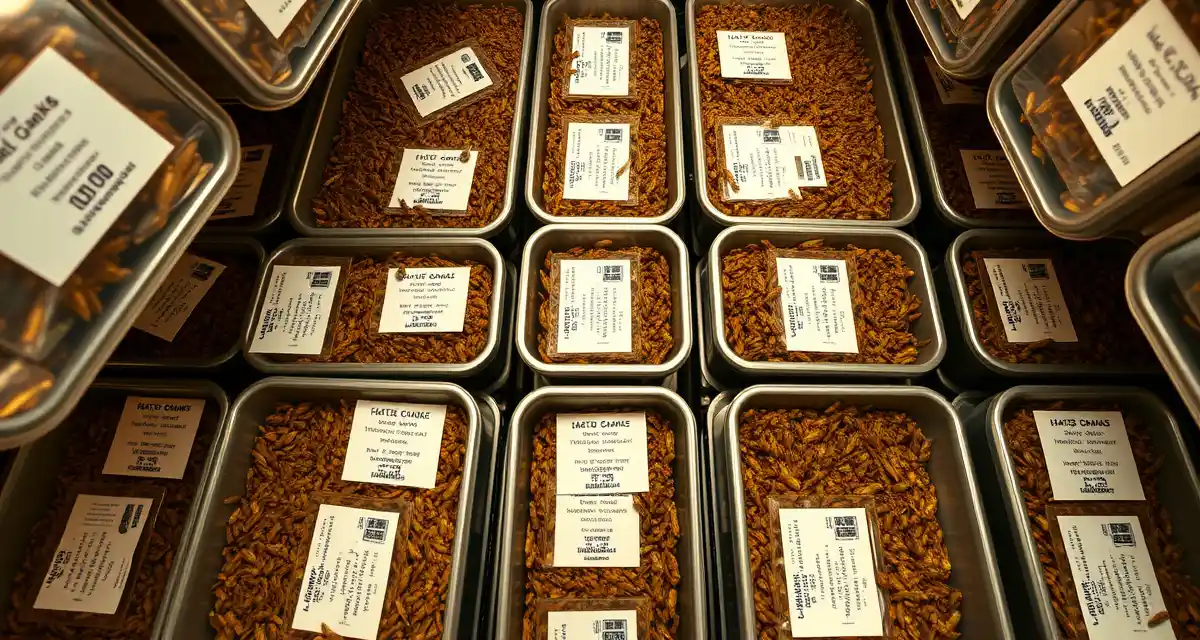
Every bin needs a unique identifier that stays with it through its lifecycle. Use whatever format makes sense for your setup: B001, B002, or a shelf-and-position format like A1-1, A1-2, A2-1.
Label each bin physically (a waterproof adhesive label or paint marker works). The label goes on the bin itself, not the lid, lids get swapped.
If you're using CricketOps, create each bin as a record when you set it up. The bin ID becomes the anchor for all data going forward.
Step 2: Log the Hatch Date Immediately
The moment you see pinhead emergence, or the day you transfer eggs to a hatch container, record the date as Day 0 for that bin.
This is the most critical data point. Every downstream calculation (projected harvest window, current instar estimate, days remaining on grow-out) depends on an accurate hatch date.
Don't log "approximately when I think they hatched." Log the first day of confirmed pinhead activity. If you're not checking daily during the hatch window, start checking daily.
Minimum data to log at hatch:
- Bin ID
- Hatch date
- Species (Acheta domesticus or Gryllus bimaculatus)
- Starting egg quantity (if trackable)
- Temperature at time of hatch
Step 3: Log Feedings Per Bin
Feed logging per bin is what makes FCR calculation possible. Without it, you're guessing how much each bin consumed.
For each feeding event, record:
- Bin ID
- Date and time
- Feed type
- Feed quantity (by weight, not volume, weights are consistent, volume measurements vary)
This doesn't have to be elaborate. A simple notation per feeding works. What matters is that it's per-bin, not a total for the whole farm.
In CricketOps, feed logging is a 15-second entry per bin per feeding event. Over a 5-week grow-out, this becomes the FCR baseline for that bin.
Step 4: Log Any Mortality Events
When you find dead crickets during a check, log it:
- Bin ID
- Date
- Approximate count
- Apparent cause (temperature event, look of dehydration, mite sign, unknown)
Mortality data has two uses: it adjusts your expected harvest yield per bin, and over time it reveals patterns you'd otherwise never see.
Step 5: Track Your Harvest Window
For Acheta domesticus at 85–90°F: optimal harvest window opens at approximately 5 weeks post-hatch and closes around week 6.5–7. After that, natural die-offs accelerate and usable yield drops.
For Gryllus bimaculatus: add 1–2 weeks. Optimal window is approximately 6.5–8 weeks.
Set a projected harvest date for each bin when you log the hatch date. In CricketOps, this is calculated automatically. In a spreadsheet, add 35 days (Acheta domesticus at 88°F) to your hatch date and flag that cell as your earliest harvest date.
Adjust the projection as you go. A bin that ran cooler than average for a week will need a few extra days. A bin that's been at optimal temp throughout will be right on schedule.
Step 6: Record the Harvest
At harvest, log:
- Bin ID
- Harvest date
- Harvest weight (live weight)
- Any qualitative notes (size uniformity, condition)
This closes the loop on FCR calculation: you now have feed input and live weight output for the entire grow-out cycle.
Common Mistakes in Bin Lifecycle Tracking
Using hatch container date instead of first confirmed pinheads. Eggs can sit in a hatch container for 2–4 days without hatching. Day 0 should be when you see pinheads, not when you set up the container.
Tracking feed by room instead of by bin. "Fed everyone on Tuesday" tells you nothing about which bins are performing. Per-bin feed logs are non-negotiable if you care about FCR.
Skipping the harvest weight measurement. If you don't weigh harvest output, you can't calculate FCR. A $30 kitchen scale is the only equipment you need.
Keeping notes in multiple places. The value of lifecycle data comes from having it all in one place so patterns emerge. A bin's temperature event, FCR, and mortality history should all be connected to the same bin record.
FAQ
How do I log hatch dates for each cricket bin?
Record the date you first observe pinhead emergence as Day 0 for that bin. Log the bin ID, hatch date, species, and room temperature. If using CricketOps, create the bin record and enter the hatch date, the platform projects the harvest window automatically. In a spreadsheet, use a dedicated column for hatch date with a formula that adds your grow-out days to generate a projected harvest date.
What data should I track per bin in a cricket farm?
The minimum viable per-bin dataset is: hatch date, species, feed log (date, type, quantity per feeding), mortality events (date, count, apparent cause), and harvest record (date, weight). This data supports FCR calculation, harvest window management, and mortality pattern analysis.
Can I manage cricket bin lifecycles in a spreadsheet?
Yes, for operations under 20 bins with a single operator. You need a row per bin, columns for hatch date, projected harvest date, feed log, and mortality log. The limitation is that spreadsheets can't send automated harvest alerts, calculate FCR automatically, or flag bins approaching their window without manual checking. At 20+ bins, the daily management overhead of a spreadsheet approach starts to cost more than a dedicated platform.
What data should a cricket farm management system track at minimum?
At minimum: bin identification, population counts by life stage, feed inputs and quantities, mortality events, temperature and humidity readings, and harvest dates and weights. These categories give you enough data to calculate FCR, identify underperforming bins, and audit any production batch. More advanced tracking adds environmental sensor integration, financial cost allocation, and buyer order fulfillment records.
How long does it take to see a return on investment from farm management software?
Operations that move from spreadsheets to purpose-built software typically see measurable FCR improvement within two to three production cycles, as patterns invisible in manual records become visible in aggregated data. The timeline depends on operation size -- larger farms benefit faster because there are more data points and more decisions that can be improved. The ROI accelerates when the software also reduces the time spent on manual data entry and reporting.
Can cricket farm management software integrate with environmental sensors?
Yes, platforms designed specifically for commercial insect production such as CricketOps support direct integration with temperature and humidity sensors via IoT protocols. This eliminates the need for manual environmental logging and enables automated alerts when readings fall outside set thresholds. When evaluating software, confirm which sensor brands and communication protocols (WiFi, Zigbee, 4G) are supported before purchasing equipment.
Sources
- Food and Agriculture Organization of the United Nations (FAO) -- Edible Insects: Future Prospects for Food and Feed Security
- North American Coalition for Insect Agriculture (NACIA)
- Entomological Society of America
- Journal of Insects as Food and Feed (Wageningen Academic Publishers)
- University of Florida IFAS Extension -- Entomology and Nematology Department
Get Started with CricketOps
Managing a cricket operation with disconnected tools -- a spreadsheet for bins, a separate doc for feed logs, manual temperature notes -- creates gaps in your data that become costly blind spots. CricketOps brings bin tracking, environmental monitoring, FCR calculations, and harvest records into one place built specifically for insect agriculture. Try it and see how much clearer your production picture becomes.