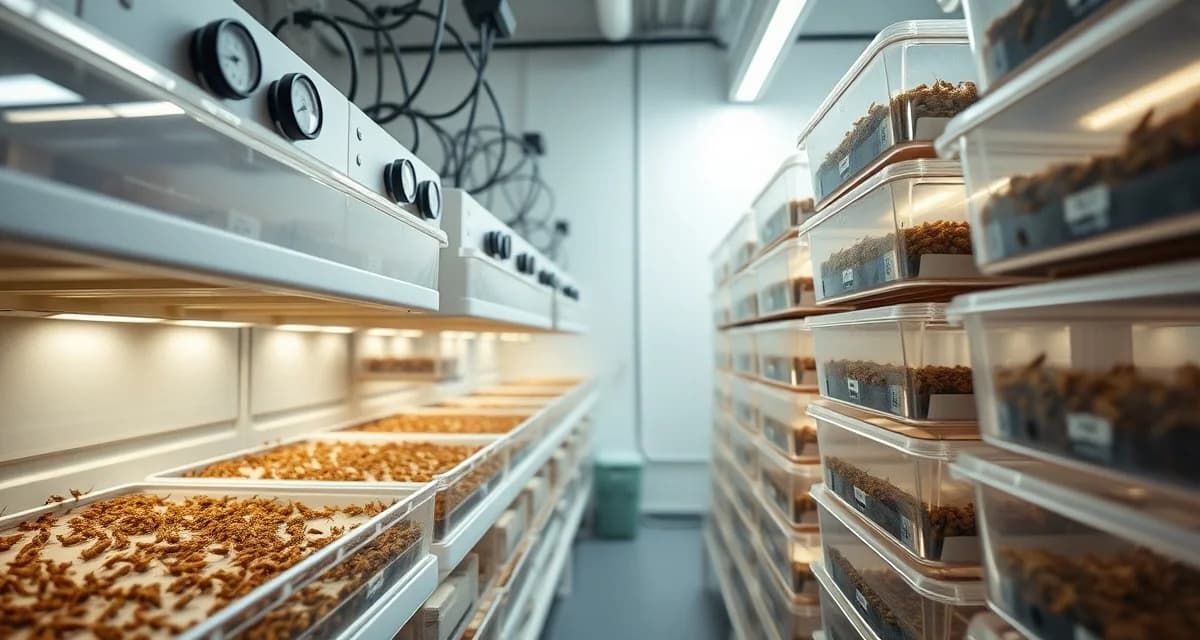
Cricket Farming in Humid Continental Climates: Four-Season Management
If you're farming crickets in the Midwest, Great Lakes region, or Northeast US, you're operating in a humid continental climate, and your biggest operational challenge isn't any single season. It's the full 12-month cycle of radically different conditions that all require different management approaches. Farms in humid continental climates see FCR performance improve 15% in summer vs winter due to lower heating cost impact, but capturing that summer advantage means surviving the winter and executing a clean spring startup.
This guide walks through each season with specific management actions for each. No other single guide covers the full four-season management cycle for this climate zone, and that gap costs farms real money in missed production and avoidable die-offs.
TL;DR
- It's the full 12-month cycle of radically different conditions that all require different management approaches
- Manual overnight checks at 3am aren't sustainable
- Cricket farms that follow a structured spring startup plan reach full production capacity 3 weeks faster than unplanned restarts, and that 3-week difference represents real revenue
- March 1-15: Equipment inspection
- Replace any sensors that drifted more than 2F from calibration over winter
- March 15-April 1: Gradual density increase
- A 50-bin Acheta domesticus operation generates approximately 15,000-20,000 BTU/hour of metabolic heat at full production
Temperature monitoring with alerts. Manual overnight checks at 3am aren't sustainable.
- Cricket farms that follow a structured spring startup plan reach full production capacity 3 weeks faster than unplanned restarts, and that 3-week difference represents real revenue.
- Your spring startup checklist:
March 1-15: Equipment inspection.
- Replace any sensors that drifted more than 2F from calibration over winter.
March 15-April 1: Gradual density increase.
Winter: November Through February
Winter is the highest-cost, highest-risk period for humid continental cricket farms. Heating failures are responsible for 40% of total cricket farm closure events in northern US states, and even non-catastrophic cold events, where temperatures drop but don't kill the colony, reduce FCR and breeding performance for weeks.
Your winter management priorities, in order:
Insulation first. Before you spend money on heaters, make sure your facility holds heat. In a well-insulated building, cricket metabolism alone generates meaningful warmth. A 50-bin Acheta domesticus operation generates approximately 15,000-20,000 BTU/hour of metabolic heat at full production. That's not enough to heat a poorly insulated warehouse in Minnesota in January, but it's notable in a well-sealed building.
Heating system redundancy. You need a backup heat source. It doesn't need to be rated for your full facility. It needs to be capable of keeping your breeding room above 25C (77F) for 12 hours during a primary system failure. A propane torpedo heater and a 20-pound tank costs around $150 and can save a $5,000 colony.
Temperature monitoring with alerts. Manual overnight checks at 3am aren't sustainable. Connect a wireless temperature sensor to an alert system that texts you when temperatures drop below your threshold. See cricket farm winter management for specific sensor setup recommendations.
Reduced stocking density. Winter heating costs money per BTU. Dense bins require more total heat. Running 15-20% fewer crickets per bin in winter reduces your heating cost per pound of cricket produced while maintaining colony health metrics.
FCR expectations. A well-run winter operation in the upper Midwest will typically achieve FCR of 2.0-2.3, compared to 1.7-1.9 in summer. This reflects the metabolic energy crickets use to maintain body temperature when ambient room temperature is at the lower end of the comfort range. Don't measure summer performance against winter benchmarks.
Spring: March Through May
Spring is your production restart and the most underplanned season on most farms. Cricket farms that follow a structured spring startup plan reach full production capacity 3 weeks faster than unplanned restarts, and that 3-week difference represents real revenue.
Your spring startup checklist:
March 1-15: Equipment inspection. Clean all bins thoroughly before restocking. Inspect heaters, fans, and temperature sensors for winter wear. Replace any sensors that drifted more than 2F from calibration over winter.
March 15-April 1: Gradual density increase. Don't jump from winter low-density to summer full-density in one week. Increase by 10% per week. Your facility's ventilation capacity needs to scale with cricket density, and a rapid density jump without ventilation adjustment can spike ammonia levels.
April: Breeding room optimization. As ambient temperatures climb, you can reduce heating costs in your grow-out areas while keeping your breeding room at 30-32C (86-90F). Use this transition to test whether you can maintain breeding performance with less supplemental heat.
May: Full summer configuration. Target full production density by mid-May in most Midwest locations. Review your cricket farm management production forecast and align with any buyer commitments for Q3.
Summer: June Through August
Summer is your highest-productivity, lowest-cost period in a humid continental climate. Heating costs disappear. FCR improves. Die-off rates, assuming your facility doesn't overheat, should hit their annual low.
The risk is complacency. Hot summers in the Midwest and Northeast occasionally push daytime temperatures above 35C (95F), and your facility can overheat even with ventilation fans running. In 2022, an extended heat wave across the Midwest caused widespread cricket farm die-off events in operations without active cooling.
Summer management priorities:
- Monitor daily high temperatures in your facility, not just daily averages.
- Keep a portable evaporative cooler or portable AC unit available for heat waves.
- Ventilate aggressively at night to use the cooler overnight air.
- Track your summer FCR per bin weekly. A sudden FCR increase in summer usually indicates a ventilation problem, disease pressure, or feed quality issue.
Fall: September Through October
Fall is your planning and production-building season. The reptile-keeping hobby generates a predictable Q4 demand spike for feeder crickets, and flour buyers often increase purchasing before the holiday season as well.
See cricket farm production planning for specific Q4 forecasting methods. The key fall actions:
- Begin increasing bin density in early September when temperatures are comfortable but before the cold forces you to reduce again.
- Lock in your Q4 supply commitments with buyers by mid-October, before production ramp-up decisions need to be made.
- Order any winter heating supplies and spare parts in October, before the first cold snap triggers panic buying.
Frequently Asked Questions
How do I manage my cricket farm through all four seasons in the Midwest?
Manage each season distinctly. In winter, prioritize insulation, heating redundancy, 24/7 temperature monitoring with alerts, and reduced stocking density to lower heating costs. In spring, execute a structured restart: inspect equipment in early March, increase density gradually through April, and reach full summer configuration by mid-May. In summer, use the free ambient heat while monitoring for heat wave risks and tracking FCR improvements per bin. In fall, ramp up production density in September and lock in Q4 buyer commitments in October before the cold forces density reductions again.
What are the biggest cricket farm challenges in a humid continental climate?
The three main challenges are winter heating costs and failure risk, spring production restart timing, and the four-season management complexity that most other climate zones don't face. Winter heating can represent 30-40% of total variable costs for a northern farm. Heating system failures in winter are the leading cause of cricket farm closures in northern states. Spring restarts that lack a structured plan regularly come up 3-4 weeks late to full production, missing early Q3 demand. The management complexity of running four distinct operational modes in a single year also means more documentation and planning overhead.
How do I prepare my cricket farm for a Midwest winter?
Start in September and October. Inspect and repair building insulation, seal any drafts, and test your primary heating system before it's critical. Install at least one wireless temperature sensor in your breeding room and configure alerts that wake you if temperatures drop below 20C (68F) overnight. Purchase or confirm availability of your backup heat source. Reduce stocking density by 15-20% as temperatures drop below 10C outdoors to lower heating cost per pound of output. Make sure your winter FCR benchmarks are set appropriately, since winter FCR will always run higher than summer FCR due to metabolic overhead.
How do I manage large daily temperature swings in my facility?
Thermal mass and building insulation are your primary buffers against external temperature swings. Concrete floors, thick walls, and insulated ceiling panels absorb heat during the day and release it overnight, smoothing the delta your HVAC equipment has to compensate for. Secondary heating and cooling systems then hold bins within target range against whatever residual swing the building allows. Facilities in climates with large diurnal variation often find that insulation upgrades pay back faster than running more HVAC equipment.
What is the minimum facility insulation standard for year-round cricket production?
Most commercial operations targeting year-round production in non-tropical climates aim for at least R-19 in walls and R-30 in ceilings. This level of insulation reduces heating and cooling loads enough to make climate control economically practical. In climates with below-freezing winters, higher R-values and positive-pressure ventilation systems with heat recovery are common in facilities that run production year-round without seasonal shutdowns.
How do I handle humidity control during wet seasons or in high-humidity climates?
Dehumidifiers placed in the production space are the standard tool for controlling humidity in warm, wet conditions. Target 50-60% relative humidity for most life stages to balance the risk of desiccation against the risk of mold growth on feed and substrate. Adequate ventilation is equally important -- stale, humid air with poor circulation elevates pathogen risk even if overall humidity is in the target range. Monitor humidity at bin level, not just room level, since bins create microclimates.
Sources
- Food and Agriculture Organization of the United Nations (FAO) -- Edible Insects: Future Prospects for Food and Feed Security
- North American Coalition for Insect Agriculture (NACIA)
- Entomological Society of America
- University of Florida IFAS Extension -- Entomology and Nematology Department
- USDA Agricultural Research Service
Get Started with CricketOps
Maintaining the right environmental conditions in a cricket facility depends on having reliable data -- not just what your thermostat is set to, but what temperatures your bins actually experienced overnight and over the past week. CricketOps connects to temperature and humidity sensors, logs readings by bin, and alerts you when conditions drift outside your set thresholds. Try CricketOps and build the environmental record your operation needs.