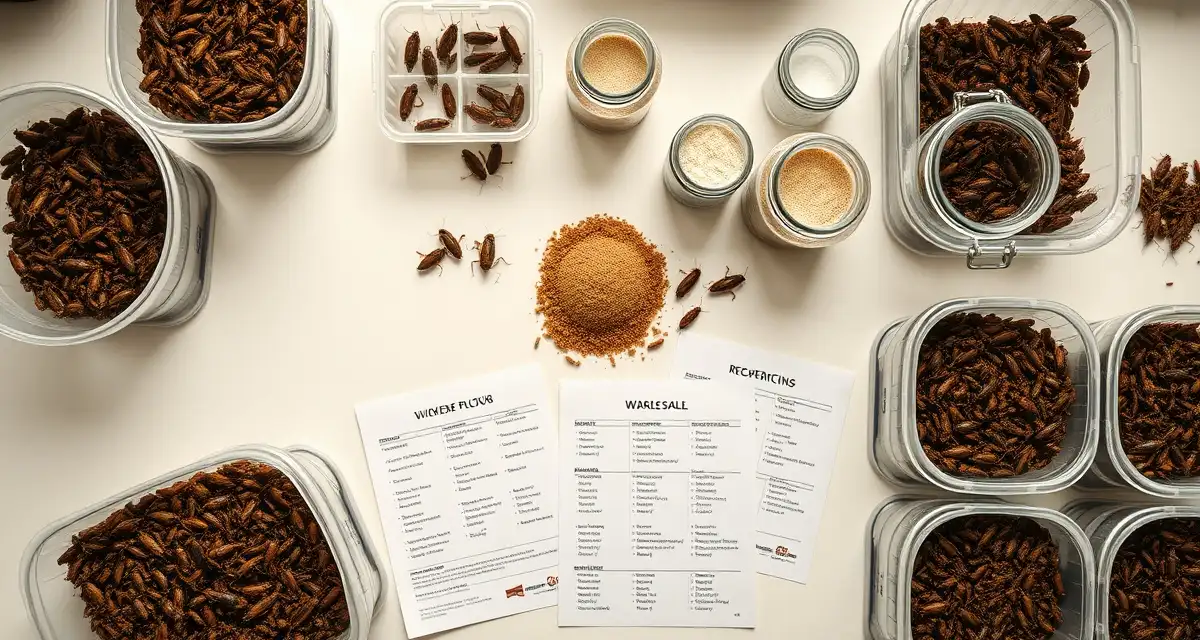
Cricket Farm Wholesale Pricing: How to Price Feeder Crickets and Cricket Flour
Feeder cricket wholesale prices range from $8 to $18 per thousand depending on size grade. Most cricket farm operators don't know this range before they price their first order. They guess, they undercut, and they lock themselves into pricing that doesn't support a profitable operation.
Pricing guides for cricket products don't exist publicly. Farmers price based on what a neighbor told them or what they think the buyer will accept. This guide provides specific 2026 market rate benchmarks for feeder crickets by size grade and cricket flour by quality tier, along with a practical approach to setting your own prices and volume discount structure.
TL;DR
- Feeder cricket wholesale prices range from $8 to $18 per thousand depending on size grade
- This guide provides specific 2026 market rate benchmarks for feeder crickets by size grade and cricket flour by quality tier, along with a practical approach to setting your own prices and volume discount structure
- For feeder crickets, most commercially viable operations target 30-50% gross margin
- Below 30%, you're running on thin margin that won't survive a bad batch or a feed price spike
- For cricket flour, gross margins of 40-60% are more typical because you're capturing more of the value chain than raw feeder production
- If a 15% discount on large orders cuts your gross margin below 25%, don't offer it
- In 2026, wholesale prices range from $8 to $18 per thousand depending on size grade
Step 2: Target Your Margin
For feeder crickets, most commercially viable operations target 30-50% gross margin.
- Below 30%, you're running on thin margin that won't survive a bad batch or a feed price spike.
- For cricket flour, gross margins of 40-60% are more typical because you're capturing more of the value chain than raw feeder production.
- If a 15% discount on large orders cuts your gross margin below 25%, don't offer it.
- Set minimums. 500 crickets minimum for local delivery accounts, 1,000 for shipped orders, is a reasonable starting point.
- In 2026, wholesale prices range from $8 to $18 per thousand depending on size grade.
Feeder Cricket Pricing in 2026
The feeder cricket wholesale market is more price-transparent than the food ingredient market, primarily because the end product (live crickets sold to consumers through pet stores) has visible retail pricing.
Wholesale Price by Size Grade
These are the market rate ranges for wholesale feeder crickets in 2026:
| Size Grade | Age (approx.) | Wholesale Price per 1,000 |
|------------|--------------|--------------------------|
| Pinhead (1/16") | 0-1 week | $14-18 |
| Extra small (1/8") | 1-2 weeks | $13-16 |
| Small (1/4") | 2-3 weeks | $10-14 |
| Medium (1/2") | 3-4 weeks | $9-13 |
| Large (3/4") | 4-5 weeks | $8-12 |
| Adult/XL (full grown) | 5-6 weeks | $8-12 |
Pinheads and extra smalls command the highest prices because they're the most perishable to ship, the highest mortality risk in transit, and the most labor-intensive to produce in consistent sizing. The price premium reflects real production complexity.
Large and adult grades are most price-competitive because they're the easiest to produce consistently and most farms produce them. This is where you compete most directly on price.
Regional Price Variation
Prices vary by region based on competing supply:
High supply regions (Southeast US, parts of the Midwest where multiple large cricket farms operate): prices tend toward the lower end of the range.
Lower supply regions (Pacific Northwest, Rocky Mountain states, New England): prices tend toward the upper end. Local supply scarcity is pricing power. If you're the only reliable local feeder cricket supplier in your region, you can price at or above the upper end of the range.
Direct-to-consumer vs. wholesale: If you're selling directly to reptile owners online, your prices should be 2-2.5x wholesale. Retail markup to consumers is where you capture the pet store margin rather than leaving it on the table.
Cricket Flour Pricing in 2026
Cricket flour for human consumption pricing is more variable and less publicly benchmarked than feeder cricket pricing. Here's the best available market data.
Price by Product Tier
| Product Type | Typical Wholesale Price |
|-------------|------------------------|
| Cricket flour, food grade, unbranded bulk | $12-18 per pound |
| Cricket flour, food grade, high-protein spec | $16-22 per pound |
| Organic certified cricket flour | $22-30 per pound |
| Whole roasted crickets, food grade | $18-25 per pound |
These are wholesale prices paid by food ingredient buyers and brands. Retail prices for branded cricket flour products run 3-5x these wholesale levels.
What drives price within the range:
- Protein content specification (higher protein = higher price)
- Moisture content and processing quality
- Batch documentation and COA quality (well-documented product commands premium)
- Supply reliability (farms with documented consistent supply get better pricing)
- Organic certification (price premium of $6-12 per pound above standard food-grade)
How to Set Your Wholesale Price
Setting prices isn't just about matching market rates. It's about understanding your costs and making sure your price supports a profitable operation.
Step 1: Calculate Your Cost Per Pound (or Per Thousand)
Before you can price correctly, you need to know your actual cost per unit. For feeder crickets:
- Total monthly variable costs (feed, labor, energy, packaging) / Total crickets produced per month = cost per cricket
- Cost per cricket × 1,000 = cost per thousand
If your cost per thousand large crickets is $7.50 and the market rate is $8-12 per thousand, your margin is thin at the low end. You need to either improve your costs or be in the upper half of the market pricing range.
For cricket flour: calculate your cost per pound including all feed, processing, packaging, and labor costs. Compare to market rates above.
Step 2: Target Your Margin
For feeder crickets, most commercially viable operations target 30-50% gross margin. Below 30%, you're running on thin margin that won't survive a bad batch or a feed price spike.
For cricket flour, gross margins of 40-60% are more typical because you're capturing more of the value chain than raw feeder production.
If your costs don't support your target margin at current market rates, the answer is cost reduction (improving FCR, reducing mortality, optimizing energy) before competing on price.
Step 3: Position Within the Market Range
You don't have to be the cheapest option to win accounts. In fact, being the cheapest option often signals lower quality to buyers.
Position your pricing based on:
- Your quality differentiators (size consistency, low DOA rate, documentation quality)
- Your supply reliability history
- Your geographic position (local supply vs. shipped supply)
A local farm delivering fresh crickets weekly to a pet store can price at the middle to upper part of the market range against distant suppliers who ship. The freshness and logistics simplicity are worth a premium to the buyer.
Volume Discount Structures
Volume discounts are standard in both feeder and food ingredient markets. Here's a practical structure.
Feeder Cricket Volume Tiers
| Weekly Order Volume | Discount |
|--------------------|---------|
| Under 5,000 crickets | Standard price |
| 5,000-15,000 crickets | 5% discount |
| 15,000-50,000 crickets | 10% discount |
| 50,000+ crickets per week | 12-15% (negotiate) |
The discount incentivizes buyers to commit to higher volumes, which is valuable for your production planning. Committed volume is worth a discount because it allows you to plan your bin rotation with confidence.
Protecting Your Margin on Volume Discounts
The mistake most small farms make is offering volume discounts that compress their margin below viability. Before publishing a discount tier, calculate your margin at each tier. If a 15% discount on large orders cuts your gross margin below 25%, don't offer it.
Minimum order requirements are a legitimate way to make volume discounts financially viable. A 10% discount with a 10,000-cricket minimum is only offered to buyers who are taking delivery of a volume that justifies the discount.
Avoiding Common Pricing Mistakes
Undercutting to win the account. New farms often price below market to get their first accounts. This establishes a price relationship that's hard to raise without losing the customer. Price at market from the first order. If you lose an account on price, the account probably wasn't worth winning at the lower price.
Not adjusting for cost increases. When feed prices rise, your pricing needs to follow. Most feeder buyers understand this. Have the pricing review conversation annually rather than absorbing cost increases silently until your margin is gone.
No minimum order. Offering any quantity at wholesale pricing means you're delivering 250 crickets to accounts that cost you more in labor and packaging than you're charging. Set minimums. 500 crickets minimum for local delivery accounts, 1,000 for shipped orders, is a reasonable starting point.
For the profitability context that informs your pricing decisions, see the cricket farm profitability guide. For the feeder market dynamics that affect pricing, see the feeder cricket market guide.
FAQ
What is the current wholesale price per thousand feeder crickets?
In 2026, wholesale prices range from $8 to $18 per thousand depending on size grade. Pinheads and extra smalls command the highest prices ($14-18 per thousand) because of production complexity and transit mortality risk. Large and adult grades are the most competitive ($8-12 per thousand). Regional supply variation also affects pricing: areas with less local competition support higher prices.
How do I price cricket flour for wholesale?
Cricket flour wholesale prices in 2026 range from $12-18 per pound for standard food-grade product, $16-22 per pound for high-protein spec product, and $22-30 per pound for organic-certified flour. Start by calculating your cost per pound (total production and processing costs divided by total pounds produced), target a 40-60% gross margin, and position within the market range based on your documentation quality, supply reliability, and protein specification capability.
How do I set up a volume discount structure for my cricket farm customers?
A simple tiered structure: standard price under 5,000 units per order, 5% discount from 5,000-15,000, 10% discount from 15,000-50,000, and negotiate above that. Calculate your margin at each tier before publishing the discount. Set minimum order requirements at each tier (it only makes sense to offer a 10% discount on orders large enough to justify it). Review your pricing structure annually as your costs change.
What documentation do food-grade cricket buyers typically require from suppliers?
Food manufacturers and distributors typically require a Certificate of Analysis (COA) for each batch, documentation of your food safety management system (HACCP plan), proof of facility registration with FDA if required, allergen management documentation, and supplier qualification questionnaires. Start building these records from your first commercial production batch -- retroactively reconstructing production documentation is difficult and sometimes impossible.
How should I price feeder crickets for wholesale accounts?
Wholesale pricing should cover your fully-loaded cost per unit plus a margin that accounts for the variable quality of large accounts (payment terms, return policies, volume discounts). A common approach is to start from your cost per 1,000 crickets (feed plus variable overhead plus allocated fixed costs), multiply by your target margin, and compare the result against known wholesale market rates. Feeder cricket wholesale prices vary significantly by species, size, and region.
What certifications improve the marketability of cricket products?
For food-grade products, certifications that resonate with buyers include USDA Organic (requires organic feed and approved inputs), non-GMO verification, and food safety system certifications such as SQF Level 2 or FSSC 22000. For feeder crickets going to pet industry accounts, health documentation and quarantine protocols are often more important than formal certifications. Check with your specific buyers to understand which certifications they value or require.
Sources
- Food and Agriculture Organization of the United Nations (FAO) -- Edible Insects: Future Prospects for Food and Feed Security
- North American Coalition for Insect Agriculture (NACIA)
- Specialty Food Association
- Good Food Institute -- Alternative Protein Market Data
- New Hope Network -- Natural Products Industry Research
Price Like the Professional Operation You Are
The farms that get the best prices aren't the ones with the most aggressive discounts. They're the ones with the best documentation, the most consistent quality, and the most reliable supply. Buyers pay for consistency and reliability.
Know your costs. Target your margin. Position based on your genuine differentiators. And don't compete primarily on price in a market where quality and reliability are the real purchasing decision.
That's how you build a pricing structure that supports a profitable operation year after year.
Get Started with CricketOps
Selling cricket products consistently to food-grade buyers requires demonstrating consistent quality and reliable fulfillment. CricketOps gives you the production records and batch traceability documentation that buyers increasingly require as part of their supplier qualification process. Start building your production documentation in CricketOps before your first major account asks for it.