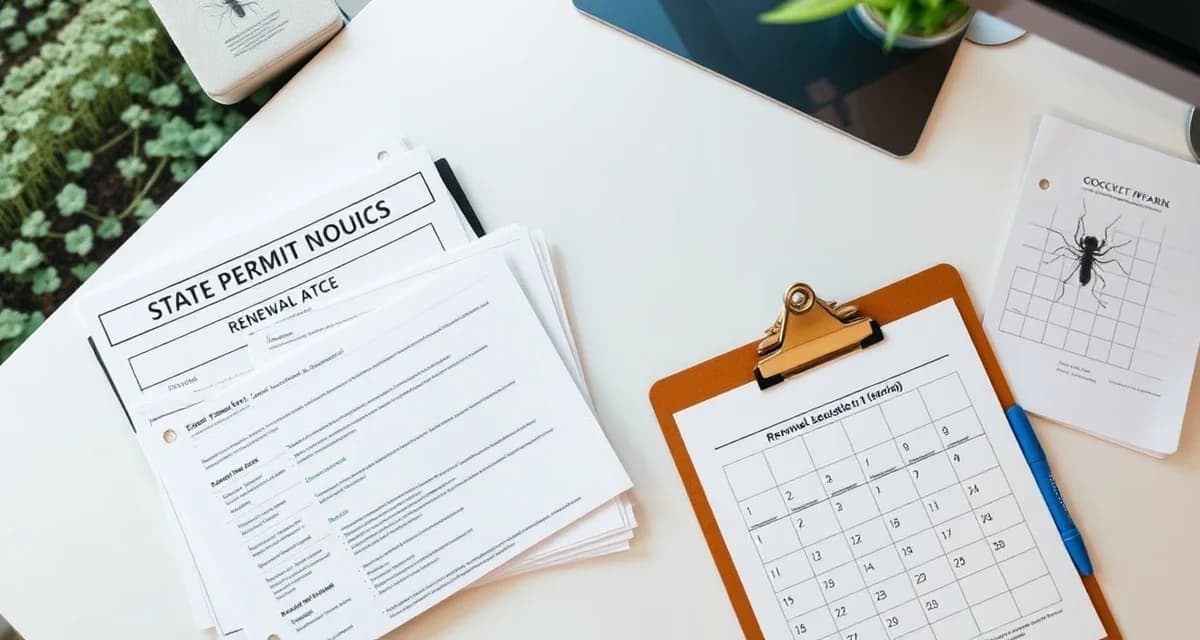
Cricket Farm State Permit Renewal: Staying Current with Your Agricultural Licenses
Failure to renew an insect producer license before expiration results in a mandatory cease-and-desist order in 5 US states. Those states don't issue warnings or grace periods; an expired permit means you're operating without authorization, and the enforcement response is an order to stop production. For a farm with live inventory that can't just be paused, this is a business-threatening event.
State permit requirements for cricket farms vary more than most operators realize. Some states require annual renewal, others biennial. Some have insect-specific permits; others regulate crickets under general agricultural production or livestock licenses. If you're not certain which permits your farm holds and when they renew, this guide gives you the framework to find out.
TL;DR
- Failure to renew an insect producer license before expiration results in a mandatory cease-and-desist order in 5 US states
- Biennial renewal: Permit is valid for 2 years
- Add your permit expiration date and a 60-day advance reminder to your compliance calendar
- The 60-day advance reminder system in CricketOps is designed specifically to prevent permit lapses
- Submit renewal materials at least 30 days before your expiration date to allow processing time
- Enter each expiration date into your CricketOps compliance calendar with a 60-day advance reminder
- A 60-day advance reminder gives you time to gather required documents, complete any required inspections, and submit renewal materials well before the deadline
Biennial renewal: Permit is valid for 2 years.
- Add your permit expiration date and a 60-day advance reminder to your compliance calendar.
- The 60-day advance reminder system in CricketOps is designed specifically to prevent permit lapses.
- Submit renewal materials at least 30 days before your expiration date to allow processing time.
- Enter each expiration date into your CricketOps compliance calendar with a 60-day advance reminder.
- A 60-day advance reminder gives you time to gather required documents, complete any required inspections, and submit renewal materials well before the deadline.
Which States Require Specific Insect Producer Permits
Not all states have insect-specific licensing. Cricket farms typically operate under one of three state regulatory structures:
State with insect-specific permit requirements: A growing number of states have adopted specific regulations for insect farming, including explicit permit or registration requirements. States that have been active in insect farming regulation include Texas, California, Florida, and several Midwestern agricultural states. These require you to hold an active permit and renew it on the state's schedule.
State regulating crickets under general livestock or agricultural production law: Many states don't have insect-specific regulations and instead apply existing agricultural licensing to cricket farms. In these states, you may hold a livestock production registration, an agricultural sales license, or similar general permit.
State with no specific permit requirement for insect production: Some states don't currently require a state-level permit for cricket farming, though county and local permits may still apply.
To confirm your specific state requirements, contact your state Department of Agriculture. Provide them with your production description (live Acheta domesticus, sold as feeder insects and/or for food production) and ask what permits, registrations, or licenses they require for your operation.
Annual vs. Biennial Renewal Cycles
Most state permits for agricultural producers renew on one of these schedules:
Annual renewal (calendar year): Permit expires December 31 and must be renewed by January 31 of the following year. Some states require renewal by the anniversary of initial issuance rather than calendar year-end.
Biennial renewal: Permit is valid for 2 years. Renewal is due before the expiration date, which is typically 2 years after the initial issuance date.
Anniversary-date renewal: Some states issue permits that expire on the anniversary of the initial issuance date. Your permit card or certificate should show the expiration date.
Add your permit expiration date and a 60-day advance reminder to your compliance calendar. The cricket farm compliance calendar guide provides the full framework for managing regulatory deadlines.
What You Need for State Permit Renewal
While requirements vary by state, most state permit renewals require:
Updated facility information. If your facility address, phone number, ownership structure, or primary contact has changed since your last renewal, report the changes during renewal.
Production volume reporting. Some states require annual reporting of production volumes (pounds produced, sales revenue) as part of the renewal. This data is used for agricultural census purposes.
Fee payment. Most state permits require a renewal fee. Fees for insect producer permits typically range from $25-$200 depending on the state and your operation scale.
Confirmation of continued compliance. Some states require an attestation that your operation continues to comply with applicable regulations, including any food safety or environmental requirements.
Third-party inspection or audit (less common). A small number of states require facility inspection as part of permit renewal. If your state requires this, schedule the inspection well before your renewal deadline.
What Happens If You Let a Permit Lapse
Mandatory stop-work orders. In states with enforcement programs, an expired permit can trigger an automatic cease-and-desist order. You're not given time to catch up; you're required to stop production immediately.
Retroactive penalty fees. Some states charge penalty fees for the period between permit expiration and renewal. These fees can exceed the normal renewal fee significantly.
Permit reinstatement delays. A lapsed permit that requires reinstatement (as opposed to simple renewal) may take weeks or months to restore, during which production is unauthorized.
Customer and distribution impacts. If your permits are public record and a customer or distributor verifies your permit status, a lapsed permit can trigger contract issues or supply disruption.
The 60-day advance reminder system in CricketOps is designed specifically to prevent permit lapses. Set your reminders now, before any deadlines are imminent.
Tracking Multiple State Permits
Farms that sell across state lines may hold permits in multiple states. Each state has its own renewal date and requirements. Managing multiple state permits requires:
- A master list of all permits held. Farm name, permit number, issuing authority, expiration date.
- 60-day advance reminders for each. Don't rely on the state to notify you; states vary in how reliably they send renewal notices.
- A consistent renewal process. Many state renewals can be completed online; bookmark the renewal portal for each state's permit.
The cricket farm compliance overview covers your full regulatory permit structure, including which permits apply to feeder cricket sales versus food production.
Frequently Asked Questions
How do I renew my cricket farm state permit?
Log into your state Department of Agriculture's online licensing portal (most states now offer online renewal) using your existing permit credentials. Review and update your facility information, complete any required production reporting, pay the renewal fee, and submit. You'll receive a confirmation and updated permit certificate by email or mail. If your state doesn't have an online renewal portal, contact your state ag department directly for paper renewal forms. Submit renewal materials at least 30 days before your expiration date to allow processing time. For states that require facility inspection as part of renewal, initiate that process 60-90 days before your expiration date.
What documentation do I need for annual permit renewal?
Most state agricultural permit renewals require your current permit number (from your existing permit certificate), updated contact and facility information, production volume data for the prior year if your state requires reporting, and payment of the renewal fee. Some states request copies of any relevant food safety certifications, FDA registration confirmation, or insurance certificates. Gather these documents before starting your renewal application so you can complete the process in a single session. Keep your renewed permit certificate accessible and update your master permit file with the new expiration date immediately after renewal.
How do I track state permit renewal deadlines for my cricket farm?
Create a master permit list that includes every permit you hold at the state and county level, with the issuing agency, permit number, expiration date, and renewal fee. Enter each expiration date into your CricketOps compliance calendar with a 60-day advance reminder. Don't rely on receiving a renewal notice from the state; some states send notice, some don't, and mail can be missed. A 60-day advance reminder gives you time to gather required documents, complete any required inspections, and submit renewal materials well before the deadline. Check your permit expiration dates annually even if your reminder system is in place; permit renewal cycles can change with regulatory updates.
Do federal regulations differ from state regulations for cricket farming?
Yes. Federal oversight of insect production for human food falls primarily under FDA authority, including Food Safety Modernization Act (FSMA) requirements. State regulations vary widely -- some states have specific insect production permits, others treat cricket farming under broader agricultural licensing frameworks. Operations selling across state lines must comply with both their state of production and the destination state's requirements. Check with your state department of agriculture and an attorney familiar with food law for current requirements.
What documentation should I keep to demonstrate regulatory compliance?
Maintain records of feed ingredient sourcing with supplier documentation, batch production records, environmental monitoring logs (temperature, humidity), mortality records, sanitation logs, and any third-party audit results. Buyers from food manufacturing companies increasingly require these records as part of their supplier qualification process, so keeping them organized from the start saves significant effort later.
How often should a cricket farm conduct internal food safety audits?
A minimum of one formal internal audit per quarter is a reasonable starting point for a commercial operation. The audit should cover environmental monitoring records, sanitation log completeness, pest control documentation, and critical control point records for your HACCP plan. Operations seeking third-party certification (SQF, BRC, or similar) should align internal audit frequency and format with the standard's requirements.
Sources
- Food and Agriculture Organization of the United Nations (FAO) -- Edible Insects: Future Prospects for Food and Feed Security
- North American Coalition for Insect Agriculture (NACIA)
- U.S. Food and Drug Administration (FDA) -- Food Safety Modernization Act (FSMA)
- USDA National Organic Program
- Global Food Safety Initiative (GFSI)
Get Started with CricketOps
Maintaining organized compliance records is much easier when you build the system from day one rather than reconstructing it before an audit. CricketOps keeps your batch records, environmental monitoring logs, and traceability data in one place so that responding to a buyer documentation request or a regulatory inquiry does not require hunting through spreadsheets and paper files.