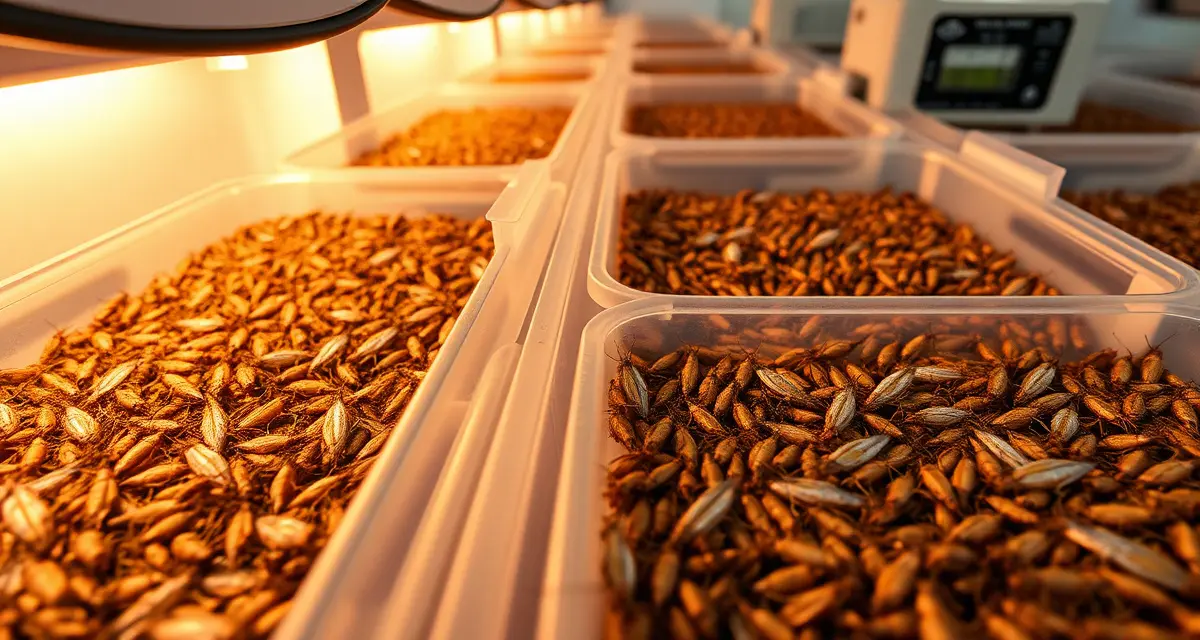
Juvenile Cricket Temperature Guide: Nymph Stages 3-7
Here's something most cricket farming guides won't tell you: the juvenile stage, instars 3 through 7, is where temperature deviation does the most damage to your bottom line. Not through mass die-offs, which tend to be dramatic and obvious, but through quietly degraded feed conversion ratios that don't show up until you're staring at a harvest that came in 15% light.
The juvenile stage is the period when temperature deviation has the greatest impact on final harvest weight. That's not a minor footnote. It's the central insight for anyone trying to optimize their cricket farm's economics.
TL;DR
- Here's something most cricket farming guides won't tell you: the juvenile stage, instars 3 through 7, is where temperature deviation does the most damage to your bottom line
- Not through mass die-offs, which tend to be dramatic and obvious, but through quietly degraded feed conversion ratios that don't show up until you're staring at a harvest that came in 15% light
- Sustained 90°F or above during instars 3-7 begins to increase stress mortality and can shorten the effective juvenile phase without improving harvest weight
- Suppose your target is 87°F and your actual average over a 21-day juvenile phase is 83°F, a 4-degree deficit that might not trigger any alarms on a simple thermostat
- The transition from pinhead (instars 1-2) to juvenile (instars 3-7) brings some important changes in how temperature affects cricket biology
- A juvenile cricket at 83°F won't die the way a pinhead would
- Occasional peaks to 90°F are fine
87-88°F is a solid operational target.
- Most commercial operations running tight margins target this range.
90°F approaches the upper limit for prolonged juvenile exposure.
- Sustained 90°F or above during instars 3-7 begins to increase stress mortality and can shorten the effective juvenile phase without improving harvest weight.
- Suppose your target is 87°F and your actual average over a 21-day juvenile phase is 83°F, a 4-degree deficit that might not trigger any alarms on a simple thermostat.
What Changes at Instar 3
The transition from pinhead (instars 1-2) to juvenile (instars 3-7) brings some important changes in how temperature affects cricket biology.
Pinheads are fragile and cold-sensitive to the point of dying quickly when temperatures drop. Juveniles are more resilient in terms of survival, but that resilience is deceptive. A juvenile cricket at 83°F won't die the way a pinhead would. It'll just grow slowly, eat inefficiently, and deliver a suboptimal yield.
The biological reason is that feed conversion efficiency in crickets peaks during the rapid growth phase of the juvenile stage. At the right temperature, every gram of feed goes predominantly toward growth. Drop the temperature and a greater proportion of that same feed goes toward thermogenesis, the cricket's attempt to maintain internal temperature. You're paying for feed that produces heat instead of cricket.
The Target Temperature Range for Juveniles: 85-90°F
This range supports maximum growth rate and best feed conversion:
85°F is the practical lower bound. Below this, feed conversion starts to slip. Development slows noticeably. You may not see mortality spikes, but your batch will take longer to reach harvest size and will come in underweight.
87-88°F is a solid operational target. This balances energy costs with production efficiency. Most commercial operations running tight margins target this range.
90°F approaches the upper limit for prolonged juvenile exposure. Occasional peaks to 90°F are fine. Sustained 90°F or above during instars 3-7 begins to increase stress mortality and can shorten the effective juvenile phase without improving harvest weight.
Compare this with pinhead requirements of 88-92°F and adult requirements of 82-88°F, and you'll see why multi-zone temperature management is worth considering at commercial scale.
How Temperature Deviation Compounds Over Time
The math on this is illuminating. Suppose your target is 87°F and your actual average over a 21-day juvenile phase is 83°F, a 4-degree deficit that might not trigger any alarms on a simple thermostat.
At 83°F, development takes approximately 30-35% longer to reach instar 7. Feed consumption continues across those extra days. Your FCR (feed conversion ratio), the grams of feed per gram of cricket produced, worsens because you're feeding the same crickets for more days to reach the same weight.
If your target FCR is 2.0:1 and a 4-degree temperature deficit pushes it to 2.4:1, that 20% increase in feed cost flows directly out of your margin. At any meaningful production scale, that's hundreds or thousands of dollars per month in unnecessary feed expense.
Multi-Zone Temperature Management
The practical challenge for most farms is that adults, juveniles, and pinheads all want different temperatures. Running your whole facility at 90°F satisfies your pinheads but stresses your adults. Running at 85°F keeps adults comfortable but disadvantages your juveniles.
A few approaches worth considering:
Separate Juvenile Zone
Dedicate a section of your facility, or a separate smaller room, to instars 3-7. Set this zone to 87-88°F and run your adult area slightly cooler. This requires more real estate but dramatically simplifies temperature optimization.
Vertical Temperature Stratification
Warm air rises. A room at 86°F at the thermostat level may be 82-83°F at floor level and 88-89°F near the ceiling. You can use this to your advantage by positioning juvenile bins on upper shelves and adult bins on lower shelves. It's not precise, but it's zero-cost once you understand the gradient in your specific space.
Time-Based Scheduling
If your juvenile bins progress through instars 3-7 on a predictable schedule, you can synchronize batch timing to concentrate juveniles during higher-temperature periods (summer for farms in cooler climates) or during peak heating efficiency windows.
Check cricket farm temperature guide for detailed equipment options and zone management strategies.
Nighttime Temperature Management
This is where a lot of juvenile temperature problems originate. Daytime temperatures check out fine when you're in the building. But farm buildings cool down at night, and a juvenile bin that averages 87°F across a 24-hour period may actually be spending 10 of those hours at 82-83°F.
The average temperature across the day matters, but so does the minimum. Extended exposure to temperatures below 82°F during the dark hours accumulates as growth deficit. The crickets don't "catch up" during the warm part of the day. They simply average out with more days needed to reach target size.
Smart thermostats with overnight setpoint settings help measurably here. Set your heating system to maintain 87°F rather than just reaching it during peak hours. See the Acheta domesticus lifecycle guide for more on how temperature integrates with overall developmental timing.
Monitoring Temperature at Bin Level, Not Room Level
A recurring theme in cricket farm temperature management: the thermostat on the wall and the actual temperature in your bins are often different numbers.
Causes of the gap:
- Bins themselves generate heat. A heavily populated juvenile bin in a confined space may run 2-3°F warmer than the room thermostat reads.
- Shelving location matters. Bins on the top shelf near the ceiling in a room with a high-mounted thermostat may be 4-5°F warmer than the room average.
- Poor air circulation creates temperature gradients. A room with a single wall-mounted fan can have 6-8°F of variation between the fan side and the far corner.
Buy a handful of inexpensive wireless probe thermometers. Place them in bins throughout your juvenile section and log the readings daily. After a week, you'll have a clear picture of the actual temperature environment your juveniles are experiencing, and it'll almost certainly differ from what your wall thermostat reads.
FCR Benchmarks by Temperature
Based on published insect biology research and commercial operator data:
| Temperature | Relative Development Rate | FCR Impact |
|------------|--------------------------|------------|
| 82°F | ~70% of optimal | FCR +30-40% worse |
| 85°F | ~85% of optimal | FCR +15-20% worse |
| 87°F | ~95% of optimal | FCR +5% worse |
| 88-90°F | 100% (optimal) | Baseline |
| Above 92°F | Declining | FCR worsens, mortality rises |
Running cool doesn't just cost you time. It costs you feed.
Frequently Asked Questions
What temperature should juvenile crickets be kept at?
The optimal range for juvenile crickets (instars 3-7) is 85-90°F, with 87-88°F as a practical operational target for most commercial farms. Below 85°F, feed conversion efficiency begins to decline noticeably. Above 90°F for sustained periods, stress mortality begins to increase.
Does temperature during the juvenile stage affect final harvest yield?
Yes, and it's one of the largest controllable variables in cricket farm economics. Temperature during instars 3-7 directly affects feed conversion ratio. A 4°F deficit from optimal can worsen FCR by 20-30%, meaning you're spending measurably more on feed to produce the same harvest weight.
How do I prevent temperature drops during the nymph stage?
The key interventions are nighttime thermostat management (setting overnight heating targets to prevent the facility from cooling below 85°F), using in-bin or under-bin supplemental heat sources for juvenile bins, and monitoring actual bin-level temperature rather than relying solely on room thermostats. Wireless probe thermometers in representative juvenile bins give you the ground truth you need.
How do I recover a cricket bin after an accidental temperature spike?
First, restore the target temperature for that life stage immediately. Remove any dead crickets to prevent ammonia buildup and monitor the bin closely for the next 48-72 hours. If you see continued elevated mortality, assess whether the colony has enough healthy population to recover or whether early harvest is the better option. Maintaining a detailed temperature log makes it easier to understand how severe the event was and adjust heating protocols to prevent a repeat.
What is the best way to measure temperature inside a cricket bin accurately?
A digital probe thermometer placed at mid-bin height, away from heating elements and exterior walls, gives the most representative reading for the cricket population's actual environment. Infrared (non-contact) thermometers measure surface temperature only and frequently give misleading readings in bin environments. Data-logging sensors that record continuously are preferable to manual spot-checks, since swings between readings can go undetected.
How much does electricity cost to maintain target temperatures in a cricket facility?
Energy cost varies significantly by facility size, climate, and insulation quality. A well-insulated small operation (under 30 bins) in a moderate climate typically adds $40-$80/month to electricity costs for heating. Larger commercial facilities in cold climates can spend $300-$800/month or more during winter months. Improving building insulation is usually the highest-ROI investment for reducing heating costs compared to upgrading heating equipment.
Sources
- Food and Agriculture Organization of the United Nations (FAO) -- Edible Insects: Future Prospects for Food and Feed Security
- North American Coalition for Insect Agriculture (NACIA)
- Entomological Society of America
- University of Florida IFAS Extension -- Entomology and Nematology Department
- USDA Agricultural Research Service
Get Started with CricketOps
Maintaining the right environmental conditions in a cricket facility depends on having reliable data -- not just what your thermostat is set to, but what temperatures your bins actually experienced overnight and over the past week. CricketOps connects to temperature and humidity sensors, logs readings by bin, and alerts you when conditions drift outside your set thresholds. Try CricketOps and build the environmental record your operation needs.