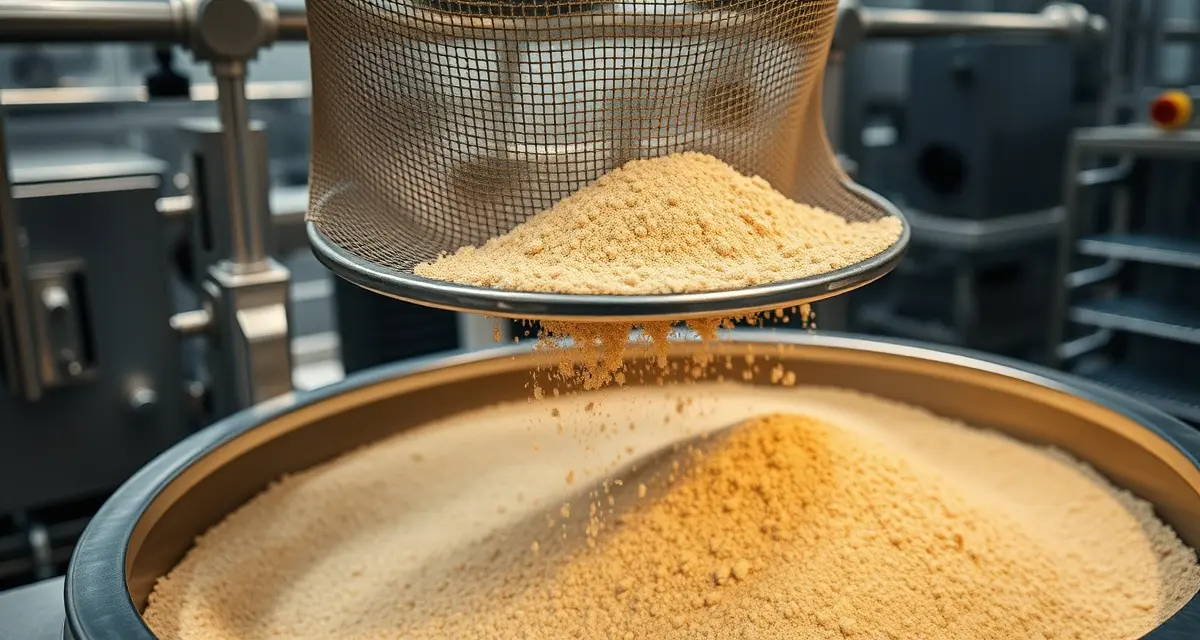
Cricket Flour Sieving and Grading: Creating Consistent Particle Size Distributions
A two-stage sieving process produces a fine flour (below 100 microns) for baking and a coarser protein powder (150-300 microns) for smoothie applications from a single milling run. Instead of one undifferentiated product, you get two distinct products at different price points from the same input.
Sieving is the step that converts a milled cricket output with a wide particle size distribution into a commercial product with defined, consistent specifications. Without it, you're selling whatever your mill produces, which is a blend of particle sizes that performs inconsistently across applications.
TL;DR
- A two-stage sieving process produces a fine flour (below 100 microns) for baking and a coarser protein powder (150-300 microns) for smoothie applications from a single milling run
- Material passing through a 100-mesh sieve is below 150 microns, appropriate for baking applications
- Material passing 60-mesh but retained on 100-mesh is the 150-250 micron protein powder fraction
- Retains particles above 400 microns that should be re-milled
- A standard two-stage sieving setup uses a 40-mesh top screen (removes oversize for re-milling) and a 100-mesh bottom screen (separates baking flour from coarser powder)
- For small commercial operations (up to 50 lbs/hour throughput), a vibratory sieve shaker is the appropriate tool
- These units hold 2-3 sieve frames stacked vertically with an electric motor providing consistent vibration
- Oversize (retained on the coarsest sieve). Too large for any powder application.
- Return to the mill for re-milling.
- Mid-grade fraction (passed through coarse sieve, retained on fine sieve). 150-300 micron protein powder.
- Appropriate for smoothie blending and protein supplement applications.
- Fine flour (passed through both sieves). Below 100-150 microns.
- The two most useful sizes for cricket flour grading:
100-mesh (150 microns). This is your primary baking/food-grade separation point.
- Material passing through a 100-mesh sieve is below 150 microns, appropriate for baking applications.
60-mesh (250 microns). Separates your coarser protein powder grade.
- Material passing 60-mesh but retained on 100-mesh is the 150-250 micron protein powder fraction.
40-mesh (400 microns). A coarser screen for initial separation before the finer stages.
Understanding Particle Size Distribution
When you mill dried crickets, the output isn't a uniform particle size. It's a distribution: some particles finer than your target, some at your target, some coarser. This distribution depends on your mill type, screen size, feed rate, and the physical properties of your specific cricket material.
Sieving separates this distribution into fractions with more defined particle size ranges. A two-stage sieve separates your milled output into three fractions:
- Oversize (retained on the coarsest sieve). Too large for any powder application. Return to the mill for re-milling.
- Mid-grade fraction (passed through coarse sieve, retained on fine sieve). 150-300 micron protein powder. Appropriate for smoothie blending and protein supplement applications.
- Fine flour (passed through both sieves). Below 100-150 microns. Baking-grade cricket flour.
Mesh Size Selection
Sieve mesh sizes are typically described in mesh count (threads per inch) or micron openings. The two most useful sizes for cricket flour grading:
100-mesh (150 microns). This is your primary baking/food-grade separation point. Material passing through a 100-mesh sieve is below 150 microns, appropriate for baking applications.
60-mesh (250 microns). Separates your coarser protein powder grade. Material passing 60-mesh but retained on 100-mesh is the 150-250 micron protein powder fraction.
40-mesh (400 microns). A coarser screen for initial separation before the finer stages. Retains particles above 400 microns that should be re-milled.
A standard two-stage sieving setup uses a 40-mesh top screen (removes oversize for re-milling) and a 100-mesh bottom screen (separates baking flour from coarser powder).
Sieving Equipment Options
Vibratory Lab Sieve Shakers
For small commercial operations (up to 50 lbs/hour throughput), a vibratory sieve shaker is the appropriate tool. These units hold 2-3 sieve frames stacked vertically with an electric motor providing consistent vibration.
Equipment cost: $500-$3,000 for sieve shakers appropriate for cricket flour. Sieve frames (8-12 inch diameter) add $30-$100 each.
Throughput: Typically 5-20 lbs per batch, depending on screen area and vibration intensity.
Best for: Small-scale production batches and quality control sampling.
Rotary Drum Sieves (Trommel Screens)
For higher throughput, rotary drum sieves use a rotating perforated drum that continuously feeds material through the screen. These are appropriate for operations processing 100+ lbs per batch.
Equipment cost: $2,000-$15,000 for small-to-medium commercial trommel sieves.
Throughput: 50-200+ lbs per hour depending on screen area and rotation speed.
Best for: Commercial flour production operations where sieving is a continuous process rather than a batch step.
Centrifugal Sieving (Centrifugal Screeners)
High-end option for fine flour production. Uses centrifugal force to push material through the screen, achieving higher throughput with finer screens than gravity-fed sieves.
Equipment cost: $5,000-$30,000+ for commercial centrifugal screeners.
Best for: Large operations producing very fine flour (below 75 microns) where high throughput is required.
The Two-Stage Sieving Process
Here's the step-by-step for a production batch:
Step 1: Pre-sieve setup. Stack your sieve frames in order from coarsest (top) to finest (bottom), with a collection tray at the bottom. For a two-stage setup: 40-mesh on top, 100-mesh in the middle, collection pan at the bottom.
Step 2: Load sieving capacity. Don't overload your sieve. Overloading reduces efficiency and produces wider particle size distribution in the output fractions. For a standard 12-inch sieve, limit loads to 500g-1kg per batch for accurate results.
Step 3: Sieve for the appropriate time. For vibratory sieve shakers, 5-10 minutes at medium vibration intensity is typical. Check your manufacturer's recommended time for your specific material.
Step 4: Collect and label fractions. The oversize fraction (retained on 40-mesh) is material to re-mill. The mid-grade fraction (retained on 100-mesh) is your coarser protein powder grade. The fines (in the collection pan) are your baking-grade flour.
Step 5: Weigh and record each fraction. For production control, you want to know the proportion of each fraction your milling process produces. Consistent ratios indicate stable milling performance. Significant changes in fraction distribution signal a milling issue.
Step 6: Re-mill oversize fraction. Return the oversize material to your mill for another pass. Most mills can process recycled oversize efficiently.
Creating Multiple Product SKUs
The two-fraction output from a single milling and sieving run creates a practical opportunity for product differentiation:
Fine cricket flour (<150 microns): Your primary baking-grade product. Higher value per pound. Appropriate for retail flour applications.
Coarse cricket protein powder (150-300 microns): A distinct product with different application recommendations. Can be sold at the same or slightly lower price point than the fine flour, depending on your market.
Both products come from the same production run, with sieving as the only additional step. For operations producing large volumes, the fraction distribution (roughly 60-70% fine flour, 20-30% protein powder, 10% oversize for re-milling, based on typical hammer mill output) creates a natural product mix that serves different buyer segments.
For complete production workflow integration, connect your sieving data to your cricket flour production guide batch records.
Frequently Asked Questions
How do I create consistent particle size in my cricket flour?
Consistent particle size requires controlling three variables: milling (consistent screen size, feed rate, and input moisture), sieving (consistent sieve mesh, sieve time, and batch size), and re-milling oversize (returning oversized particles to the mill for a second pass). The single most important step for consistency is sieving every batch to the same target mesh size. Without sieving, your product particle size varies with every change in input material properties or milling conditions. With consistent sieving, you remove particle size variability and produce a defined specification that buyers can rely on. Verify your sieve output periodically by testing a sample with a laser particle size analyzer if you have access to one, or use a wet sieve test with a reference standard.
What mesh size sieve should I use for cricket flour production?
For baking-grade cricket flour, a 100-mesh sieve (150-micron opening) is the standard separation point. Material passing through a 100-mesh sieve is appropriate for baking applications. For a two-stage sieving process that creates both a fine baking flour and a coarser protein powder, stack a 40-mesh (400 microns) over a 100-mesh. The 40-mesh removes true oversize for re-milling, and the 100-mesh separates baking flour from the 150-400 micron protein powder fraction. For very fine applications (below 75 microns for some premium baking and ingredient applications), add a 200-mesh (75 micron) screen as your final stage. Most entry-level cricket flour operations start with just a 100-mesh and add stages as they develop multiple product grades.
Can I sell different particle size grades of cricket flour at different price points?
Yes, and this is one of the most practical ways to increase revenue from the same production volume. Fine baking-grade cricket flour (below 150 microns) commands the highest price per pound in most markets because it performs best in the broadest range of applications. The coarser protein powder fraction (150-300 microns) can be positioned as a smoothie/protein shake ingredient and sold at a similar or slightly lower price point with different marketing. The key is developing distinct product specifications, application guides, and marketing for each grade so buyers understand why they're choosing one over the other. Both products come from the same milling run with only the sieving step creating the separation.
What documentation do food-grade cricket buyers typically require from suppliers?
Food manufacturers and distributors typically require a Certificate of Analysis (COA) for each batch, documentation of your food safety management system (HACCP plan), proof of facility registration with FDA if required, allergen management documentation, and supplier qualification questionnaires. Start building these records from your first commercial production batch -- retroactively reconstructing production documentation is difficult and sometimes impossible.
How should I price feeder crickets for wholesale accounts?
Wholesale pricing should cover your fully-loaded cost per unit plus a margin that accounts for the variable quality of large accounts (payment terms, return policies, volume discounts). A common approach is to start from your cost per 1,000 crickets (feed plus variable overhead plus allocated fixed costs), multiply by your target margin, and compare the result against known wholesale market rates. Feeder cricket wholesale prices vary significantly by species, size, and region.
What certifications improve the marketability of cricket products?
For food-grade products, certifications that resonate with buyers include USDA Organic (requires organic feed and approved inputs), non-GMO verification, and food safety system certifications such as SQF Level 2 or FSSC 22000. For feeder crickets going to pet industry accounts, health documentation and quarantine protocols are often more important than formal certifications. Check with your specific buyers to understand which certifications they value or require.
Sources
- Food and Agriculture Organization of the United Nations (FAO) -- Edible Insects: Future Prospects for Food and Feed Security
- North American Coalition for Insect Agriculture (NACIA)
- Specialty Food Association
- Good Food Institute -- Alternative Protein Market Data
- New Hope Network -- Natural Products Industry Research
Get Started with CricketOps
Selling cricket products consistently to food-grade buyers requires demonstrating consistent quality and reliable fulfillment. CricketOps gives you the production records and batch traceability documentation that buyers increasingly require as part of their supplier qualification process. Start building your production documentation in CricketOps before your first major account asks for it.