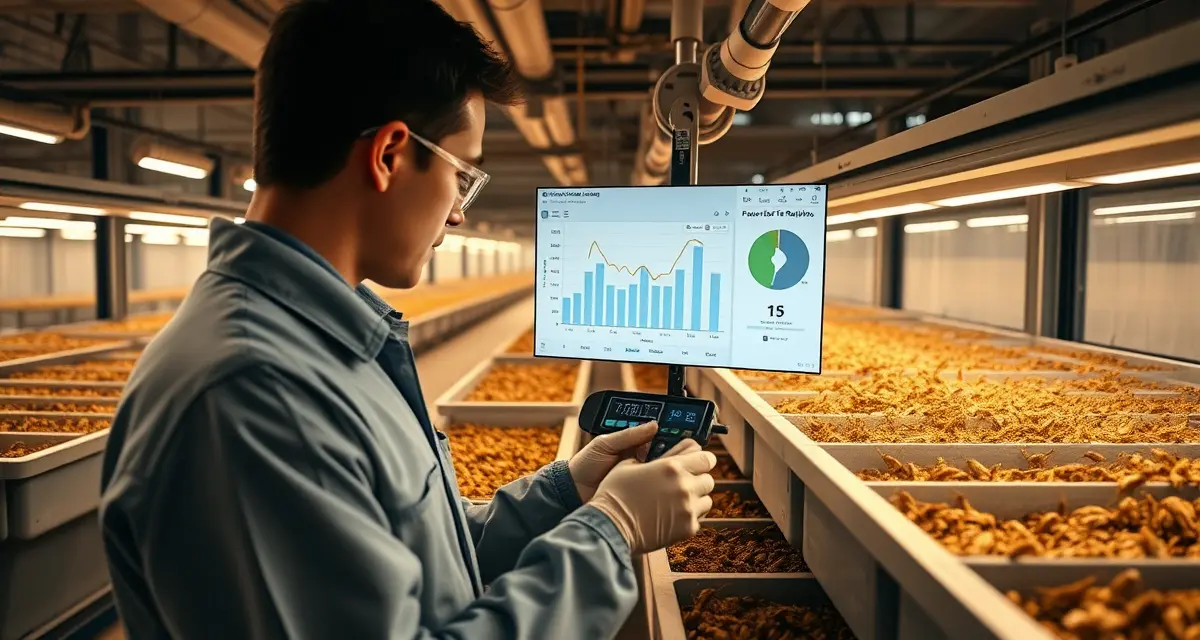
Cricket Farm FCR Calculator: Feed Conversion Ratio Tool
The best-in-class FCR for Acheta domesticus is approximately 1.5 kg of feed per kg of live weight output. The industry average is 1.7–2.1. If you don't know your number, you don't know where you are.
Use this calculator to get your FCR per bin, then compare against benchmarks to see how much room you have to improve.
TL;DR
- The best-in-class FCR for Acheta domesticus is approximately 1.5 kg of feed per kg of live weight; the industry average runs 1.7-2.1.
- FCR formula: total feed input divided by harvest weight, using consistent units throughout.
- Example: 1,840g feed divided by 950g harvest = FCR of 1.94, above the 1.7 benchmark and worth investigating.
- In most operations, 20% of bins drive 60% of feed waste -- you only find those bins with per-bin data, not farm averages.
- A farm averaging FCR 1.9 may have 35 bins at 1.7 and 5 bins at 3.1 hidden inside that aggregate number.
- The most common causes of high FCR are suboptimal feed protein, low pinhead feeding frequency, and temperature variance during grow-out.
- Most farms see FCR improvement within 1-2 cycles after stabilizing temperature in the 85-90°F range.
FCR Calculator
The Formula: FCR = Total Feed Input (kg) ÷ Harvest Weight (kg)
To calculate your bin FCR:
- Sum all feed deliveries to a bin across its grow-out cycle (in kg or lbs, keep units consistent)
- Weigh your harvest output from that bin (in the same units)
- Divide feed input by harvest weight
| If you fed... | And harvested... | Your FCR is... |
|---|---|---|
| 1.5 kg | 1.0 kg | 1.5 (excellent) |
| 1.7 kg | 1.0 kg | 1.7 (benchmark) |
| 2.0 kg | 1.0 kg | 2.0 (room for improvement) |
| 2.5 kg | 1.0 kg | 2.5 (significant issues) |
Example: You fed Bin 014 a total of 1,840g of feed across its 5-week grow-out. At harvest, it yielded 950g of live crickets.
FCR = 1,840 ÷ 950 = 1.94, above benchmark, worth investigating.
FCR Benchmarks for Acheta domesticus
| FCR | Assessment | Common Causes |
|---|---|---|
| 1.4–1.6 | Excellent, best-in-class | Optimal temperature, feed quality, and density |
| 1.7–1.9 | Good, at or near industry benchmark | Well-managed operation |
| 2.0–2.3 | Above average, room to improve | Suboptimal feed frequency or temp variance |
| 2.4–2.8 | Poor, significant losses | Temperature issues, overcrowding, feed quality |
| Above 2.8 | Critical, investigate immediately | Multiple compounding problems |
What FCR Should I Aim for With House Crickets?
For Acheta domesticus in a well-managed commercial operation, target FCR is 1.7. This is the industry benchmark based on commercial farm data.
If you're new to tracking FCR, don't be discouraged if your first measurements come in above 2.0. Most farms see FCR improve as they:
- Increase feeding frequency at the pinhead stage
- Stabilize temperature in the 85–90°F range throughout grow-out
- Optimize bin density (overcrowding degrades FCR)
- Improve feed protein content (aim for 22–25%)
Why Track FCR Per Bin Instead of Farm Average?
Farm-average FCR hides the signal. In most operations, 20% of bins drive 60% of feed waste. These underperformers look fine in aggregate, but when you look at FCR per bin, they stand out.
A farm running an average FCR of 1.9 might have:
- 35 bins averaging 1.7 (good)
- 10 bins averaging 2.4 (poor)
- 5 bins averaging 3.1 (critical)
The 5 critical bins might be in a cold corner of the room, or near a draft, or have been overstocked. You'll only find them with per-bin data.
FAQ
What FCR should I aim for with house crickets?
For Acheta domesticus in a well-managed commercial operation, target FCR is 1.7. This is the industry benchmark based on commercial farm data. Best-in-class operations achieve FCR around 1.5. If your first measurements come in above 2.0, focus on the three most common drivers: feed protein content (aim for 22-25%), feeding frequency at the pinhead stage (3x per day), and temperature stability in the 85-90°F range.
How do I track FCR accurately across multiple bins?
Record the total feed input to each bin across its entire grow-out cycle (from stocking to harvest), then weigh the live harvest output from that bin. Divide feed input by harvest weight using consistent units. The key is logging every feeding event to a specific bin, not just total farm-wide feed purchases. Without per-bin feed logs, you can calculate a farm average but cannot identify which specific bins are underperforming.
How often should I calculate FCR?
Calculate FCR at the end of each bin's grow-out cycle when you harvest. This gives you one data point per bin per cycle. After 3-5 cycles, you will have enough data to see patterns -- bins that consistently run high FCR, seasonal variation, and the impact of any feed or management changes you made. One-off FCR calculations are useful, but trend data over multiple cycles is what reveals actionable patterns.
Sources
- Food and Agriculture Organization of the United Nations (FAO) -- Edible Insects: Future Prospects for Food and Feed Security
- North American Coalition for Insect Agriculture (NACIA)
- Journal of Insects as Food and Feed (Wageningen Academic Publishers)
- Entomological Society of America
- University of Georgia Cooperative Extension
Get Started with CricketOps
Consistent harvest timing and FCR improvement both require historical data on how your specific bins perform across the production cycle. CricketOps tracks growth milestones, logs harvest weights by bin, and builds the record that lets you identify which bins consistently hit your targets and which ones need attention. Try CricketOps on your next production cycle.