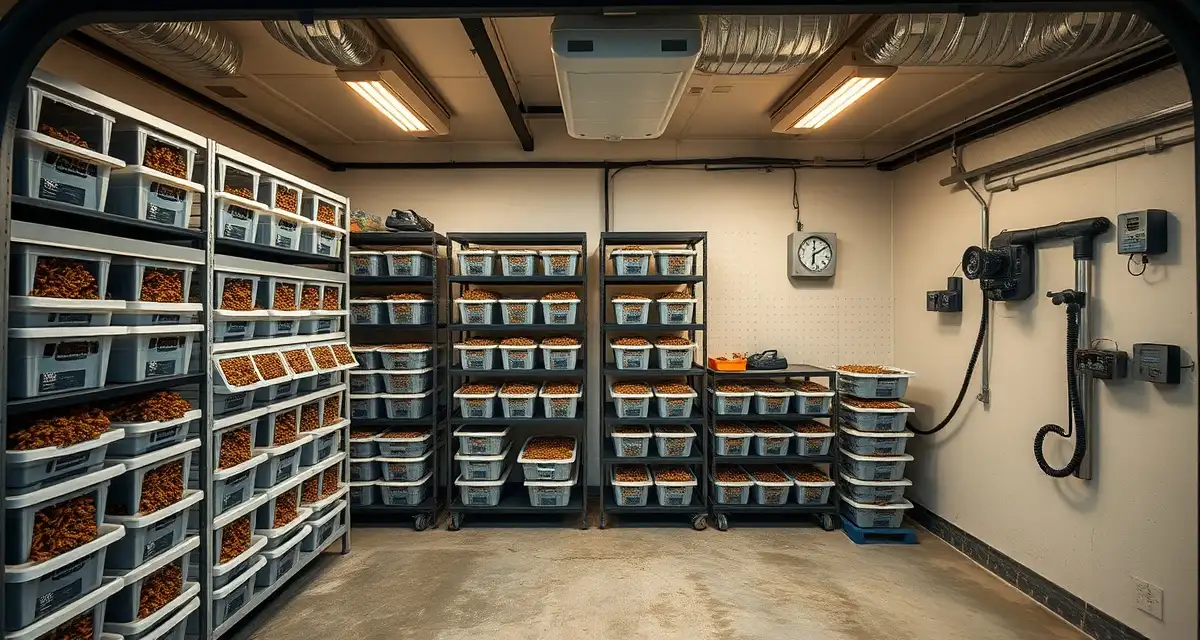
Cricket Farming in a Garage: Setting Up a Home-Based Operation
A standard 2-car garage (400-500 sq ft) can accommodate 15-20 cricket bins with double-stacked shelving and proper airflow. At $200-$400 per bin in monthly feeder cricket revenue, a well-run garage operation can generate $3,000-$8,000 per month. This is the most common entry point for new cricket farmers, and the decision about whether to pursue it seriously depends on understanding both its potential and its real constraints.
Garage cricket farming works. Commercial-scale operations often started in a garage. But the garage environment presents specific challenges, including temperature extremes, humidity control, odor management, and zoning considerations, that you'll need to address systematically to run a productive operation.
TL;DR
- A standard 2-car garage (400-500 sq ft) can accommodate 15-20 cricket bins with double-stacked shelving and proper airflow
- At $200-$400 per bin in monthly feeder cricket revenue, a well-run garage operation can generate $3,000-$8,000 per month
- Acheta domesticus needs consistent 80-90°F temperatures
- A single 12,000-18,000 BTU unit handles a 2-car garage cricket operation in most climates
- Space heaters: Lower upfront cost ($50-$150 each) but less precise control and higher operating costs
- Crickets need 50-70% relative humidity
- Harvesting frass regularly (every 5-7 days in active bins) is the single most effective odor reduction strategy
Insulation and temperature control. Acheta domesticus needs consistent 80-90°F temperatures.
- A single 12,000-18,000 BTU unit handles a 2-car garage cricket operation in most climates.
Space heaters: Lower upfront cost ($50-$150 each) but less precise control and higher operating costs.
- Higher installation cost, but crickets and equipment love even floor-level heat.
Humidity management:
Crickets need 50-70% relative humidity.
- Harvesting frass regularly (every 5-7 days in active bins) is the single most effective odor reduction strategy.
- Replace the filter medium every 3-6 months.
Zoning and Permit Considerations
A residential garage cricket farm typically falls under your municipality's home occupation regulations.
Is Your Garage Suitable?
Before investing in bins and equipment, evaluate your garage against four criteria:
Insulation and temperature control. Acheta domesticus needs consistent 80-90°F temperatures. An uninsulated garage in a climate with cold winters will require significant heating costs and can be difficult to keep in range during temperature extremes. An insulated garage with an existing HVAC connection is far easier to manage. If your garage isn't insulated, evaluate the cost of adding insulation to your walls and ceiling before factoring it into your startup budget.
Electrical capacity. A 15-20 bin operation with heating and ventilation requires 2,000-5,000W of continuous electrical load. Confirm your garage's electrical panel can handle this load. If your garage has a single 15-amp circuit, you'll need an electrician to add capacity before heating and ventilation equipment can be safely operated.
Ventilation. Crickets generate ammonia and CO2. Without adequate ventilation, these gases accumulate to levels that stress crickets and create unpleasant working conditions. A garage with windows and a door is the minimum. Active ventilation (an exhaust fan ducted to the exterior) is better for managing both air quality and humidity.
Water access. You'll need water for hydration and for cleaning. A garage with a utility sink or water line access is significantly more convenient than one requiring water to be carried from the house.
Layout for 15-20 Bins in a 2-Car Garage
A 2-car garage offers approximately 400-500 square feet. Here's a layout that maximizes bin capacity while maintaining working space:
Shelving configuration:
- Use 6-foot wire utility shelves, 2 shelves high per unit
- Position shelves along 3 walls (2 long walls + 1 short wall), leaving one short wall for your entrance and equipment
- Each 6-foot shelf section holds 2-3 standard cricket bins side by side
- Double-stacking (2 bin levels per shelf unit) doubles your capacity per linear foot
A typical layout along 3 walls of a 20x20 garage:
- 3 shelf units per long wall (20 ft) x 2 walls = 6 units = 12-18 bins
- 2 shelf units on the short wall = 4-6 bins
- Total: 16-24 bins without compromising the center walkway
Leave 3-4 feet of center walkway for moving between bin rows, harvest activities, and equipment access.
Equipment placement:
- Heating equipment (space heaters, HVAC mini-split) positioned to distribute heat evenly across all bin rows
- Exhaust fan on the opposite wall from fresh air intake for cross-ventilation
- Feed and supplies storage in a covered area separate from the bin zone
Temperature and Humidity Management
Heating strategies for garages:
Mini-split heat pump: The best option if your budget allows ($1,500-$3,000 installed). Provides precise temperature control, doubles as cooling in summer, and is energy efficient. A single 12,000-18,000 BTU unit handles a 2-car garage cricket operation in most climates.
Space heaters: Lower upfront cost ($50-$150 each) but less precise control and higher operating costs. Use thermostatic space heaters that maintain a set temperature; cycling heaters that run continuously are inefficient and create temperature swings. Position 2-3 heaters strategically to eliminate cold spots.
Radiant floor heating: If you're committed to the space long-term, electric radiant floor heating under the garage floor provides the most even heat distribution. Higher installation cost, but crickets and equipment love even floor-level heat.
Humidity management:
Crickets need 50-70% relative humidity. Garages can swing between too dry in winter (HVAC heat dries the air) and too humid in summer. You'll likely need both a humidifier and a dehumidifier depending on the season.
- Target 55-65% RH for most of the year
- Monitor with a digital hygrometer placed at bin level
- In summer, a dehumidifier running in the space prevents the humidity spikes that encourage mite infestations
Odor Management
Cricket farms produce odor from ammonia (cricket waste) and from the crickets themselves. In a residential garage, this is your most sensitive neighbor and family-relations issue.
Ventilation is the primary control. Exhaust fans that draw air from the bin zone and exhaust it outside the garage are the most effective odor management tool. An exhaust fan rated for 150-250 CFM on a timer or thermostat, combined with a passive fresh air intake vent on the opposite wall, keeps ammonia levels manageable.
Bin management reduces odor generation. The primary ammonia source is the accumulation of frass (waste) in bins. Harvesting frass regularly (every 5-7 days in active bins) is the single most effective odor reduction strategy. Don't let frass accumulate.
Activated carbon filters placed in your exhaust air path can reduce odor in the exhausted air. These are commonly used in indoor growing operations and work well for cricket farm exhaust. Replace the filter medium every 3-6 months.
Zoning and Permit Considerations
A residential garage cricket farm typically falls under your municipality's home occupation regulations. Before setting up:
Check your zoning. Most residential zones allow limited home-based businesses. "Agricultural" activities may or may not be specifically permitted in residential zones depending on your municipality. Look up your property's zoning designation and your municipality's home occupation ordinance.
Common restrictions that affect cricket farms:
- No employees working on premises (limits how big you can scale without triggering a commercial zoning review)
- No commercial vehicles parked on premises
- No retail sales on premises
- No external signage
- Limited square footage of the home used for business
HOA rules. If your property is in an HOA, the HOA's CC&Rs may prohibit commercial activities or specifically prohibit keeping live animals beyond typical pets. Review your CC&Rs before investing in a garage setup.
State agricultural permits. Even a home-based cricket farm may require a state insect producer permit if you're selling commercially. Check with your state Department of Agriculture. The complete cricket farming guide and cricket farm zoning permits guide cover the full permit landscape.
Frequently Asked Questions
Can I start a cricket farm in my garage?
Yes. A standard 2-car garage is the most common starting point for commercial cricket farming, and many currently operating commercial farms started in exactly this setting. You need adequate insulation and electrical capacity (2,000-5,000W minimum), functional ventilation for ammonia control, reliable heating to maintain 80-90°F year-round, and water access. Address these four requirements before investing in bins and production equipment. Check your local zoning and HOA rules before starting; some municipalities restrict commercial agricultural activities in residential zones. A well-managed 15-20 bin garage operation can generate meaningful revenue while you develop the skills and capital to scale to a dedicated commercial facility.
How do I insulate my garage for cricket farming?
The priority areas are the garage door, walls, and ceiling. The garage door is often the biggest heat loss point; a garage door insulation kit (rigid foam panels that fit standard garage door sections) costs $50-$100 and reduces heat loss significantly. Wall insulation (R-13 fiberglass batt between studs) is the next priority; hiring a contractor for this is efficient if you're not comfortable with DIY. Ceiling insulation (R-19 to R-30 above the drywall or directly above the ceiling joists) completes the thermal envelope. A well-insulated garage reduces heating costs by 40-60% and makes temperature stability much easier to achieve. The payback on insulation investment is typically under 2 years in reduced heating costs for a year-round cricket operation.
Do I need a permit to run a cricket farm in my residential garage?
This depends on your municipality's zoning ordinances and your state's agricultural licensing requirements. At the local level, most municipalities require a home occupation permit for any commercial business operated from a residential property; this typically involves a simple application and a small annual fee. Your home occupation permit may have restrictions (no employees on premises, limited square footage) that affect how you scale. At the state level, you may need an insect producer license or agricultural business registration even for a home-based operation if you're selling commercially. Contact your city or county planning and business licensing office and your state Department of Agriculture to confirm your specific requirements before beginning commercial sales.
How does CricketOps help track the metrics described in this article?
CricketOps provides bin-level logging for the variables that drive production outcomes -- feed inputs, environmental conditions, mortality events, and harvest results. Rather than maintaining these records in separate spreadsheets, you can view performance trends across bins and over time to identify which operational variables correlate with better outcomes in your specific facility.
Where can I find industry benchmarks to compare my operation's performance?
The North American Coalition for Insect Agriculture (NACIA) publishes periodic industry reports with production benchmarks. University extension programs in agricultural states, including the University of Georgia and University of Florida IFAS, occasionally publish insect farming production data. Industry conferences hosted by the Entomological Society of America and the Insects to Feed the World symposium series are additional sources of peer benchmarking data.
What is the biggest operational mistake cricket farmers make in their first year?
Expanding bin count before achieving consistent FCR and mortality targets in existing bins is the most common and costly first-year mistake. At 5-10 bins, problems are manageable. At 30-50 bins, the same proportional problems represent much larger financial losses. Most experienced cricket farmers recommend holding expansion until you have three consecutive production cycles hitting your FCR and mortality targets.
Sources
- Food and Agriculture Organization of the United Nations (FAO) -- Edible Insects: Future Prospects for Food and Feed Security
- North American Coalition for Insect Agriculture (NACIA)
- Entomological Society of America
- University of Georgia Cooperative Extension
- Journal of Insects as Food and Feed (Wageningen Academic Publishers)
Get Started with CricketOps
The practices covered in this article are easier to apply consistently when they are supported by organized production data. CricketOps gives cricket farmers the tools to track what matters -- by bin, by batch, and over time. Start your next production cycle in CricketOps and see how organized data changes the way you manage your operation.