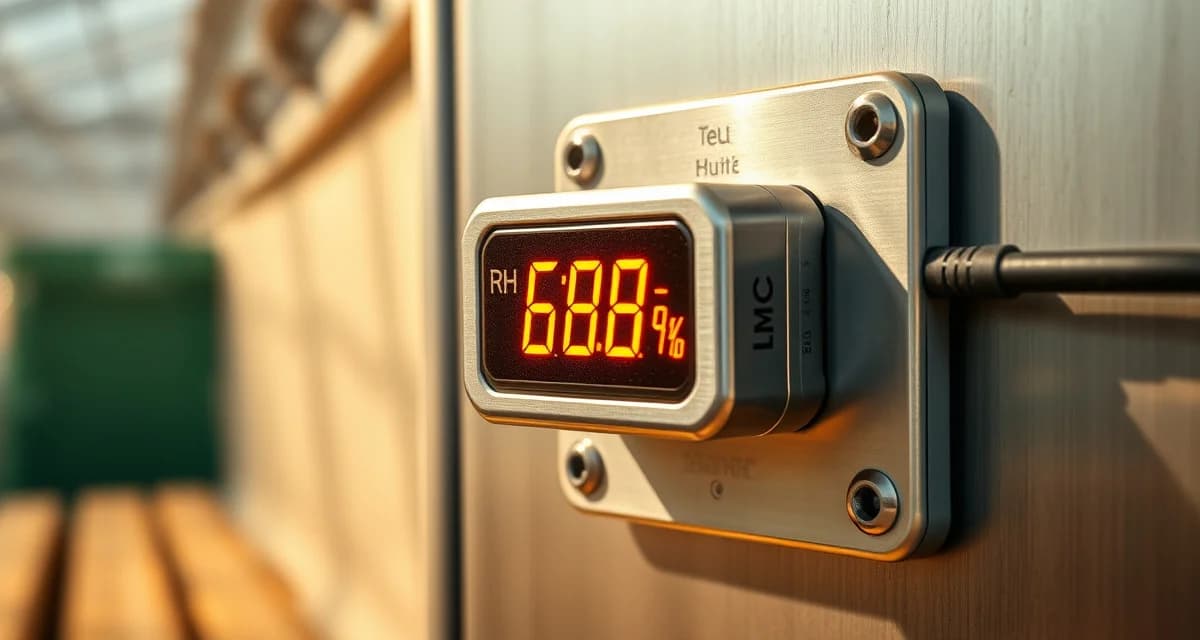
Cricket Farm Humidity Sensor Buyer's Guide: Finding the Right Hygrometer
Humidity sensors with less than ±3% accuracy miss the critical range between 60-80% RH where cricket health changes most. That makes the accuracy specification the most important number on any humidity sensor you're evaluating for cricket farm use - not the price, not the display design, and not the brand name.
This guide covers how to evaluate humidity sensors for cricket farm use, what accuracy level you actually need, how to calibrate them, and how to integrate them with your monitoring system.
TL;DR
- Humidity sensors with less than ±3% accuracy miss the critical range between 60-80% RH where cricket health changes most.
- Below 50% RH, crickets dehydrate, feed consumption drops, and mortality increases.
- Above 80% RH, mold growth on feed and substrate accelerates, bacterial load increases, and conditions favor the pathogens that cause die-offs.
- That 60-80% RH window is your target zone, and it's only 20 percentage points wide.
- A sensor with ±5% accuracy doesn't tell you whether you're at 65% or 75% - the reading of 70% could mean anywhere from 65-75%.
- At the extremes, a reading of 62% with ±5% accuracy could actually be 57% (dehydration range) or 67% (fine).
- Reject anything claiming only ±5%.
- Range: Should cover 0-99% RH.
Why Humidity Matters Enough to Get the Sensor Right
Acheta domesticus performs best at 60-70% relative humidity. Below 50% RH, crickets dehydrate, feed consumption drops, and mortality increases. Above 80% RH, mold growth on feed and substrate accelerates, bacterial load increases, and conditions favor the pathogens that cause die-offs.
That 60-80% RH window is your target zone, and it's only 20 percentage points wide. A sensor with ±5% accuracy doesn't tell you whether you're at 65% or 75% - the reading of 70% could mean anywhere from 65-75%. At the extremes, a reading of 62% with ±5% accuracy could actually be 57% (dehydration range) or 67% (fine). You can't manage to the window if your measurement error is larger than a meaningful slice of the window.
The ±3% RH standard in this guide's headline is the minimum for meaningful cricket farm management. ±2% or better is preferable.
Sensor Types Explained
Capacitive humidity sensors: The most common type in modern digital hygrometers. A capacitive sensing element changes its electrical properties in response to moisture absorption. These sensors are generally accurate and affordable, but they can suffer calibration drift in persistently high-humidity environments over 6-12 months.
Resistive humidity sensors: Less accurate than capacitive and not recommended for cricket farm applications where ±3% accuracy is required.
Thermal conductivity sensors: High accuracy, but expensive and typically found in industrial rather than agricultural applications. Overkill for most cricket farms.
What this means for you: Look for capacitive humidity sensors with ±2-3% RH specified accuracy, from a manufacturer that uses high-quality sensing elements rather than the cheapest available component.
Key Specifications Checklist
When evaluating a humidity sensor for your cricket farm, check:
- Accuracy: ±3% RH or better. ±2% is ideal. Reject anything claiming only ±5%.
- Range: Should cover 0-99% RH. Some cheaper sensors have reduced accuracy above 80% RH.
- Temperature operating range: Should operate accurately at 85-100°F. Some sensors are specified for accuracy at 77°F (25°C) only.
- Calibration: Can the sensor be field-calibrated, and how? (More below.)
- Data logging: Does it log readings at regular intervals, and can you export the data?
- Connectivity: WiFi or Bluetooth for remote monitoring, or a display-only unit for local reading?
Calibration: Why It Matters More Than You Think
All humidity sensors drift over time. In a high-humidity environment like a cricket farm, capacitive sensors can drift more quickly than they would in a typical indoor application. A sensor that was accurate at ±2% RH when new may be reading ±5-6% after 18 months in a 70-80% RH environment without calibration.
Calibration method (salt solution method):
The most reliable field calibration method uses a saturated salt solution to create a reference humidity environment:
- Sodium chloride (table salt) saturated solution at 77°F creates approximately 75% RH
- Potassium chloride saturated solution creates approximately 84% RH
- Magnesium chloride saturated solution creates approximately 33% RH
Place the sensor in a sealed container with the salt solution (sensor above the solution, not touching it) for 6-8 hours. The reading should stabilize to the reference humidity. If it reads outside the manufacturer's specified accuracy range, either apply the offset adjustment (if the sensor supports it) or replace the sensor.
Calibration frequency: Calibrate or verify your humidity sensors every 6 months. Build this into your regular maintenance schedule.
Placement Strategies
In-room placement: Position humidity sensors at mid-height level in your production zone, away from direct contact with water gel containers or open feed dishes that create local humidity spikes. You want the ambient humidity of the production zone, not the microclimate 2 inches from a water source.
Multiple-sensor strategy: In a large production room, humidity varies by location - corners, areas near HVAC vents, and areas near heavy cricket density all have different humidity profiles. Use multiple sensors to map your humidity distribution. A 50-bin production room should have at minimum 3-4 sensors.
High-humidity detection: Place one sensor in the area most likely to develop high-humidity problems (typically the warmest, most densely stocked area). This is your early warning sensor for mold-risk conditions.
Integration with CricketOps: CricketOps can integrate with wireless humidity sensor platforms to log your readings continuously alongside production records. This connects environmental data to production outcomes, which is how you identify whether your humidity management is affecting FCR or die-off rates. See the humidity monitoring tools guide for additional context on the full monitoring system.
Recommended Sensor Tiers
Budget-conscious operations (under $30/sensor): Inkbird IBS-TH2 Plus, Govee H5075. These meet the ±3% RH standard in most conditions but require more frequent calibration verification and may need replacement within 18-24 months in high-humidity environments.
Mid-range (30-$80/sensor): SensorPush HT1, Temp Stick Wireless Sensor, Govee H5179. Better accuracy (±2-3% RH), more reliable connectivity, better data logging.
Commercial grade ($80-$200/sensor): Onset HOBO MX2301, Monnit Wireless Humidity Sensor. Designed for agricultural and food industry use, highest durability in high-humidity environments, best data export options, typically the best choice for any operation with FSMA compliance requirements.
Frequently Asked Questions
What humidity sensor accuracy do I need for a cricket farm?
The minimum acceptable accuracy for meaningful cricket farm humidity management is ±3% RH. This is the floor, not the target - ±2% is better. Accuracy matters because your target humidity range for Acheta domesticus is 60-70% RH, and the consequence of humidity going below 50% RH (dehydration stress) or above 80% RH (mold and pathogen risk) is notable. A sensor with ±5% accuracy provides a reading that could be 10% off from actual humidity, which makes precision management impossible. Sensors claiming only ±5% accuracy on their specification sheet are not suitable for cricket farm use.
How do I calibrate humidity sensors for a cricket farm?
The salt solution calibration method is the most accessible field calibration approach. Place your sensor in a sealed container above a saturated sodium chloride solution (which creates approximately 75% RH at 77°F) for 6-8 hours and compare the sensor reading to the reference. If the reading falls outside the sensor's specified accuracy range, apply an offset correction if your sensor supports it, or replace it if it doesn't. Calibrate every 6 months - more frequently if you're in a consistently high-humidity environment. Most commercial-grade sensors either include an offset adjustment feature or have a factory recalibration service available.
Can CricketOps connect to humidity sensors for automated logging?
Yes. CricketOps integrates with commercial wireless humidity sensor platforms to receive continuous humidity readings that are logged alongside your production records. This integration means your humidity history is automatically associated with the production batches that experienced those conditions, enabling you to correlate humidity patterns with production outcomes like die-off rate and FCR. For operations with FSMA compliance requirements, automated humidity logging creates the continuous environmental records that support your food safety plan monitoring documentation.
What documentation do food-grade cricket buyers typically require from suppliers?
Food manufacturers and distributors typically require a Certificate of Analysis (COA) for each batch, documentation of your food safety management system (HACCP plan), proof of facility registration with FDA if required, allergen management documentation, and supplier qualification questionnaires. Start building these records from your first commercial production batch -- retroactively reconstructing production documentation is difficult and sometimes impossible.
How should I price feeder crickets for wholesale accounts?
Wholesale pricing should cover your fully-loaded cost per unit plus a margin that accounts for the variable quality of large accounts (payment terms, return policies, volume discounts). A common approach is to start from your cost per 1,000 crickets (feed plus variable overhead plus allocated fixed costs), multiply by your target margin, and compare the result against known wholesale market rates. Feeder cricket wholesale prices vary significantly by species, size, and region.
What certifications improve the marketability of cricket products?
For food-grade products, certifications that resonate with buyers include USDA Organic (requires organic feed and approved inputs), non-GMO verification, and food safety system certifications such as SQF Level 2 or FSSC 22000. For feeder crickets going to pet industry accounts, health documentation and quarantine protocols are often more important than formal certifications. Check with your specific buyers to understand which certifications they value or require.
Sources
- Food and Agriculture Organization of the United Nations (FAO) -- Edible Insects: Future Prospects for Food and Feed Security
- North American Coalition for Insect Agriculture (NACIA)
- Entomological Society of America
- USDA Agricultural Research Service
- AgriNovus Indiana -- AgTech Industry Resources
Get Started with CricketOps
Maintaining the right environmental conditions in a cricket facility depends on having reliable data -- not just what your thermostat is set to, but what temperatures your bins actually experienced overnight and over the past week. CricketOps connects to temperature and humidity sensors, logs readings by bin, and alerts you when conditions drift outside your set thresholds. Try CricketOps and build the environmental record your operation needs.