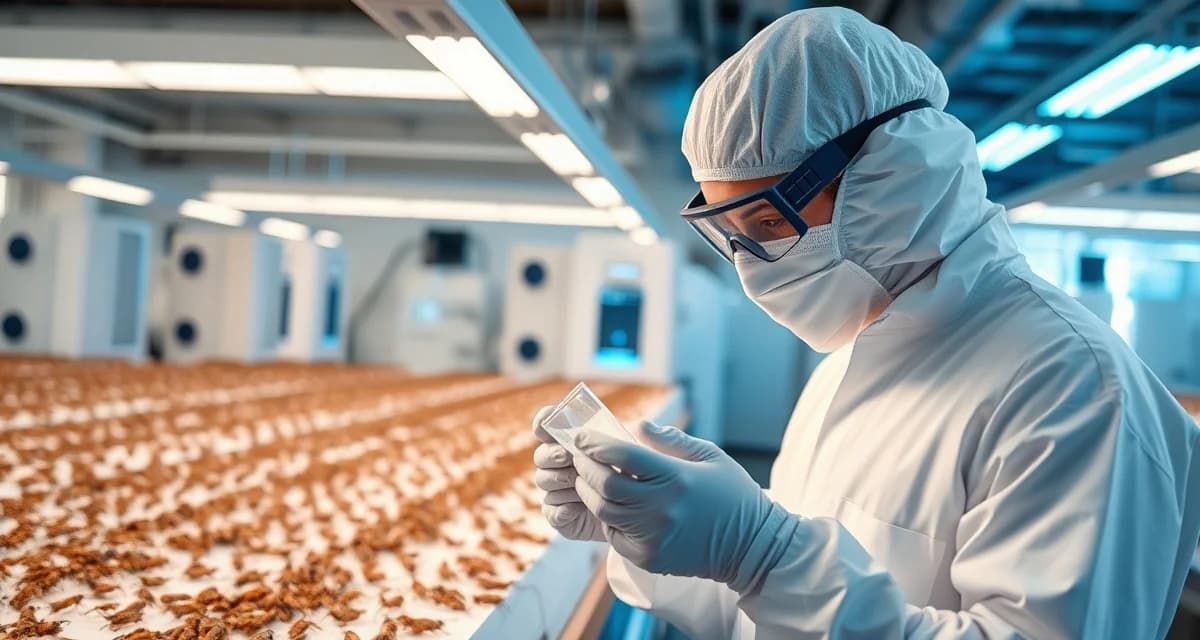
Cricket Farm Environmental Monitoring Program: Testing for Pathogens in the Facility
Listeria monocytogenes environmental monitoring is required for cricket flour facilities that produce a ready-to-eat finished product. If your cricket flour goes into the market without further cooking - as an ingredient in protein bars, smoothie powders, or direct-to-consumer products - you're producing a ready-to-eat (RTE) food. Under FSMA Preventive Controls, RTE food producers must implement an environmental monitoring program to verify that their sanitation controls are working and that pathogens are not establishing themselves in the production environment.
This guide covers what an environmental monitoring program (EMP) looks like for a cricket flour facility, including what to test for, where to sample, how often, and what to do when you find something.
TL;DR
- Zone 1 - Food contact surfaces: The surfaces that directly touch your product.
- Equipment frames, table surfaces next to processing equipment, conveyor supports.
- Under 21 CFR Part 117 (FSMA Preventive Controls), a written EMP is required for RTE food facilities unless Listeria is not a hazard requiring a preventive control based on your hazard analysis.
- Zone 1 is the highest priority but also the zone where you least want to find Listeria - a positive here is an immediate hold-and-investigate situation.
- Surfaces adjacent to Zone 1 that could splash or transfer contamination.
- These are the best "early warning" locations - Listeria typically establishes in Zone 3 and 4 before it spreads to Zone 1.
- Immediate hold of all product produced since the last negative Zone 1 sample.
- Zone 1 (food contact surfaces) should be tested quarterly or after significant cleaning events.
Zone 1 - Food contact surfaces: The surfaces that directly touch your product.
- Equipment frames, table surfaces next to processing equipment, conveyor supports.
Zone 3 - Farther from food contact: Floors, walls, drains, and other environmental surfaces in the production area.
- These are the best "early warning" locations - Listeria typically establishes in Zone 3 and 4 before it spreads to Zone 1.
Zone 4 - Non-production areas: Hallways, locker rooms, entry areas.
- Zone 1 (food contact surfaces) should be tested quarterly or after significant cleaning events.
- Increase frequency if you find positive results - a positive Zone 3 finding should trigger additional sampling of Zone 2 and Zone 1 until you've confirmed the issue is resolved.
- At 5-10 bins, problems are manageable.
Zone 3 - Farther from food contact: Floors, walls, drains, and other environmental surfaces in the production area.
- These are the best "early warning" locations - Listeria typically establishes in Zone 3 and 4 before it spreads to Zone 1.
Zone 4 - Non-production areas: Hallways, locker rooms, entry areas.
- Zone 1 (food contact surfaces) should be tested quarterly or after significant cleaning events.
- Increase frequency if you find positive results - a positive Zone 3 finding should trigger additional sampling of Zone 2 and Zone 1 until you've confirmed the issue is resolved.
- Listeria monocytogenes environmental monitoring is required for cricket flour facilities that produce a ready-to-eat finished product.
- The logic: if Listeria is present in your facility environment, it can contaminate your product during production even if your raw materials are pathogen-free.
What Is an Environmental Monitoring Program?
An EMP is a systematic sampling and testing program that monitors the surfaces and environment in your facility for pathogens - primarily Listeria in the context of cricket flour production. The logic: if Listeria is present in your facility environment, it can contaminate your product during production even if your raw materials are pathogen-free. By sampling surfaces and testing for Listeria, you're verifying that your cleaning and sanitation program is actually controlling pathogen growth.
Under 21 CFR Part 117 (FSMA Preventive Controls), a written EMP is required for RTE food facilities unless Listeria is not a hazard requiring a preventive control based on your hazard analysis. If your finished product undergoes a kill step (heat treatment, for example), you may need to demonstrate that the kill step is effective rather than monitoring the post-kill-step environment.
For cricket flour that is dried/processed but not otherwise heat-treated post-packaging, an EMP is the standard approach.
What Pathogens to Test For
Listeria monocytogenes (Lm) is the primary pathogen for cricket flour EMP. Listeria survives in cool, moist environments and is a particular concern in food processing facilities with cracks, drains, and hard-to-clean equipment.
Salmonella environmental monitoring is required if Salmonella is identified as a significant hazard in your hazard analysis. For cricket flour, Salmonella is typically controlled via drying/heat treatment, but if there's any possibility of post-process contamination, environmental monitoring may be appropriate.
Most small cricket flour EMPs focus on Listeria.
Sample Locations: Zone 1-4 Framework
The food industry uses a zone classification system for EMP sampling:
Zone 1 - Food contact surfaces: The surfaces that directly touch your product. For cricket flour, this includes grinder surfaces, conveyor belts, hoppers, packaging equipment surfaces, and any other surface that contacts flour during or after the kill step. Zone 1 is the highest priority but also the zone where you least want to find Listeria - a positive here is an immediate hold-and-investigate situation.
Zone 2 - Near food contact surfaces: Surfaces adjacent to Zone 1 that could splash or transfer contamination. Equipment frames, table surfaces next to processing equipment, conveyor supports.
Zone 3 - Farther from food contact: Floors, walls, drains, and other environmental surfaces in the production area. These are the best "early warning" locations - Listeria typically establishes in Zone 3 and 4 before it spreads to Zone 1.
Zone 4 - Non-production areas: Hallways, locker rooms, entry areas. Less frequent sampling, useful for understanding whether contamination is coming from outside the production area.
A small cricket flour EMP should include:
- 4-6 Zone 3 locations (drains, floor-wall junctions, under equipment)
- 2-4 Zone 2 locations (equipment frames, nearby surfaces)
- Periodic Zone 1 sampling (every quarter or after major cleaning)
Testing Frequency
For a small cricket flour RTE producer:
- Routine swabbing: Monthly for Zone 2 and 3 locations
- Zone 1: Quarterly, or more frequently if routine sampling finds positives
- After major events: After facility maintenance, equipment cleaning, flooding, or any event that could introduce contamination
Some buyers (particularly large food manufacturers) may require more frequent testing as part of their supplier qualification requirements.
What to Do When You Find Listeria
Zone 3 positive: Investigate the source, perform targeted cleaning and sanitation of the positive location and surrounding area, retest the location and adjacent surfaces before resuming production.
Zone 2 positive: More urgent. Perform a thorough investigation, deep clean the affected equipment and surrounding area, hold product produced during the period when the positive sample was taken until you can demonstrate the issue is resolved through negative resampling.
Zone 1 positive: Immediate hold of all product produced since the last negative Zone 1 sample. Notify your PCQI (Preventive Controls Qualified Individual). Consider whether any finished product needs to be tested before release. Document the full investigation and corrective action.
All positive findings, investigations, and corrective actions must be documented.
For your overall FDA compliance program, see cricket flour FDA compliance. For pathogen testing of finished product, see cricket farm pathogen testing.
Frequently Asked Questions
Does my cricket flour facility need an environmental monitoring program?
If your cricket flour is a ready-to-eat (RTE) product - meaning it will be consumed without a cooking step that would eliminate pathogens - then yes, an EMP is required under FSMA Preventive Controls unless your hazard analysis concludes that environmental pathogens are not a significant hazard (which is difficult to defend for an RTE product). The EMP requirement applies to the post-kill-step environment: the surfaces and spaces where your product could be re-contaminated after any heat treatment. Small producers often overlook this requirement because they focus on raw material testing and miss the environmental pathway for Listeria contamination.
What pathogens should an EMP test for in a cricket flour facility?
Listeria monocytogenes is the primary pathogen for cricket flour EMP. Listeria survives in cool and moist environments including drains, cracks, and equipment joints - common in food processing facilities. If your hazard analysis identifies Salmonella as a significant environmental hazard (which depends on your specific process and whether there's a post-process contamination pathway), Salmonella environmental swabs may also be appropriate. Testing for both adds cost but provides broader coverage. Most small cricket flour producers implement Listeria-only EMPs and supplement with periodic finished product testing for Salmonella and E. coli.
How often should I conduct environmental swabbing in my cricket flour facility?
For a small RTE cricket flour producer, monthly swabbing of Zone 2 (near food contact) and Zone 3 (floors, drains, environmental surfaces) locations is a reasonable baseline. Zone 1 (food contact surfaces) should be tested quarterly or after significant cleaning events. Increase frequency if you find positive results - a positive Zone 3 finding should trigger additional sampling of Zone 2 and Zone 1 until you've confirmed the issue is resolved. After major maintenance, flooding, or pest activity, additional swabbing is appropriate regardless of your regular schedule. Document your swab locations, dates, results, and any corrective actions taken.
How does CricketOps help track the metrics described in this article?
CricketOps provides bin-level logging for the variables that drive production outcomes -- feed inputs, environmental conditions, mortality events, and harvest results. Rather than maintaining these records in separate spreadsheets, you can view performance trends across bins and over time to identify which operational variables correlate with better outcomes in your specific facility.
Where can I find industry benchmarks to compare my operation's performance?
The North American Coalition for Insect Agriculture (NACIA) publishes periodic industry reports with production benchmarks. University extension programs in agricultural states, including the University of Georgia and University of Florida IFAS, occasionally publish insect farming production data. Industry conferences hosted by the Entomological Society of America and the Insects to Feed the World symposium series are additional sources of peer benchmarking data.
What is the biggest operational mistake cricket farmers make in their first year?
Expanding bin count before achieving consistent FCR and mortality targets in existing bins is the most common and costly first-year mistake. At 5-10 bins, problems are manageable. At 30-50 bins, the same proportional problems represent much larger financial losses. Most experienced cricket farmers recommend holding expansion until you have three consecutive production cycles hitting your FCR and mortality targets.
Sources
- Food and Agriculture Organization of the United Nations (FAO) -- Edible Insects: Future Prospects for Food and Feed Security
- North American Coalition for Insect Agriculture (NACIA)
- Entomological Society of America
- University of Florida IFAS Extension -- Entomology and Nematology Department
- USDA Agricultural Research Service
Get Started with CricketOps
The practices covered in this article are easier to apply consistently when they are supported by organized production data. CricketOps gives cricket farmers the tools to track what matters -- by bin, by batch, and over time. Start your next production cycle in CricketOps and see how organized data changes the way you manage your operation.